
UAE Business Guide · 2026
Best Business Ideas in UAE for 2026: 40+ Opportunities to Consider
The best business to start in the UAE is not simply the idea with the biggest headline market. It is the opportunity where customer demand, your experience, available capital and the legal structure needed to operate all fit together.
This guide compares more than 40 business ideas across major UAE sectors, explains which models can work for first-time founders, looks at profitability factors and shows how location, licensing and operating requirements should influence your decision.

The short answer
What is the best business to start in the UAE?
There is no single best business for every entrepreneur. Strong opportunities exist across e-commerce, technology and AI, professional services, tourism, property, logistics, education, health, sustainability, trading and consumer services.
The better question is: which business can you operate competitively and sustainably? A founder with specialist professional experience, for example, may have a stronger starting position in consultancy than in a capital-intensive restaurant or logistics business, even if the larger industry receives more attention.
Before choosing an idea, prioritise opportunities that fit:
- Your experience and specialist knowledge
- Your realistic first-year budget
- The customers you can realistically reach
- Your visa and staffing requirements
- Any external approvals the activity requires
- Your banking and payment model
- Your premises, equipment or stock requirements
- Your longer-term expansion plan
Opportunity comparison
Compare popular business ideas in the UAE
Use this comparison as an initial screening tool rather than a promise of profitability. Licensing, premises, staffing, approvals, working capital and operating requirements can change considerably within the same sector.
| Sector | Typical entry profile | Physical premises | Regulatory complexity | Often suited to |
|---|---|---|---|---|
| E-commerce | Low to medium | Not always | Low to medium | Digital-first founders |
| Marketing & creative | Low | Often flexible | Generally lower | Service specialists |
| Technology & AI | Low to high | Depends on model | Varies by activity | Technical founders |
| Consulting & advisory | Low to medium | Often flexible | Varies by profession | Experienced professionals |
| Tourism & events | Medium | Depends on activity | Medium to high | Operators with local networks |
| Healthcare & wellness | Medium to high | Often required | High for regulated services | Qualified operators |
| Real estate services | Medium | Often required | Medium to high | Property and sales specialists |
| Sustainability services | Low to high | Depends on model | Activity dependent | B2B and technical specialists |
| Education & training | Low to high | Depends on delivery | Medium to high | Educators and trainers |
| Food & beverage | Medium to high | Usually | High | Experienced operators |
| Trading & logistics | Medium to high | Often | Medium to high | Operational businesses |
“Low”, “medium” and “high” are relative planning indicators only. Actual cost, licensing and approval requirements need to be checked against the exact business activity.
Choose before you licence
How to choose the right business idea for you
A popular industry is not automatically the right opportunity. Work backwards from the business you intend to operate before comparing licence packages.
Consider the licence, visas, workspace, stock, equipment, staff, marketing and working capital rather than the incorporation fee alone.
Starting close to your existing skill set can reduce the learning curve and give the business a clearer point of differentiation.
Decide whether you will sell mainly within the UAE, internationally or through a combination of both.
Healthcare, education, finance, food and other regulated activities can require additional permissions beyond the company licence.
Consider whether you need an office, shop, warehouse, vehicles, specialist equipment, stock, client-site access or employees.
Choose a structure that can still support the business when you employ staff, add shareholders, raise finance or enter new markets.

Current market context
What current UAE market signals tell founders
Market data should support an idea rather than replace commercial validation. Three current indicators help explain why digital businesses, visitor-economy businesses and foreign-founded companies continue to attract interest.
The UAE Digital Economy Strategy aims to increase the digital economy's contribution to GDP from 9.7% in 2022 to 19.4% within ten years.
UAE Government sourceDubai welcomed 19.59 million international overnight visitors during 2025, 5% more than in 2024, according to Dubai DET.
Dubai DET sourceFull foreign ownership is available for most UAE mainland business activities, although strategic and regulated activities can have different requirements.
UAE Government sourceBusiness opportunities
Business ideas in UAE worth considering in 2026
These categories include more than 40 individual business models. Some can begin as relatively lean founder-led companies; others require premises, specialist approvals, significant working capital or operational infrastructure.
E-commerce and online brands
E-commerce can suit founders building a digital-first business for UAE or wider GCC customers. The right setup depends on what you sell, where stock is kept, whether goods are imported and how customers will receive orders.
Ideas to explore
- Niche online retail brand
- Direct-to-consumer product business
- Marketplace selling
- Specialist online wholesale
Digital marketing, content and creative services
Skill-led agencies can often launch without the premises, inventory and equipment required by physical businesses. Commercial success still depends on positioning, client acquisition and recurring demand.
Ideas to explore
- Social media management
- Performance marketing
- Content production
- Brand and creative consultancy
Technology, AI and cybersecurity
Technology companies can range from individual consultancies to software and SaaS businesses serving customers across multiple countries. Licence selection should follow the actual service or product rather than the broad label “AI”.
Ideas to explore
- AI implementation consultancy
- SaaS tools for SMEs
- Cybersecurity services
- Business automation solutions
Professional, corporate and advisory services
Professionals can build companies around strategy, management consulting, accounting, corporate support, HR and specialist B2B advice. Exact activity wording matters because regulated professional services can require additional permissions.
Ideas to explore
- Management consultancy
- Accounting and bookkeeping
- Corporate support services
- Specialist B2B consultancy
Tourism, hospitality and events
The visitor economy creates opportunities beyond hotels. Travel services, corporate events, visitor experiences and hospitality-support businesses can serve international travellers, residents and companies.
Ideas to explore
- Specialist travel services
- Corporate event management
- Experience-led tourism concepts
- Holiday-home support services

Health, wellness and beauty
This category ranges from regulated healthcare businesses to fitness, wellness and personal-care concepts. Qualifications, premises standards and external approvals vary substantially between activities.
Ideas to explore
- Specialist healthcare services
- Fitness and wellness studios
- Beauty and grooming concepts
- Digital wellness services
Real estate and property services
A property-sector business does not necessarily mean buying property. Brokerage, management, relocation, corporate accommodation and supporting professional services all represent different commercial models.
Ideas to explore
- Real estate brokerage
- Property management
- Corporate housing support
- Relocation services
Sustainability and environmental services
Opportunities can arise where companies need practical support around resource efficiency, environmental performance, waste, reporting and sustainable operations.
Ideas to explore
- Sustainability consulting
- Energy-efficiency services
- Eco-friendly packaging
- Recycling and waste solutions
Education, training and skills development
Training companies can serve professionals, corporate teams, students or specialist industries. Approval requirements depend heavily on whether the activity is informal professional training, formal education or another regulated service.
Ideas to explore
- Corporate training
- Professional skills programmes
- Online education products
- Education technology services
Food, beverage and lifestyle brands
F&B can create recognisable consumer businesses, but it also involves significant operational considerations around location, premises, food safety, fit-out, staffing, delivery and margins.
Ideas to explore
- Speciality café concept
- Delivery-focused kitchen
- Meal subscription business
- Packaged food brand
Trading, logistics and delivery
The UAE's trading and logistics infrastructure can support businesses involved in importing, exporting, distribution, fulfilment, storage and specialist delivery. Product categories, customs, facilities and shipment routes should be understood before incorporation.
Ideas to explore
- General trading
- Import and export
- Fulfilment and warehousing
- Specialist delivery services
Explore logistics business setup →
Profitability
Which businesses can be most profitable in the UAE?
No sector is automatically profitable. Two companies with the same activity can produce very different results because customer acquisition, pricing, gross margin, staff costs, rent, working capital and execution differ.
A better way to compare profitability: assess how much capital the model absorbs, how quickly customers can be acquired, whether revenue can repeat, how much delivery costs increase as the business grows and how difficult the business is to operate compliantly.
| Business model | Why founders consider it | Main commercial challenge |
|---|---|---|
| Consulting & professional services | Can begin around existing expertise with fewer physical assets than many operational businesses. | Revenue can depend heavily on the founder, reputation and consistent client acquisition. |
| Software, AI & SaaS | A successful digital product can serve additional customers without replicating every operating cost. | Product development, competition, technical delivery and customer acquisition can require substantial investment. |
| E-commerce | Provides access to broad customer markets and can support focused, scalable product brands. | Inventory, advertising, fulfilment, returns and price competition can reduce margins quickly. |
| Trading & distribution | Can serve UAE, regional and international product flows. | Working capital, stock, credit terms, customs and logistics need careful management. |
| Food, hospitality & consumer concepts | Strong concepts can build repeat local demand and recognisable brands. | Rent, fit-out, labour, wastage, location and day-to-day operating costs can be substantial. |
So when comparing the most profitable businesses in the UAE, do not rely on industry rankings alone. Build a simple model for customer numbers, average revenue, direct costs, fixed costs and the capital you need before the company reaches break-even.
Starting lean
Best business ideas in UAE for beginners
First-time founders often benefit from businesses that can be validated before they commit to substantial premises, inventory, equipment or staffing.
-
Freelance or consultancy services
Start with a professional skill you already understand and a clearly defined target customer. -
Digital marketing and content services
Focus on a narrow service or industry rather than launching as an undifferentiated general agency. -
Focused e-commerce
Test genuine product demand and fulfilment economics before building a large catalogue. -
Online tutoring or training
Suitable where your expertise and the permitted delivery model align with the relevant activity. -
IT, software or automation services
A practical option for technical founders able to solve clearly defined business problems. -
Cleaning and practical local services
Can serve identifiable recurring local needs but require proper staffing, licensing and operational planning.
“Low investment” does not mean “no investment”. Even a lean business should budget for the appropriate licence, immigration requirements where applicable, banking, marketing, insurance where required and adequate working capital.
For a narrower Dubai-focused comparison, see small business ideas in Dubai with low investment .

Location matters
Which emirate is best for your business?
The UAE is not one uniform business environment. Customers, industry clusters, logistics, premises and the available licensing authorities can make one emirate more suitable than another.
Dubai
Particularly relevant to founders considering trade, tourism, property, professional services, technology, e-commerce and a large international customer market. Competition can also be intense.
Abu Dhabi
Worth assessing for businesses connected with finance, industry, technology, energy, professional services and larger institutional customers.
Sharjah
Can be relevant to manufacturing, education, creative industries, trading and logistics depending on the operating model and target market.
Ras Al Khaimah
Often considered for industrial, manufacturing, tourism, trading and selected internationally focused structures.
Ajman and Umm Al Quwain
May be relevant when comparing smaller-emirate operating environments for selected trading and service activities.
Fujairah
Its east-coast location can be relevant to maritime-linked activity, logistics, trade and businesses with particular supply-chain requirements.
If your planned company will operate specifically in Dubai, use our separate guide to the best businesses to start in Dubai rather than assuming every UAE-wide recommendation applies in exactly the same way.
Choose the structure
Mainland, free zone or offshore?
Choosing the business idea is only half of the decision. The company structure has to support where you will trade, the people you need to employ, the premises you require, your customer model and the authority regulating the activity.
Mainland
Often considered where broad UAE-market activity, client-site work, retail, operational premises or an activity aligned with mainland licensing forms an important part of the model.
Free zone
Can suit consulting, technology, e-commerce, international services, trading and other activities where a particular free zone's activities, facilities and operating conditions suit the company.
Offshore
Primarily a structural option for matters such as international holdings or asset ownership rather than a substitute for an operational mainland company.
For many permitted activities, foreign investors can hold 100% ownership. Strategic and specially regulated activities can be treated differently, so confirm the requirements for the exact proposed activity.
A free-zone company should also not be chosen on the assumption that all of its income will automatically be subject to 0% Corporate Tax. The Federal Tax Authority explains that a Qualifying Free Zone Person can receive the 0% rate on Qualifying Income, subject to the applicable conditions. Read the FTA guidance .
From idea to company
How to start a business in the UAE
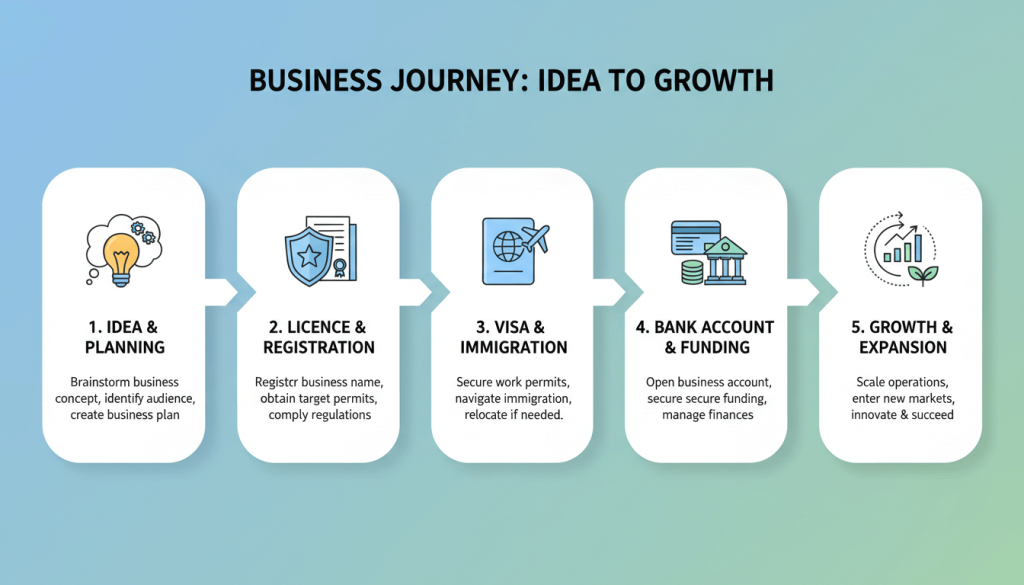
The exact process varies between mainland authorities, free zones, legal forms and regulated activities. Most founders, however, need to work through the following core decisions.
Define the commercial activity
Describe exactly what the business will sell, provide or manage. This affects the activity code, licence and potential regulator.
Choose the jurisdiction and legal structure
Compare suitable mainland and free-zone routes against how the company actually needs to operate.
Choose and reserve the trade name
Prepare suitable company-name options and follow the naming and reservation process of the selected authority.
Prepare shareholder and company documents
Requirements depend on the shareholders, legal form, activity, jurisdiction and whether another company will hold shares.
Meet premises and external-approval requirements
Some activities can use flexible workspace arrangements while others need a specific office, shop, warehouse or regulated facility.
Complete licensing and establishment steps
Complete the incorporation and licence requirements of the selected authority before commencing regulated commercial activity.
Plan visas, banking, tax and ongoing compliance
After incorporation, address the immigration, corporate banking, accounting, tax-registration and renewal requirements that apply to the business.
For a more detailed walkthrough, read how to register and start a business in the UAE .
If you want help comparing and coordinating the company route itself, see our UAE business setup service .
Before you commit
Common mistakes when starting a business in the UAE
A good commercial idea can become unnecessarily expensive when the company is formed around the wrong assumptions.
Choosing the cheapest licence instead of the right licence
A low headline fee offers little value if the licence, activity, premises or operating permissions do not support what the company needs to do.
Underestimating the total first-year cost
Consider visas, premises, approvals, employees, insurance, stock, accounting, marketing and working capital as well as the company-formation fee.
Selecting an activity that does not match the revenue model
The company's authorised activities should reflect what it will actually invoice customers for. Fixing an unsuitable activity later can create additional work.
Ignoring banking until after incorporation
Consider customers, suppliers, expected transactions, countries involved and the documentation needed to explain the business while you are still planning the company structure.
Assuming every free zone or emirate works in the same way
Authorities differ in permitted activities, facilities, documentation, visa arrangements and operating requirements.
Failing to plan for compliance after launch
Incorporation is the beginning of the company lifecycle. Accounting, renewals, immigration, Corporate Tax, VAT and other requirements may apply depending on the business.
Need to narrow the options?
Compare the setup route before paying for a licence
Tell First Elite Global what the business will do, where its customers are, who will own it, whether you need UAE residence visas and what premises or operating requirements you expect. The available setup routes can then be compared against the actual business model.
Discuss your business setupCommon questions
FAQs about starting a business in the UAE
Which business is most profitable in the UAE?
There is no single business that is automatically the most profitable. Technology, professional services, e-commerce, property, tourism, trading, logistics and other sectors can all support successful companies. Profitability depends on demand, margins, acquisition costs, competition, fixed overhead, working capital and execution.
What is the best business in UAE for beginners?
First-time founders often benefit from businesses based on an existing skill and relatively simple operations, such as consulting, digital marketing, selected e-commerce models, IT services or other professional services. Licensing and operating requirements still need to be checked for the exact activity.
What small business ideas in UAE can start with a lean model?
Examples include consultancy, content and creative services, selected online retail models, training, software services and other companies that do not initially require substantial premises, inventory or staffing. A lean model still requires adequate capital for licensing and normal operating costs.
Can foreigners own 100% of a UAE company?
Full foreign ownership is available for most mainland commercial activities and is widely available in free zones. Strategic or specially regulated activities can have different ownership or approval requirements, so the position should be confirmed against the exact proposed activity.
How much does it cost to start a business in the UAE?
There is no reliable single cost covering every UAE company. The total depends on the activity, licensing authority, legal structure, shareholders, visas, premises, external approvals and operating requirements. Compare the complete first-year setup rather than the licence fee alone.
Do I need a local sponsor to start a UAE business?
Many UAE businesses can now be wholly foreign owned. Requirements vary according to the activity, legal structure and whether the business falls within a strategic or otherwise regulated category.
Which emirate is best for starting a company?
Choose according to where the business will operate, its customers, premises, logistics, sector and licensing requirements rather than selecting an emirate purely because its advertised package is cheaper. Dubai, Abu Dhabi, Sharjah, Ras Al Khaimah, Ajman, Umm Al Quwain and Fujairah each offer different commercial environments.
Is mainland or free zone better?
Neither structure is universally better. Mainland can suit businesses requiring particular onshore operations, physical premises or local commercial flexibility. A free zone can suit selected consulting, technology, international, trading and digital businesses when the individual zone's activities and facilities fit the operating model.
Final takeaway
The best UAE business is the one that fits the market and the founder
Do not choose a company simply because it appears on a list of supposedly “most profitable” businesses. Start with a genuine customer problem, an area where you have a credible advantage and an operating model you can afford to sustain.
Then validate demand and confirm the appropriate activity, jurisdiction, ownership structure, external approvals, premises, visa requirements, banking model and ongoing compliance before committing to incorporation.
That process will not guarantee a successful business, but it gives a promising idea a much stronger commercial foundation than choosing a licence package first and trying to build the business around it afterwards.
