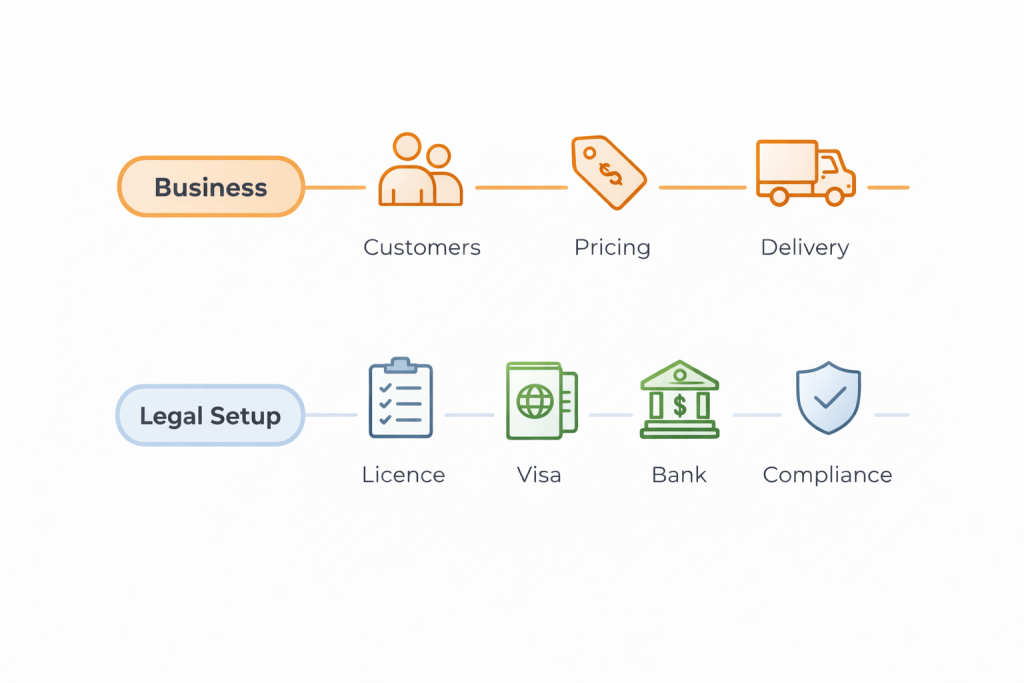
Dubai is one of the few places where you can go from idea to trading licence quickly — but only if you treat entrepreneurship as two tracks running in parallel:
- Building a real business (customers, pricing, delivery, margins, traction)
- Building a legal operating base (licence, visas, banking, compliance)
Most founders struggle because they over-focus on one track and neglect the other. This guide gives you a practical roadmap that keeps both moving at the same pace — with clear startup steps, funding basics, and a setup checklist you can actually use.
If you want a personalised plan (free zone vs mainland vs offshore, visa strategy, realistic budget and timeline), request a free consultation with First Elite Global and we’ll map it out based on your exact business model.
The 60-second roadmap (what you’ll do first)
If you want the fastest “from zero to launch” path, start here:
- Define your offer in one sentence (who you help, what you deliver, and why you win)
- Pick the correct business activity (this drives licensing, approvals, and banking)
- Choose your setup route: free zone, mainland, or offshore
- Select your legal form and ownership structure
- Reserve a trade name and secure initial approval (where required)
- Confirm your facility requirement (flexi-desk, office, warehouse, or none)
- Submit the application and issue your trade licence
- Process visas, Emirates ID and establishment paperwork (if needed)
- Open a business bank account and set up accounting from day one
- Launch with a 90-day traction plan (sales first, polish second)
Now let’s go deeper — with decisions that stop expensive backtracking later.
Start by choosing your “entrepreneur type” (it changes everything)
Dubai offers many setup options, but the best route depends on how you’ll earn money in the first 6–12 months. Choose the closest fit:
1) The Solo Service Founder (consulting, marketing, coaching, design, agency)
- Priorities: low overhead, quick licensing, smooth banking, ability to invoice
- Biggest risk: choosing an activity or structure that complicates banking later
2) The Online Seller (e-commerce, social selling, personal brand products)
- Priorities: trading permissions, payment gateways, logistics, scalable visa options
- Biggest risk: picking a low-cost licence that blocks growth or platform compliance
3) The Trading & Logistics Founder (import/export, wholesale, distribution)
- Priorities: warehousing, customs/logistics, larger banking needs, trade finance readiness
- Biggest risk: selecting the wrong jurisdiction for real-world market access
4) The Funded Startup Founder (SaaS, fintech, apps, marketplace)
- Priorities: investor-ready structure, cap table clarity, IP ownership, hiring visas
- Biggest risk: launching “legally” before the business model is proven
If you’re not sure which category you sit in, First Elite Global can assess it in a short call and recommend the route that supports your next 3–5 years — not just your first month.
Free zone vs mainland vs offshore (the decision that shapes your growth)
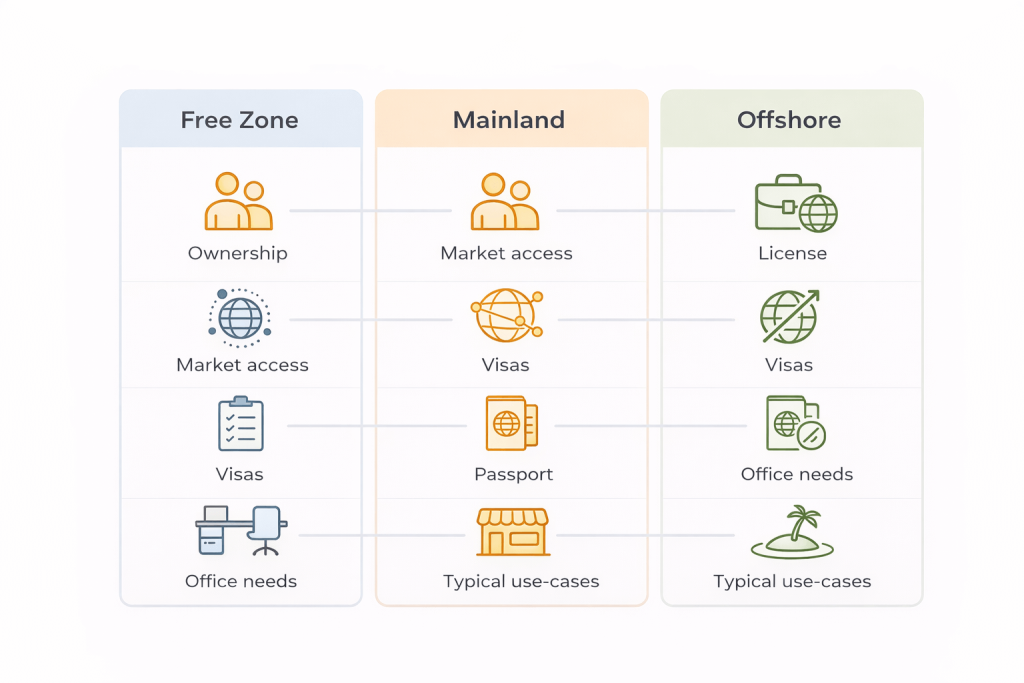
This is the choice that impacts costs, permissions, office requirements, approvals, and how you sell.
Free zone (popular for many new founders)
Best if you:
- sell internationally or online
- want a streamlined setup experience
- want an ecosystem aligned to your sector (trade, tech, media, logistics, etc.)
Watch-outs:
- some business activities and market access models require careful structuring
- your facility/desk package often affects visas and total cost
Mainland (best for full UAE market access)
Best if you:
- sell directly to clients across the UAE
- need flexibility with local contracts and onshore operations
- plan to scale locally with staff and a visible footprint
Watch-outs:
- regulated activities can require added approvals
- documentation and compliance steps can be more involved
Offshore (best for holding structures and specific use-cases)
Best if you:
- need a holding company or asset structure
- are not planning to operate “on the ground” in Dubai in the same way
Watch-outs:
- not the right choice for most operational startups
- banking and substance expectations must be understood early
Practical rule:
If you will physically deliver services on-site in the UAE or want broad local contracting flexibility, mainland often wins. If you’re building an international-first business, many founders start in a free zone and structure market access thoughtfully.
Startup steps that matter before you spend money on setup
Before you apply for anything, do these four things. They save time, reduce rejections, and make your first investor/bank conversation far easier.
1) Validate demand with paid signals (not opinions)
Do one of these within 14 days:
- Pre-sell a package at a discounted “founder rate”
- Collect deposits for a pilot cohort
- Secure letters of intent with clear budgets and timelines
- Run a small paid ad test to a waitlist landing page
You’re not trying to be perfect — you’re proving someone will pay.
2) Build your “Dubai-ready offer”
Write this and keep it visible:
- Who: the exact customer
- Problem: what they struggle with
- Outcome: what you deliver in measurable terms
- Proof: why you’re credible (experience, results, portfolio, prototype, traction)
- Price anchor: what your first offer costs and what it includes
3) Choose your activity like a banker would
In Dubai, your activity is not a marketing tagline. It’s a compliance and banking filter. A mismatch can cause:
- licensing delays
- extra approvals you didn’t plan for
- banking friction later
If you describe your business one way to customers and another way on your licence, that’s where problems start.
4) Create a simple 12-month operating plan
You don’t need a 40-page document. You need clarity:
- 3 revenue streams (now / next / later)
- your first 20 target customers
- pricing and delivery method
- monthly cost expectations (lean vs growth)
- what “success” looks like in 90 days
This becomes the backbone of your setup strategy and funding conversations.
The legal setup process (what actually happens, step by step)
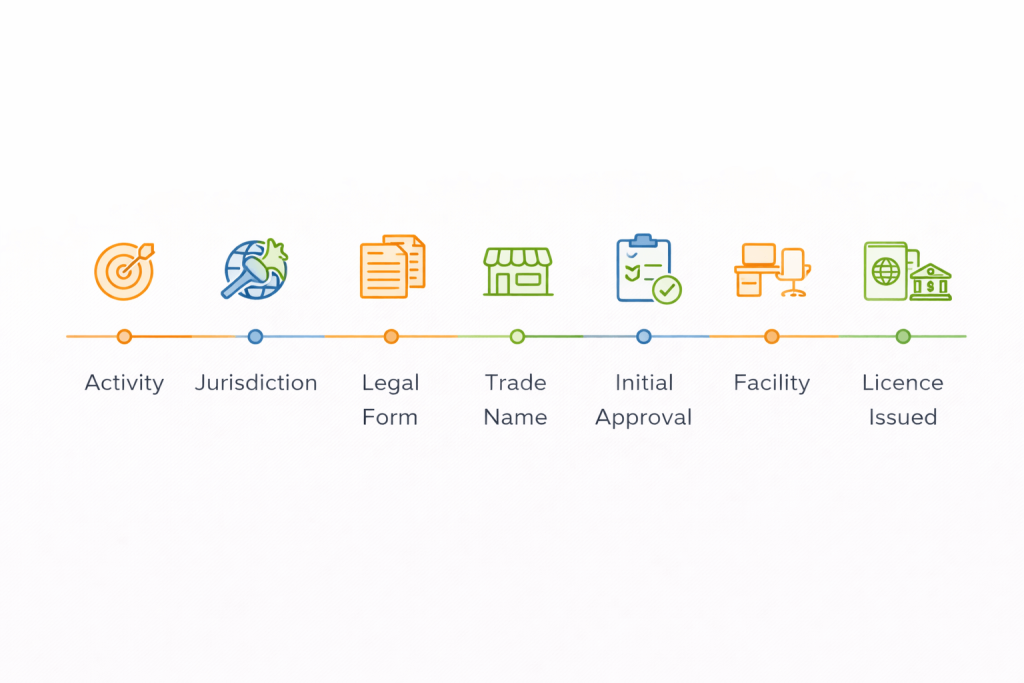
Below is the end-to-end setup flow most entrepreneurs follow. Exact steps vary by activity and jurisdiction, but the sequence is consistent.
Step 1: Select the correct jurisdiction and licence category
Your activity typically determines whether your licence is:
- professional
- commercial (trading)
- industrial/manufacturing
- specialist/regulated
Get this wrong and you may need to restart parts of the process.
Step 2: Decide the ownership and legal form
You’ll choose a structure aligned to:
- number of shareholders
- whether you need investors later
- whether you plan to create multiple entities
- how you’ll manage governance
If funding is part of your plan, don’t “hack it” now and hope it’s easy later — investors care about clean ownership and clarity.
Step 3: Reserve your trade name and secure initial approval (where required)
Trade names have rules and availability constraints. A good setup partner can shortlist options that are likely to be accepted and approved quickly.
Step 4: Confirm your facility requirement
This is often where costs quietly increase. Options may include:
- flexi-desk / shared workspace
- dedicated office
- warehouse / industrial unit
- special approvals for specific sectors
Your facility choice can influence visa allocation and total annual running costs.
Step 5: Submit documents and issue the trade licence
Typical documents may include:
- passport copies
- proof of address
- shareholder details
- business plan (for some activities/authorities)
- NOC (in specific circumstances)
- application forms and declarations
Once approved and fees are paid, your trade licence is issued.
Step 6: Establishment and immigration steps (if you need residency)
If you’re moving to Dubai or hiring, you may need:
- establishment card / immigration file
- entry permits (if applicable)
- medical test, Emirates ID, visa stamping
- sponsor/dependent planning (if relevant)
Step 7: Banking and payment readiness

This is where many entrepreneurs get stuck — not because they did anything “wrong”, but because banking has its own risk controls.
To move faster:
- prepare a clean company profile
- show source of funds and a clear business model
- have contracts/invoices ready (even pilot contracts help)
- ensure your licence activity and pitch align
Step 8: Tax, accounting, invoicing and compliance from day one
Entrepreneurs often treat accounting as a future task — then lose weeks cleaning up early mistakes. Start simple:
- choose accounting software
- define expense categories
- set an invoicing policy
- track receipts and contracts centrally
If you want to scale, build the operating system early.
Funding basics (how Dubai investors and lenders think)

Funding in Dubai typically comes in layers. Your goal is to match the funding type to your stage.
Layer 1: Bootstrapping and customer-funded growth
Best when you can sell quickly and deliver profitably. Focus on:
- pre-sales
- retainers
- paid pilots
- partnerships with revenue share
This is the cleanest path because you keep control and build credibility.
Layer 2: Angels and strategic investors
Often appropriate when you have:
- early traction
- clear differentiation
- scalable distribution
- an execution-focused team
What they usually ask for:
- a crisp pitch deck
- clear unit economics (how you make money)
- realistic acquisition strategy (not “we’ll go viral”)
- an investment plan (what the money unlocks)
Layer 3: Venture capital
Best when you have:
- high growth potential
- repeatable sales motion or product-led growth
- clear market size and a competitive moat
VCs fund speed and defensibility — not just ideas.
Layer 4: Business lending
A good fit when you have:
- stable revenues
- predictable cash flow
- clean documentation and compliance
Funding tip that founders miss:
Your legal setup affects funding readiness. A structure that makes ownership unclear, limits hiring, or complicates banking will slow fundraising and operations — even if it was cheap up front.
If you want, First Elite Global can help you build a funding-ready setup plan that aligns licensing, banking and investor expectations.
The Dubai Entrepreneur Setup Checklist (copy/paste this)
Use this as your working checklist. Keep it in a single doc and tick it off.
A) Before you apply (strategy + clarity)
- One-sentence business definition (who, what, outcome)
- Activity shortlist (2–3 options that fit what you actually do)
- Decision on free zone vs mainland vs offshore (with reasons)
- Shareholder plan (now and future funding)
- Budget range and “must-haves” (visas, office, speed, bank needs)
- 90-day traction plan (how you’ll get customers immediately)
B) Licence stage (documents + approvals)
- Passports and shareholder details
- Proof of address and contact details
- Trade name shortlist
- Basic company profile (what you do, who you serve, how you earn)
- Facility preference (flexi-desk, office, warehouse)
- Any required approvals (sector-dependent)
C) Visa and operations stage (if needed)
- Establishment/immigration file setup
- Visa route for founder and dependants (if applicable)
- Medical test and Emirates ID planning
- Hiring needs (roles, timing, visa requirements)
D) Banking and money flow
- Company profile and business plan summary
- Source of funds explanation
- Draft contracts / invoices / proposals
- Expected monthly turnover and key counterparties
- Payment gateway requirements (if e-commerce)
- Accounting system set up with categories and invoicing rules
E) Compliance and scale-readiness
- Contract templates (client agreements, supplier agreements)
- Record-keeping system (receipts, invoices, company documents)
- Renewal calendar (licence, visas, office/facility)
- Basic KPIs (sales pipeline, conversion rate, gross margin)
Want this checklist turned into a personalised action plan with your exact costs and timeline? Request a free consultation and we’ll map it properly.
A practical 90-day launch plan (what to do when)
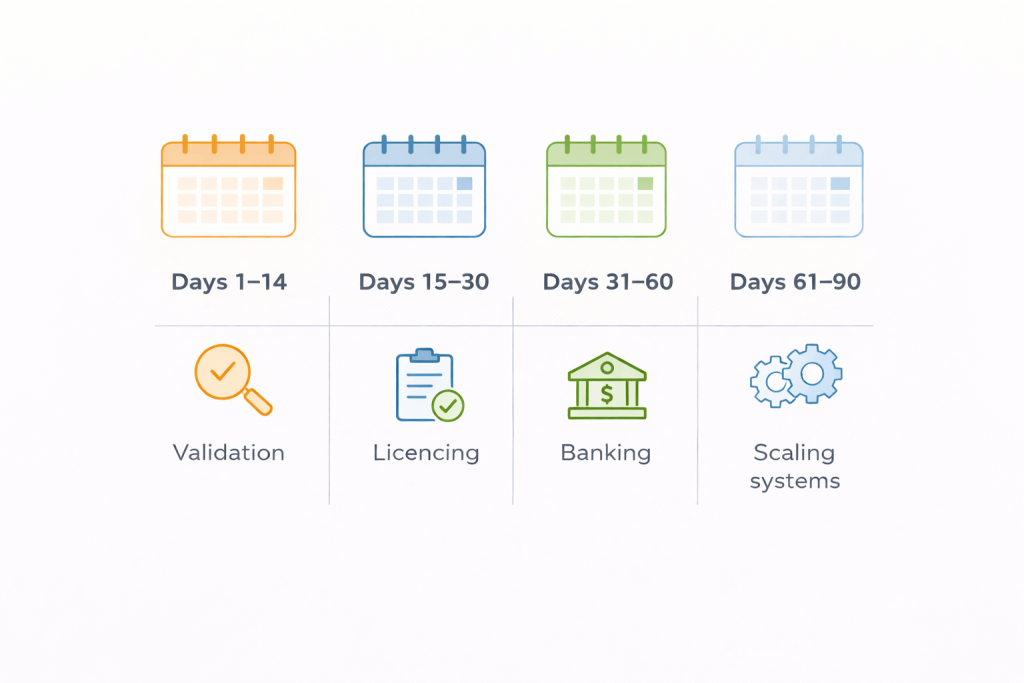
Entrepreneurs do better when the timeline is clear. Here’s a realistic plan:
Days 1–14: Proof before paperwork
- Validate demand (pilot offers, pre-sales, paid tests)
- Confirm your activity and setup route
- Prepare your company profile and document pack
Days 15–30: Licence and launch assets
- Submit application and issue trade licence
- Build your “minimum viable presence” (website/landing page, pricing, offer)
- Start your content + outreach engine (daily outreach, weekly webinars, partner outreach)
Days 31–60: Banking + consistent sales
- Complete banking steps and payment flows
- Deliver your first projects and collect testimonials
- Document your delivery process so you can delegate later
Days 61–90: Scale with systems
- Hire your first support role or contractor
- Tighten margins, reduce churn, improve conversion
- Prepare the funding pack (only if needed)
Common mistakes that cost entrepreneurs months (avoid these)
- Choosing a licence route based only on the cheapest headline price
It’s rarely the cheapest after you add visas, facilities and compliance. - Picking an activity that doesn’t match your real operations
This creates delays, approval issues and banking friction. - Starting without a banking plan
Banking is smoother when your story is consistent and documented. - Treating compliance and accounting as a “later” problem
Fixing messy records and gaps is more expensive than doing it right early. - Trying to do everything alone
A good setup partner doesn’t just file forms — they help you avoid expensive dead ends.
How First Elite Global helps you launch faster (and with fewer headaches)
Entrepreneurs come to us for three reasons: clarity, speed, and confidence.
When you request a free consultation, we’ll:
- translate your business model into the correct activity and licensing route
- recommend a setup structure that supports your growth (not just day one)
- give you a clear checklist and timeline
- explain the real cost drivers (visas, facilities, approvals, renewals)
- support with licensing, visas, banking readiness and ongoing PRO needs
If you want to become an entrepreneur in Dubai without second-guessing every step, request a free consultation and we’ll help you launch on solid ground.
Frequently asked questions
1) How to become an entrepreneur in Dubai as a foreigner?
You start by validating your business idea, selecting the correct activity, choosing free zone or mainland based on how you’ll sell, then issuing a trade licence. If you need residency, you plan visas alongside the setup so your timeline stays smooth.
2) Do I need a local partner to start a business in Dubai?
In many cases, foreign entrepreneurs can own their company fully. The best structure depends on your activity, market access goals, and any sector-specific requirements.
3) How much money do I need to start as an entrepreneur in Dubai?
It depends on your route (free zone vs mainland), visa needs, facility requirements, and whether your activity is regulated. The smartest approach is to map a lean setup first, then scale once revenue is proven.
4) What are the startup steps I should follow before company formation?
Start with demand validation, define your offer, choose the correct activity, and build a simple 12-month plan. These steps prevent licensing mismatches and make banking and funding conversations easier.
5) What funding basics should I know before launching in Dubai?
Match funding type to stage: bootstrapping and customer-funded growth first, then angels/strategics once traction exists, and VC when you have a scalable growth engine. Your setup should keep ownership clean and operations compliant to avoid delays.
6) What should be on my Dubai business setup checklist?
Include: activity selection, jurisdiction choice, shareholder plan, document pack, facility decision, licensing steps, visa plan (if required), banking readiness documents, and accounting/compliance basics.
Helpful Links
- Dubai Department of Economy & Tourism (DET) — business licensing overview:
https://www.dubaidet.gov.ae/en/licences-and-permits/business-licensing (Dubai Department of Economy & Tourism) - UAE Ministry of Economy — Basher (set up companies via Basher):
https://www.moet.gov.ae/en/set-up-companies-via-basher (Ministry of Education) - UAE Government portal (u.ae) — Bashr/Basher service explainer:
https://u.ae/en/information-and-services/business/important-digital-services/bashr (U.AE) - Federal Tax Authority — corporate tax registration steps:
https://tax.gov.ae/en/services/corporate.tax.registration.aspx (Federal Tax Authority) - UAE Ministry of Finance — corporate tax overview:
https://mof.gov.ae/en/public-finance/tax/corporate-tax/ (وزارة المالية – الإمارات العربية المتحدة) - ICP (Identity & Citizenship) — Golden Visa overview:
https://icp.gov.ae/en/services/golden-visa/ (ICP) - Dubai Chamber of Digital Economy — Dubai Startup Guide (PDF):
https://www.dubaichamberdigital.com/documents/20119/0/Dubai-Startup-Guide-2024.pdf (dubaichamberdigital.com)