
If you’re searching for an offshore company with bank account access in the UAE, you’re probably trying to achieve one of three things:
- keep an international structure clean and tax-efficient
- invoice global clients through a reputable hub
- protect assets while still being able to move money smoothly
Here’s the truth: it’s possible, but it’s not “click-to-open”. UAE banks treat offshore entities as higher-risk unless the business story, ownership, and money trail are exceptionally clear.
This guide explains what’s realistic, what usually blocks approval, and the structures that make offshore banking in the UAE far more achievable.
The quick answer: can an offshore company open a UAE bank account?
Yes — sometimes. A UAE offshore entity can open a corporate bank account locally or internationally, but approvals depend heavily on:
- how transparent the ownership is (ultimate beneficial owners)
- where funds come from (source of wealth and source of funds)
- what the company will actually do (real contracts, real counterparties, realistic volumes)
- whether the bank can “get comfortable” with your risk profile
If your main goal is a UAE corporate bank account that works reliably day-to-day, many founders end up choosing a free zone or mainland company (often alongside an offshore holding company) because it’s simply more bankable.
What “offshore” means in the UAE (and why banks care)
A UAE offshore company is designed primarily for:
- holding assets (shares, IP, property in permitted areas)
- international trading and invoicing (outside the UAE market)
- group structuring (holding company above an operating company)
- succession and ownership planning
What it typically doesn’t provide:
- residence visas for owners/staff
- an “operating presence” in the UAE market
- easy access to merchant accounts, payment gateways, or credit facilities
Banks look for substance and clarity. Offshore companies can be legitimate tools — but they’re also the structure most commonly misunderstood by first-time founders, which is why banking teams ask harder questions upfront.
What’s realistically possible: three routes that work

1) UAE offshore company + UAE corporate bank account (possible, selective)
This is the route most people mean when they search “offshore bank account UAE”.
It can work when:
- your business model is low-risk and easy to evidence
- ownership is simple (no confusing nominee chains)
- funds come from verifiable, reputable sources
- the countries you trade with are not high-risk
- you can explain “why offshore” in one sentence that makes commercial sense
Best suited for: holding structures, international consulting/services with provable contracts, IP/licensing, simple trading with clear counterparties.
2) UAE offshore company + international bank account (often easier)
In many cases, the “win” is not necessarily a local UAE bank — it’s a stable corporate account that supports multi-currency, international payments, and clean compliance.
If your operational footprint is mainly outside the UAE, an international corporate account can be a faster, lower-friction outcome while keeping the UAE offshore entity for structuring.
Best suited for: globally distributed operations, non-UAE trading, remote-first businesses, founders without UAE residency.
3) Offshore holding + UAE free zone/mainland operating company (best for long-term bankability)
This is the most robust setup if you need any of the following:
- payment gateways
- UAE clients or suppliers
- staff visas
- stronger bank appetite and more choice
- access to financing later
In practice: the offshore company holds shares (and sometimes assets), while a free zone or mainland company runs day-to-day operations and banking.
Best suited for: founders who need a bank account that behaves like a normal business account — not a special-case exception.
If you want a clear recommendation for your situation, book a free consultation with First Elite Global and we’ll map the most bankable structure based on your nationality, activity, and target markets.
Which UAE offshore jurisdictions are used for banking?
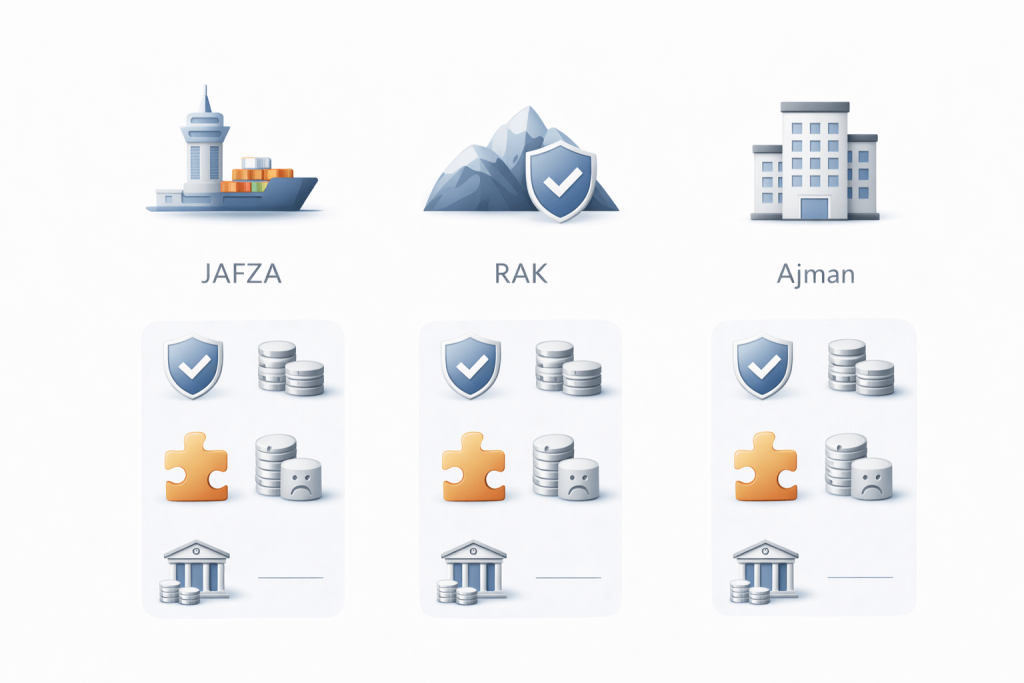
Most offshore conversations in the UAE centre around:
JAFZA Offshore
Often viewed as a premium, well-recognised option for certain structures. Typically chosen when reputation and long-term credibility matter.
RAK ICC
Popular for flexible structuring and cost efficiency, commonly used for holdings, trading, and asset protection.
Ajman Offshore
Chosen in some cases where simplicity and cost are prioritised, but banking outcomes can vary depending on bank appetite and profile.
Important: the jurisdiction alone does not “unlock” banking. Banks approve people, risk profiles, and money trails — not brochures.
Offshore banking requirements: what UAE banks usually want to see
Think of the bank’s job as answering two questions:
- Who owns and controls this company — really?
- Does the activity and money flow make sense and look clean?
Here’s what strengthens your file.
A “bankable” profile usually includes:
- a clear ownership chart showing ultimate beneficial owners
- a simple structure (avoid unnecessary layers and unrelated shareholders)
- a credible business model explained in plain English
- real evidence of income (contracts, invoices, pipeline, platform accounts)
- a logical transaction pattern (volumes and counterparties match your story)
- clean, consistent documents (names, addresses, signatures, dates aligned)
Red flags banks commonly push back on:
- vague activity like “general trading” without products, suppliers, or markets
- high-risk sectors without strong compliance (crypto-related, money services, certain commodities)
- complex multi-layer structures with no clear commercial reason
- missing proof of source of funds or source of wealth
- links to high-risk jurisdictions or sanctioned exposure
- nominee arrangements that obscure control
Document checklist: what you’ll almost always need

Banks vary, but most offshore bank account UAE applications require:
Corporate documents
- certificate of incorporation
- memorandum/articles
- register of shareholders/directors (where applicable)
- board resolution to open the bank account
- company profile and activity description
Personal KYC for owners and controllers
- passport copies for shareholders/directors/authorised signatories
- proof of address (recent utility bill/bank statement)
- CV or professional background (often requested for context)
- ownership chart showing UBOs
Business and financial evidence
- business plan or “business overview” (simple, specific, credible)
- contracts, invoices, purchase orders, or client letters
- expected turnover and transaction volumes
- source of funds documents (where initial deposit comes from)
- source of wealth documents (how owners accumulated funds)
Tip: the fastest approvals usually happen when all of this is packaged cleanly, consistently, and in the bank’s preferred format from day one.
How to open a bank account for an offshore company (step-by-step)

Step 1: Choose the structure based on banking, not just formation cost
If banking is your primary objective, select the offshore jurisdiction and ownership setup that keeps compliance straightforward.
Step 2: Build your “compliance pack”
This is the single most overlooked success factor. A well-prepared pack:
- reduces follow-up questions
- shortens approval time
- prevents contradictory answers during the call/interview
Step 3: Shortlist banks based on your real risk profile
Not every bank wants offshore structures — and appetite changes. The goal is not “the biggest bank”; it’s the bank most aligned with:
- your activity
- your residency status
- your expected volumes
- your countries of operation
Step 4: Pre-check the story (before submitting)
A short pre-check often saves weeks. If the bank’s first reaction is “unclear”, you want to know before formal submission.
Step 5: Submit, complete the interview, and stay consistent
Banks often do an onboarding call. Consistency matters:
- your explanation should match your documents
- your expected volumes should match your evidence
- your counterparties should match your markets
Step 6: Account opening, activation, and ongoing compliance
Once opened, keep the account healthy:
- run activity exactly as described
- avoid unexpected high-risk transfers
- keep invoices and contracts organised
- respond quickly to periodic compliance reviews
Timelines and expectations: how long does offshore banking take?
There’s no universal timeline. In practice:
- straightforward cases can move in a few weeks
- enhanced due diligence cases can take longer
- delays usually come from missing documents, unclear activity, or inconsistent source-of-funds evidence
The most reliable way to avoid a dragged-out process is to treat it like a professional onboarding file — not an admin task.
Common reasons offshore bank accounts get declined (and how to prevent it)
1) The business model is too vague
Fix: be specific. What exactly do you sell? Who buys it? From where? How do you deliver it?
2) The structure looks unnecessarily complex
Fix: simplify shareholders, remove layers that don’t add real commercial value, and make control obvious.
3) Source of funds isn’t documented properly
Fix: show the trail. Bank statements, sale agreements, dividends, audited accounts, salary history — whatever is appropriate, but make it verifiable.
4) Transaction expectations don’t match reality
Fix: keep turnover projections realistic and evidence-based.
5) The bank can’t get comfortable with geography risk
Fix: be transparent about countries you trade with and demonstrate controls (screening, invoices, contracts, legitimate counterparties).
Practical examples: what tends to be approved vs questioned

More bankable (when supported by documents)
- UK/EU consultancy invoicing GCC clients with signed service agreements
- holding company owning shares in an operating company with clear group structure
- IP/licensing company receiving royalties with contracts and audited history
Often questioned (not impossible, but needs a stronger file)
- “general trading” across multiple regions with no supplier/customer evidence
- high-volume transactions with thin documentation
- anything touching regulated financial activity without licences
- crypto-adjacent flows without strong compliance and clear counterparties
If a UAE bank account is essential, consider these “bank-first” alternatives
Option A: Free zone company for banking + offshore for holding
This is the most common “best of both worlds” setup:
- the operating company opens the bank account and runs payments
- the offshore company holds shares or assets above it
Option B: Mainland company when you need UAE market access
If you want local clients, contracts, or stronger bank appetite, mainland can be the practical move.
Option C: Start with international banking, then upgrade locally
For some founders, establishing clean trading history first makes later UAE banking discussions far easier.
How First Elite Global helps (without guesswork)
Banking success is rarely about luck — it’s about preparation and positioning.
With First Elite Global, you get:
- a structure recommendation based on bankability (not just setup price)
- a complete compliance pack prepared to bank expectations
- bank shortlisting aligned with your activity and risk profile
- coordination for onboarding calls and follow-ups
- optional support for related operating entities if offshore isn’t the best fit
“Everything from licence to visas and bank account was handled with professionalism and clear updates.”
— Client feedback shared after a UAE business setup engagement
If you want the most realistic path to an offshore company with bank account access, book a free consultation and we’ll map a plan that banks are more likely to approve.
FAQs
Can I open an offshore bank account in the UAE as a non-resident?
Yes, it can be possible, but it’s more selective. Banks typically want stronger evidence of business activity, ownership clarity, and clean source-of-funds documentation when owners are non-resident.
What are the offshore banking requirements for UAE corporate accounts?
Expect corporate documents, passport and address proof for all owners/controllers, a clear business model, and evidence of source of funds and source of wealth. Banks may also request contracts, invoices, and transaction forecasts.
Which is better for a UAE offshore bank account: JAFZA Offshore or RAK ICC?
Neither guarantees approval. JAFZA Offshore is often viewed as more premium, while RAK ICC is widely used for flexible structuring. The deciding factor is your business story, ownership simplicity, and compliance strength.
How long does it take to open a bank account for an offshore company?
Timelines vary by bank and risk profile. Clean, low-risk files can move faster; enhanced due diligence and missing documentation can extend the process significantly.
Why do offshore company bank account applications get rejected?
Most rejections come from unclear business activity, complex structures with no commercial reason, weak proof of source of funds/wealth, or geographic/industry risk the bank isn’t comfortable with.
If offshore banking is difficult, what’s the best alternative in the UAE?
A common solution is an offshore holding company plus a free zone or mainland operating company for banking, visas, and day-to-day transactions.