
Setting up a company in Dubai no longer means flying in just to push paper around. Today, a large part of Dubai company formation can be completed through digital registration portals, remote document submission, and e-signatures—especially for free zone setups and certain mainland routes.
That said, “online company registration in Dubai” can mean different things depending on what you’re trying to achieve:
- A trade licence only (so you can invoice and operate internationally)
- A UAE residence visa (so you can live in the UAE and sponsor family/staff)
- A corporate bank account (often the most compliance-heavy step)
- A fully operational local business (office, visas, payroll, contracts, VAT/corporate tax registrations where relevant)
This guide breaks down what you can genuinely do remotely, what still requires you (or a signatory) to be physically present, and how to choose a setup route that matches your goals.
If you want a done-for-you remote setup roadmap, book a free consultation with First Elite Global and we’ll map the fastest legal route based on your activity, nationality, banking needs and whether you want visas.
What “online company registration in Dubai” really includes
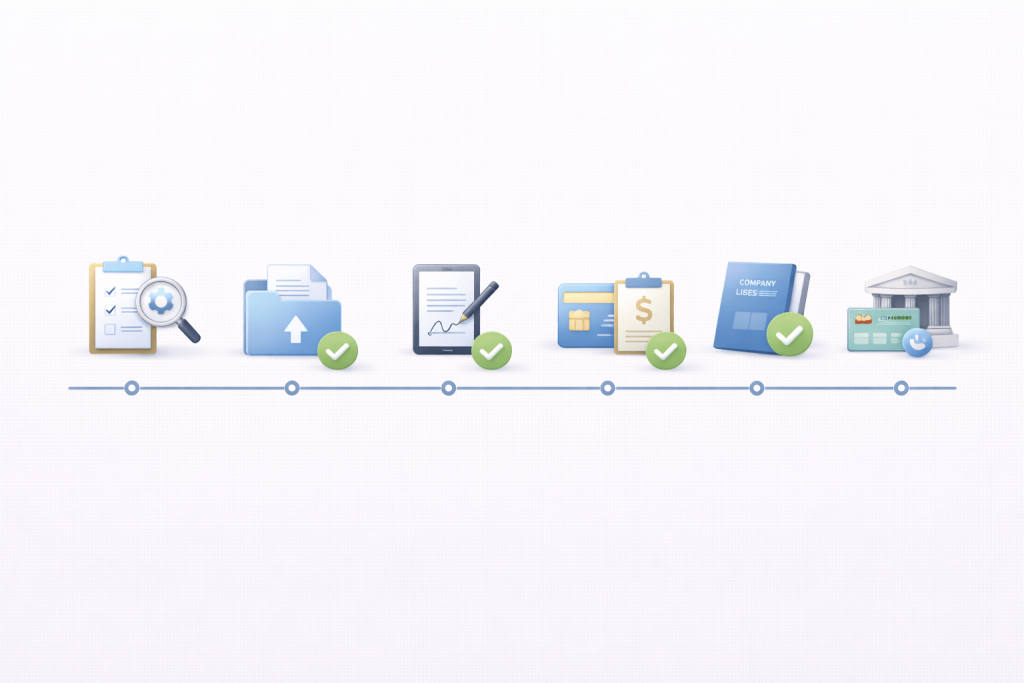
In practical terms, online company registration in Dubai usually covers:
- Digital submission of KYC and company documents online
- Online trade name reservation (where applicable)
- Remote approvals and licence issuance (PDF licence and incorporation docs)
- Online payment of government and authority fees
- Digital signing / e-signatures for specific forms and resolutions
- Remote coordination for immigration file opening (where applicable)
It does not always include:
- Emirates ID biometrics (fingerprints/photo) for residence visa applicants
- Medical fitness tests for residence visas
- Some bank account activations (depending on bank, risk profile and signatories)
- Certain regulated activities that require additional external approvals
So the right question is not “Can I do it online?” but:
Which parts can I do online, and which parts will trigger an in-person requirement?
At-a-glance: what you can do remotely vs in person

| Step | Remote? | Notes |
| Choose jurisdiction (free zone vs mainland) | Yes | Decision stage; no travel needed |
| Select business activity | Yes | Regulated activities may add approvals |
| Submit documents online | Yes | Often scans are enough; some cases require notarisation |
| Trade name reservation | Yes | Depends on jurisdiction and licence type |
| Draft/shareholding setup | Yes | Can be handled remotely with your consultant |
| E-signatures | Usually | Varies by authority and document type |
| Pay fees | Yes | Online payment links/portals |
| Licence issuance | Yes | Licence issued digitally in most setups |
| Establishment/immigration file | Often | Can be started remotely; visa steps change this |
| Entry permit (if needed) | Often | Usually processed digitally |
| Medical test | No | In-country requirement for residence visa |
| Emirates ID biometrics | No | In-country requirement for residence visa |
| Corporate bank account | Depends | Increasingly digital, but not guaranteed |
| Office lease / EJARI (if required) | Depends | Some can be arranged remotely via agents |
The most remote-friendly routes for Dubai company setup
1) Free zone company setup (most remote-friendly)
For many overseas founders, free zones are the simplest route for remote setup because they often support:
- Document submission online
- Digital approvals and licence issuance
- Flexi-desk / virtual office solutions (where allowed)
- Zero-visa packages (if you don’t need UAE residence immediately)
Best for: consultants, online services, trading (depending on licence type), startups testing the market, overseas owners who don’t need immediate visas.
Typical remote setup outcome: you can get a trade licence and incorporation documents without travelling, then decide later if you want visas.
2) Mainland company setup via digital portals (remote-friendly, but activity-dependent)
Dubai mainland licensing has become more digital through centralised portals and service centres. In some cases, you can complete major steps remotely—especially for professional/service activities—however requirements can vary based on:
- Legal structure
- Activity approvals
- Office/tenancy requirements
- Whether you need visas immediately
- Whether the signatory is UAE resident
Best for: businesses that need to trade directly in the UAE local market, B2B contracting locally, retail/hospitality (with additional requirements).
3) “Licence first, visa later” strategy (best for fully remote starts)
If you want maximum remote setup:
- Get the trade licence issued remotely (free zone is typically easiest)
- Operate and invoice internationally
- Travel later only when you’re ready to activate residence visas and banking (if required)
This approach reduces rushed travel and avoids starting visa steps before you actually need them.
What you can complete remotely: step-by-step remote setup workflow
Step 1: Define your business activity and where you will trade
Remote setup starts with clarity:
- Are you selling inside the UAE or mostly outside the UAE?
- Do you need UAE local contracts, tenders, or shopfront activity?
- Are you a solo founder, or do you need staff visas soon?
- Do you need payment processors and banking immediately?
A common mistake is choosing a jurisdiction based on the cheapest advertised package, then discovering it doesn’t support the banking, visa quota or activity approvals you need.
Best next step: tell your consultant your activity, target customers (UAE vs international), estimated annual turnover band, and whether you need a residence visa in the next 90 days.
Step 2: Prepare your documents online (digital-ready pack)

Most remote setups start with a clean digital pack. Typically you’ll be asked for:
- Passport copy (shareholders and manager)
- Passport-style photo (recent, clear background)
- Proof of address (utility bill/bank statement, depending on requirements)
- Email and mobile number
- Basic CV or business profile (sometimes for banking or regulated activities)
- Preferred company names (usually 2–5 options)
- Short business description (what you do, who you serve, where revenue comes from)
Remote setup tip: use one consistent name format across documents (e.g., include middle names consistently) to avoid approval delays.
Step 3: Choose structure and sign remotely where allowed (e-signatures)

Depending on the authority and your setup route, you may be able to sign:
- Application forms
- Shareholder resolutions
- Incorporation documents
- Service agreements
- Selected government/authority forms
E-signatures are increasingly accepted, and Dubai’s wider digital identity infrastructure supports digital signing for many official transactions.
Reality check: some documents and some banks may still request wet-ink signatures or additional identity verification for specific cases. Plan for a “hybrid” scenario even if you start fully remote.
Step 4: Submit the application through the relevant portal (digital registration)
This is the “online registration” moment: uploading documents online, selecting activity, and submitting the application.
What matters here is accuracy:
- Correct activity selection
- Name compliance
- Correct shareholder/manager details
- Correct passport and address formatting
A small error here can lead to rework later—especially if you want banking quickly.
Step 5: Pay fees online and receive your licence digitally
In most modern setups, once approvals are complete you’ll:
- Receive a payment link or portal invoice
- Pay online
- Receive a digital licence and incorporation documents
This is the point at which many founders believe the job is “done”—but operationally, you may still want:
- Corporate bank account
- VAT/corporate tax registrations (where applicable)
- Contracts and invoicing structure
- Residence visas and Emirates ID (if needed)
- Office solutions (if required by your activity)
If you want the fastest, cleanest path to “operational”, plan banking and visa strategy before you issue the licence—not after.
What still requires physical presence (and how to plan around it)
Emirates ID biometrics (for residence visas)
If you apply for a UAE residence visa through your company, biometrics are typically in-person. This is one of the most common reasons founders must travel even when the company licence was issued remotely.
Planning tip: don’t schedule travel until your entry permit (if applicable) and visa file steps are aligned, so your in-country time is efficient.
Medical fitness test (for residence visas)
Medical screening for residence visas is also in-country. If you want a visa, assume at least one trip is required (unless you already live in the UAE).
Corporate bank account (depends on bank and risk profile)

This is where many “fully online” claims fall down.
You may be able to do a large part remotely:
- Application initiation online
- Upload documents online
- Video verification (in some cases)
But approval depends on:
- Business activity risk level
- Ownership structure (simple vs complex)
- Nationality mix and residency status of signatories
- Source of funds and expected transaction flows
- Contracts/invoices supporting your business model
Banking reality: even if a bank advertises online account opening, compliance checks can still require follow-up calls, extra documents, or in-person verification for certain cases.
Remote setup timelines: what to expect (realistic ranges)

Timelines vary by jurisdiction, activity and document readiness. As a practical planning range:
- Licence-only remote setup: often days to a couple of weeks
- Licence + residence visa activation: typically a few weeks (because of medical/biometrics timing)
- Licence + bank account: can be fast for low-risk cases, but can also take longer if compliance is strict
If you’re working to a deadline (tender, contract start date, relocation date), the best way to avoid delays is to sequence the work correctly:
- Choose the correct jurisdiction and activity
- Prepare a bank-ready document pack early
- Issue licence
- Start banking in parallel (where sensible)
- Trigger visa only when travel timing is planned
Common delays (and how to avoid them)
1) Business activity mismatch
Choosing an activity that doesn’t match your real work can cause:
- Licence amendments later
- Banking rejections (because the actual revenue doesn’t match the licence)
- Issues with invoicing and contracting
Fix: describe your actual services/products clearly and select the closest correct activity.
2) Name reservation issues
Trade names can be rejected for:
- Restricted words
- Similarity to existing names
- Misleading terms
- Non-compliance with naming rules
Fix: submit multiple options and keep them simple.
3) Missing or inconsistent documents online
Typical examples:
- Proof of address doesn’t meet format requirements
- Passport scan is unclear
- Name format differs across documents
- Expired passport validity window issues
Fix: create a single “digital registration folder” with clean, consistent files.
4) Bank compliance follow-ups
Banks commonly ask for:
- Client contracts or pipeline evidence
- Website/social profiles
- Invoices and counterparties
- Source of funds explanation
- Past business history details
Fix: prepare a one-page business profile and supporting evidence before you apply.
5) Visa timing mistakes
Founders often issue a visa request too early, then struggle with travel timing.
Fix: use a “licence first, visa later” approach if you’re not ready to travel.
Remote setup scenarios: choose the right path for you
Scenario A: Overseas founder, wants a Dubai licence but no visa yet
Best fit: remote setup with a free zone licence, zero-visa package (where available).
You can usually do: documents online, remote setup, licence issuance online.
You may delay: visas, medical, biometrics, and sometimes banking.
Scenario B: Overseas founder, wants to relocate and needs residence visa soon
Best fit: start remotely, then plan one efficient trip for medical and Emirates ID biometrics.
You can do remotely first: structure, application, approvals, licence issuance.
You’ll still need: in-country steps for visa activation.
Scenario C: UAE resident (or already in Dubai)
Best fit: you can still use digital registration and e-signatures, but you can complete the in-person steps quickly.
Outcome: often fastest end-to-end operational setup.
Practical checklist: documents online for a smooth remote setup
Use this checklist before you start:
- Passport copy for each shareholder and manager (clear, full page)
- Passport photo (recent)
- Proof of address (recent; shows full address)
- Mobile number and email (for OTP verification and portals)
- 2–5 company name options
- Short business description (what you do, where clients are, how you get paid)
- Ownership split and manager appointment details
- If you want banking soon: website or landing page, pitch deck or company profile, sample invoices/contracts
If you’d like, First Elite Global can send you a bank-ready document pack template so your registration and banking steps are aligned from day one.
How First Elite Global supports remote company setup in Dubai
Remote setup works best when someone is managing the process end-to-end, not just submitting forms.
With First Elite Global, you get:
- A jurisdiction and activity recommendation based on your real business model
- Document checking before submission (to reduce rejections)
- A structured remote setup plan with clear sequencing
- Support with licences, visas and ongoing compliance steps
If you want the most efficient route for online company registration in Dubai, book a free consultation and we’ll confirm what can be done remotely in your specific case—before you spend money in the wrong place.
Frequently asked questions
Can I complete online company registration in Dubai without visiting the UAE?
In many cases, yes—especially for free zone setups where document submission online and licence issuance can be completed remotely. However, if you want a UAE residence visa, you should expect at least one in-person visit for medical screening and Emirates ID biometrics.
Are e-signatures accepted for Dubai company setup documents?
Often, yes. Many processes now support e-signatures or digital signing workflows. That said, acceptance can vary depending on the authority, the specific document type, and the bank you choose for account opening.
What documents do I need for remote setup and digital registration?
Commonly: passport copy, passport photo, proof of address, contact details, proposed company names, and a basic business description. If you want banking quickly, you should also prepare a business profile and supporting evidence (website, contracts, invoices, source of funds).
Can I open a corporate bank account remotely after registering my Dubai company online?
Sometimes. Some banks allow online initiation and document upload, and certain cases may proceed with remote verification. But approval depends on the risk profile of your activity, ownership structure, signatory residency, and transaction flows—so “remote” isn’t guaranteed for every business.
Is free zone remote setup better than mainland remote setup?
If your priority is completing the most steps remotely, free zones are often the most remote-friendly. If you need to trade directly in the UAE market, mainland may be the right choice—even if some steps become more activity-dependent.
How long does remote company setup in Dubai take?
Timelines depend on the jurisdiction and how prepared your documents online are. Licence-only setups can sometimes be completed quickly, while visa activation and banking can add extra time due to compliance and in-person requirements.
Helpful Links
- UAE Pass (official)
- UAE government overview of UAE Pass
- Invest in Dubai (official portal)
- Invest in Dubai – setting up a business (official)
- UAE government guide – starting a business in a free zone
- UAE electronic transactions & trust services law overview
- UAE legislation (e-transactions and trust services)
- Emirates NBD – online business account application