Dubai rewards operators who are reliable, responsive, and consistent. That’s exactly what a well-run cleaning company delivers: a practical, repeatable service that households, offices, retail spaces, and property managers rely on week after week.
But the founders who do well don’t just “get a licence and hire a few cleaners”. They pick the right activity and jurisdiction, set up staffing and visas properly, design profitable service packages, and build a quality system that makes customers stay.
This guide walks you through the full setup—from licensing and costs to hiring, pricing, and day-one operations—so you can launch with confidence and scale without chaos. If you want a tailored costed plan for your exact model, book a free consultation with First Elite Global and we’ll map the fastest compliant route for your business.
What “cleaning company licence” means in Dubai
A cleaning company licence in Dubai is the trade licence that allows you to legally offer cleaning services under approved business activities. If you are comparing the commercial setup route, use the dedicated cleaning company setup page for activity, licensing, approvals and post-formation planning. The activity you choose matters because it affects:
- Whether mainland or free zone makes more sense
- Whether you need extra approvals (for specialised services)
- The kind of clients you can serve most easily (residential vs corporate vs projects)
- Staffing and operational requirements (vehicles, equipment storage, site access, etc.)
The goal is simple: select the activity that matches what you actually plan to deliver—now and 12 months from now.
Step 1: Choose your cleaning niche (don’t skip this)
Dubai is a big market, but “cleaning” is not one business. Pick a niche you can execute brilliantly, then expand later.
High-demand cleaning business models in Dubai
Residential recurring (weekly/bi-weekly)
- Best for: steady cash flow, lower admin, referrals
- Challenge: churn if quality slips; scheduling complexity
Office & commercial contracts
- Best for: predictable revenue, longer agreements
- Challenge: slower sales cycle; payment terms; SLAs
Move-in / move-out & deep cleaning
- Best for: high ticket jobs, strong partnerships with agents
- Challenge: labour-heavy; quality expectations are intense
Post-construction / handover cleaning
- Best for: large invoices, contractor networks
- Challenge: site safety, time pressure, strict scope control
Specialised add-ons
- Examples: upholstery, carpet, sanitisation, high-level window cleaning
- Note: some specialised services may require additional approvals or specific compliance standards—structure your licence correctly before you sell these.
A simple niche decision rule
Start with one primary revenue engine and one add-on upsell:
- Primary: Residential recurring or Office contracts
- Upsell: Deep clean / Move-out (for residential) or Periodic deep clean (for offices)
That combination gives you recurring income plus profitable one-off boosts.
Step 2: Mainland or free zone for a cleaning business?
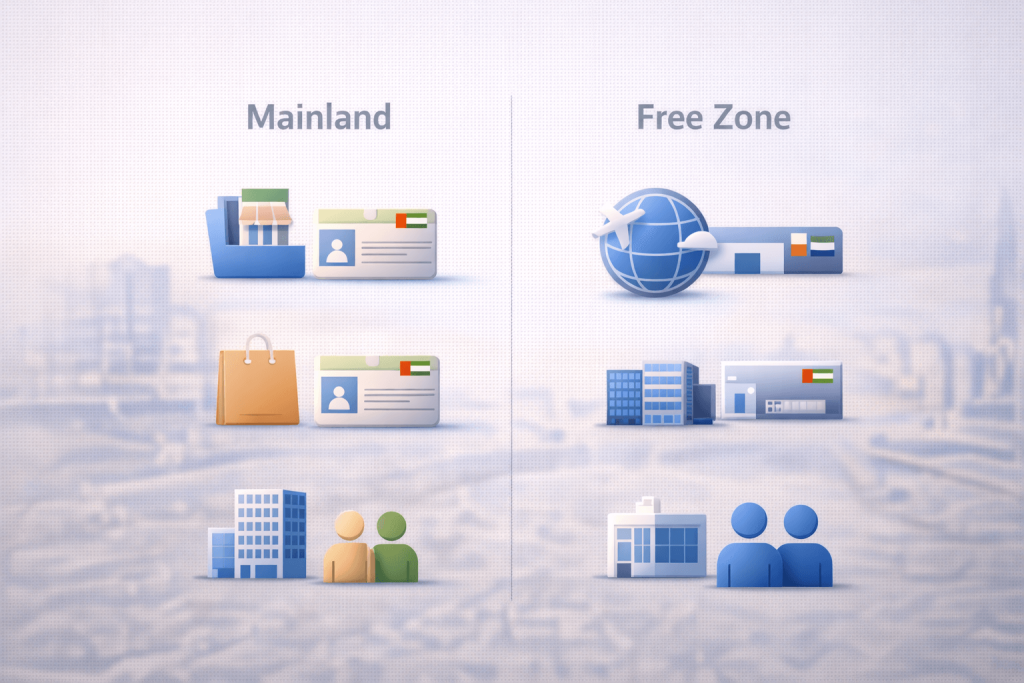
Your jurisdiction decision should follow your operating reality.
Mainland (Dubai) is usually best if:
- You will clean at client sites across Dubai regularly
- You want to target residential and office clients at scale
- You plan to build a field team with vehicles, supervisors, and rapid response
Free zone can work if:
- You’re starting lean with a small team and controlled scope
- You mainly sell contracts remotely or within a defined structure
- You want a package-based setup with predictable formation steps
Practical guidance: Most cleaning companies that intend to operate heavily “on the ground” prefer a mainland structure because it matches the day-to-day service model. If you’re unsure, we’ll compare both options side-by-side and show the trade-offs (cost, timeline, visas, and client access) before you commit.
Step 3: Build your service packages before you apply (this prevents costly mistakes)

Many new founders apply for a licence, then discover their pricing doesn’t work once staff and transport are added.
Before you submit paperwork, decide:
- Your core packages (what’s included, what’s excluded)
- Your delivery time standards (how long each job takes)
- Your staffing model (employees vs subcontractors)
- Your minimum order value and service areas
Starter service packages that sell in Dubai
Package A: Standard Home Clean
- Scheduled weekly or bi-weekly
- Light kitchen and bathroom clean, floors, dusting, bins
- Add-ons: fridge/oven interior, balcony, ironing
Package B: Deep Clean
- One-off intensive clean (kitchen + bathrooms detailed)
- Best sold as: “Deep clean + recurring plan discount”
Package C: Move-in / Move-out
- Empty-property clean designed for handover
- Best partnerships: agents, landlords, relocation services
Package D: Office Cleaning Contract
- Daily / 3x weekly / weekly options
- Includes checklist and supervisor inspection
- Add-ons: pantry restock coordination, glass partitions, quarterly deep clean
Package E: Post-Construction (optional later)
- Only add this once your quality control is strong and you have trained supervisors
If you want, we can provide a ready-to-use scope sheet and inspection checklist you can hand to customers and staff on day one.
Step 4: The step-by-step setup process (Dubai cleaning company)

Below is the typical end-to-end path founders follow to set up properly and avoid rework.
1) Confirm your activity and legal structure
Decide:
- Specific cleaning activities you will offer
- Mainland vs free zone
- Legal form and ownership structure
Tip: Keep your first licence focused. You can add activities later, but changing direction mid-application slows you down.
2) Reserve a trade name
Choose 2–3 name options that:
- Match your service and positioning (premium vs value)
- Are easy to pronounce and remember
- Don’t create approval delays (avoid sensitive or restricted terms)
3) Obtain initial approval
Initial approval confirms there’s no objection to you proceeding with the chosen activity and structure.
4) Arrange premises requirements (where applicable)
Depending on jurisdiction and activity, you may need:
- An address/office solution
- Tenancy documentation (and related registrations, if required)
- A practical ops base (even a small storage unit can change your efficiency)
Operational reality: Cleaning businesses benefit from an organised base for supplies, uniforms, equipment maintenance, and supervisor briefings.
5) Issue the trade licence
Once your documents are ready and approvals are in place, the trade licence is issued.
6) Set up tax and compliance essentials early
Even lean service businesses should treat compliance like an operating system, not an afterthought:
- Corporate tax registration requirements (where applicable)
- VAT readiness (even if you’re under the threshold today)
- Contracts and customer terms
- Wage payment compliance for staff (timely, properly documented)
7) Open your business bank account and payment rails
Set up:
- Corporate bank account (or at minimum a compliant business banking solution)
- Card payments / payment links
- Invoice templates and payment terms
Cash-flow rule: For one-off services, collect full payment upfront or a meaningful deposit. For contracts, use clear billing cycles and penalties for late payment.
8) Set up labour and immigration files for hiring
To hire cleaners and supervisors compliantly, you’ll typically need:
- Labour-related setup for employing staff
- Immigration steps for visas and residency processing (as required)
9) Hire, train, and standardise
Your first hires define your reputation. Start with:
- 1 supervisor/lead cleaner (quality anchor)
- 2–4 cleaners (initial capacity)
- A simple training system: “how we clean”, “how we behave”, “how we check”
10) Launch with a controlled service area and calendar
For the first 30 days:
- Limit service areas to reduce travel chaos
- Offer a smaller menu of packages (execute perfectly)
- Track time per task and adjust pricing fast
If you want a structured launch plan with timelines and setup milestones, request a free consultation and we’ll build a practical roadmap based on your target revenue and team size.
Setup costs: what you’ll actually pay (realistic budget scenarios)
Cleaning businesses look “low cost” until staffing, transport, and compliance are added. Plan with scenarios instead of guessing.
Cost categories to budget for
- Trade licence and related government processes
- Office/address solution (if required)
- Visas, medical fitness, Emirates ID, insurance (for staff)
- Recruitment, uniforms, training
- Equipment and consumables (vacuum, steam cleaner, chemicals, microfibre systems)
- Vehicle/transport (or transport allowance)
- Software (CRM, booking, WhatsApp Business, invoicing)
- Marketing (Google profile, website, ads, partnerships)
Scenario 1: Lean launch (2–4 cleaners)
Best for: residential recurring + deep clean upsells
Typical cost drivers:
- Licence and basic setup
- Initial visas for small team
- Equipment (start with essentials, upgrade based on demand)
- Simple booking + invoicing stack
Scenario 2: Contract-ready (6–10 staff + supervisor)
Best for: offices, clinics, retail, property managers
Additional cost drivers:
- Supervisor layer and inspection process
- Stronger payroll compliance and admin
- Transport planning (vans or allocated drivers)
- Higher insurance and operational controls
Scenario 3: Project and post-construction capable (10+ staff)
Best for: developer handovers, contractors, larger invoices
Additional cost drivers:
- Site readiness and safety processes
- Dedicated operations base and equipment capacity
- Strong QA and re-clean buffer planning
The most common budgeting mistake: underestimating transport time and labour hours. If your pricing assumes “3 hours”, but the job takes 4.5 hours once travel, setup, and rework are included, your margins disappear.
Hiring and visas: how to build a stable cleaning team in Dubai
Hiring is where most cleaning businesses either win or fail.
Your staffing options
Option 1: Employees (recommended for consistency)
- You control training, quality, and customer experience
- Better for recurring clients and contracts
- Requires proper payroll, visas, and ongoing compliance
Option 2: Subcontractors (use carefully)
- Flexible capacity for spikes
- Less control over quality and behaviour
- Can damage reputation if not tightly managed
A hybrid model works well:
- Core employee team for recurring clients
- Verified subcontractors only for overflow jobs and seasonal surges
Roles you should hire first
- Lead cleaner / supervisor (your quality backbone)
- 2–4 cleaners (capacity)
- Admin/dispatcher (part-time initially) once bookings grow
The visa workflow in plain English
For employee onboarding, the practical flow usually looks like:
- Entry/work authorisation steps (as applicable)
- Medical fitness test
- Emirates ID application and biometrics
- Residency steps and finalisation
Speed tip: Prepare documents and onboarding checklists before you recruit so you don’t lose good candidates during delays.
Pricing model that stays profitable (even when things go wrong)

Dubai is competitive. The winners don’t race to the bottom—they price based on outcomes and consistency.
Three pricing models that work for cleaning
1) Hourly pricing (common for residential)
- Simple to sell
- Risk: you lose money if tasks take longer than expected
- Fix: define what “hourly” includes and cap scope
2) Fixed package pricing (best for upsells)
- Deep clean, move-out, periodic office deep clean
- You must measure actual time and revise packages quickly
3) Contract pricing (best for offices)
- Monthly fee tied to frequency + scope + SLA
- Include inspection cadence and escalation process
A simple margin rule
Your pricing must cover:
- Labour cost (including travel time)
- Consumables and equipment wear
- Supervisor time and re-cleans
- Admin and customer support
- A profit buffer for cancellations and late payments
If you want a clean way to test profitability, use this:
- Track actual delivery time per package for 20 jobs
- Compare “planned hours” vs “real hours”
- Adjust scope or pricing immediately
Service standards: how to deliver consistent quality at scale

Most cleaning companies don’t fail because of marketing. They fail because quality is inconsistent and customers churn.
Build a simple quality system
1) Standard checklists per package
- Room-by-room tasks
- “Must do” vs “nice to do”
- Photo standards where relevant
2) Supervisor inspections
- Random spot checks on recurring clients
- Full inspection on deep cleans and move-outs
3) Re-clean policy (your reputation shield)
- Clear window to report issues
- Fast re-clean response
- Track re-clean causes and retrain
Customer experience that wins in Dubai
- Confirm arrival time with a tight window
- Uniformed staff and professional behaviour
- Clear communication if delays happen
- Quick resolution when something goes wrong
A strong cleaning brand is built in the moments that customers usually complain about—when you handle those well, you earn long-term loyalty.
Sales and marketing that generates steady bookings
The most reliable channels for cleaning businesses
1) Google presence
- Strong Google Business Profile with reviews and photos
- Clear services and service areas
- Fast response time to enquiries
2) Partnerships
- Property managers and building management
- Real estate agents (handover and move-out)
- Facilities managers (office contracts)
- Holiday home operators
3) Referral engine
- Discount or free add-on for referrals
- Make it easy: a WhatsApp message + code
Launch offer that doesn’t destroy your pricing
Instead of discounting everything, offer:
- A free add-on (e.g., inside fridge or balcony) on first booking
- A “deep clean credit” when they move to a recurring plan
- Priority slots for contract customers
If you’d like, we can help you position your offer so you attract quality clients rather than bargain hunters.
Contracts and policies you should have from day one
Even if you start small, put basic terms in writing to avoid disputes.
Include:
- Scope definition (what’s included/excluded)
- Customer responsibilities (access, parking, electricity/water)
- Breakage and liability rules (reasonable and fair)
- Cancellation and rescheduling policy
- Payment terms (especially for corporate clients)
- Re-clean policy and complaint window
This protects both you and the customer—and it signals professionalism.
Common mistakes to avoid (what we see repeatedly)
- Applying for the wrong activity, then needing amendments later
- Selling too many services at launch, and failing to deliver consistently
- Underpricing move-out and deep clean jobs (these are labour traps)
- Ignoring transport planning, causing late arrivals and staff burnout
- No supervisor layer, meaning quality depends on luck
- Weak payment rules, leading to late payments and cash-flow stress
- Hiring fast without training, then losing clients due to inconsistency
If you want to avoid the usual painful learning curve, book a free consultation and we’ll help you launch with a model that is compliant, profitable, and operationally realistic.
A practical 30–60–90 day launch plan

Days 1–30: Build the foundation
- Finalise licence route and documents
- Create 3–5 core packages with clear scope
- Hire a lead cleaner + initial team
- Set up checklists, uniforms, basic software, payment rules
Days 31–60: Stabilise delivery and reviews
- Tight scheduling and limited service areas
- Gather reviews systematically
- Build partnerships with agents and property managers
- Track job times and adjust pricing
Days 61–90: Scale carefully
- Add capacity only when quality is consistent
- Introduce office contracts or higher-ticket services
- Add a supervisor inspection routine
- Formalise training into a repeatable programme
How First Elite Global helps you set up faster and safer
A cleaning business is straightforward when it’s set up correctly—but small errors can cause weeks of delay or expensive restructuring.
When you work with First Elite Global, we help you:
- Choose the right jurisdiction and cleaning activity for your model
- Manage trade name, approvals, and licence issuance
- Plan visas and hiring based on your operational reality
- Build a costed setup plan so you don’t get surprised later
- Align your business for banking, payments, and compliance from day one
If you’re ready to start, request a free consultation and we’ll map your fastest compliant setup route with clear costs and timelines.
FAQs
How much does it cost to start a cleaning business in Dubai?
Costs depend on your licence route (mainland or free zone), number of visas, and how quickly you plan to hire staff. Budget for licensing, visas, insurance, equipment, and transport—not just the trade licence.
Do I need a cleaning company licence in Dubai to offer home cleaning?
Yes. If you are providing cleaning services commercially in Dubai, you need the appropriate trade licence under approved activities. The correct activity selection is important, especially if you plan to hire staff or add specialised services.
Can a free zone company provide cleaning services in Dubai?
Free zone structures can work for certain service models, but many on-site cleaning operations prefer mainland licensing for smoother local service delivery. The best route depends on where your clients are and how you will staff and operate.
How do I hire cleaners and arrange visas for a cleaning company in Dubai?
Once your company is licensed, you typically set up the necessary labour and immigration files and then process staff onboarding steps including medical fitness and Emirates ID. The exact flow depends on your company structure and where it is licensed.
What pricing model works best for a cleaning business in Dubai?
Most successful cleaning businesses use a mix: hourly for standard residential cleaning, fixed packages for deep cleans and move-outs, and monthly contracts for offices. The key is measuring real delivery time and keeping a buffer for re-cleans and transport.
What services should I offer first when I start a cleaning business in Dubai?
Start with one core model (residential recurring or office contracts) and one high-margin add-on (deep clean or move-out). This keeps operations simple, improves quality, and makes your pricing easier to control.
Helpful Links
- Invest in Dubai — request to book a trade name
- Invest in Dubai — request to issue a trade licence
- Dubai DET — business licensing
- MOET — establishing a business in the UAE