Dubai is one of the best places in the world to build a business — fast-moving, international, opportunity-rich.
That’s exactly why it’s unforgiving to vague plans, wrong licensing decisions, weak cash control, and “we’ll figure it out later” execution.
Most failures aren’t caused by one big disaster. They happen because five or six small, fixable mistakes stack up: the wrong setup, the wrong offer, the wrong cost base, the wrong sales engine, and compliance gaps that turn into delays, fines, or frozen operations.
If you’re researching why businesses fail in Dubai, you’re already ahead of most founders. Below is a practical, Dubai-specific breakdown of the most common causes — and what to do instead.
If you want a clear, itemised setup plan (jurisdiction, licence activity, visas, banking and compliance) built around your actual business model, book a free consultation with First Elite Global and we’ll map it properly before you spend.
The quickest way to describe business failure in Dubai
Dubai doesn’t “kill businesses”. Mismatch kills businesses.
Mismatch between:
- Your product and what buyers here will actually pay for
- Your licence and what you’re actually doing day-to-day
- Your cost base and your realistic ramp-up timeline
- Your bankability and the documentation you can prove
- Your team capacity and your promised service level
Fix the mismatches early, and Dubai becomes a powerful growth platform.
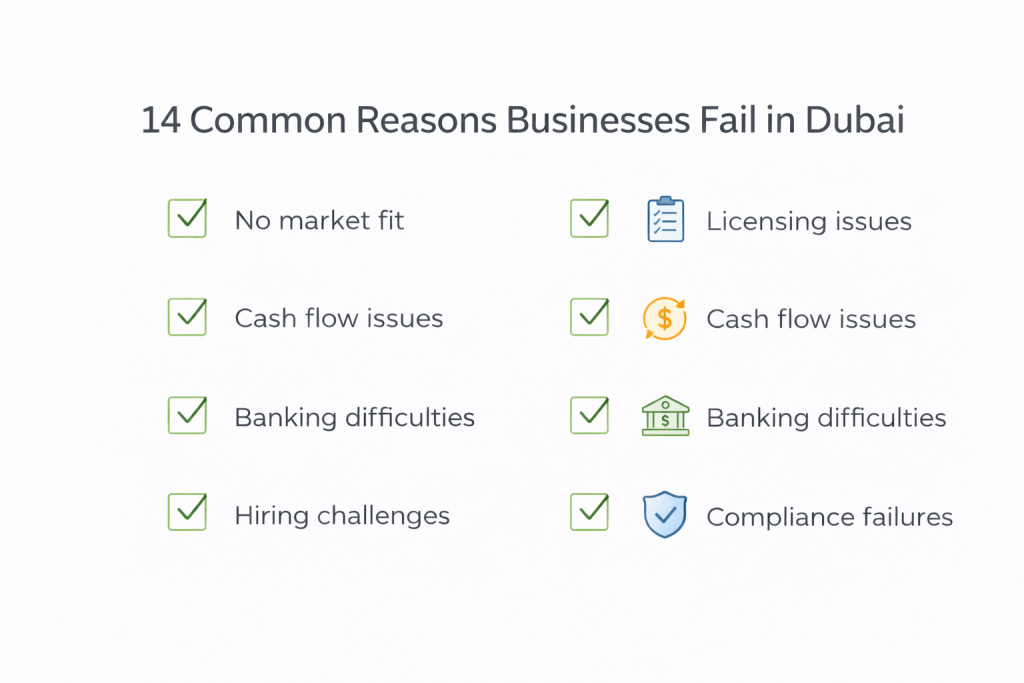
The 14 most common reasons businesses fail in Dubai
1) They launch without real market validation in Dubai
A global city doesn’t mean a universal buyer. Dubai has micro-markets: different budgets, habits, language preferences, and trust triggers across neighbourhoods and customer segments.
Common Dubai business mistakes:
- Assuming tourists = customers for your concept year-round
- Assuming online demand = local demand
- Copying a business model from another country without adapting it to Dubai’s buying behaviour
Do this instead
- Validate with paid signals, not opinions: small ad tests, pre-orders, pilot contracts, or paid consultations
- Define your “Dubai ideal customer” in one sentence (role + problem + urgency + budget)
- Build a competitor map: who wins on price, who wins on trust, who wins on speed — then choose your lane
2) They pick the wrong jurisdiction (free zone vs mainland) for how they’ll actually trade
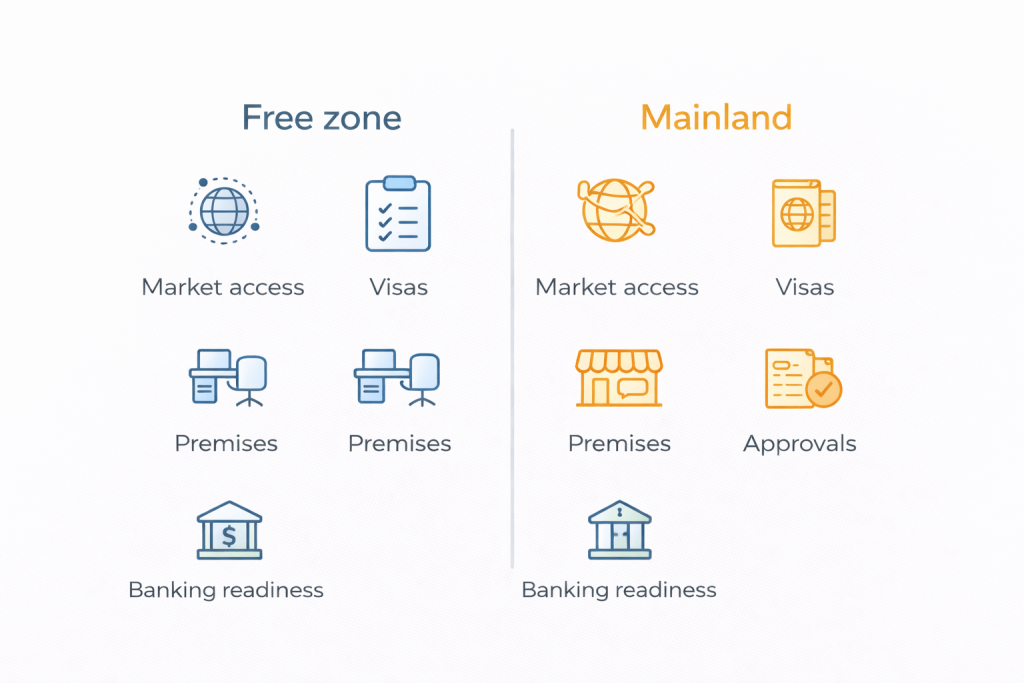
This is one of the biggest Dubai startup failure reasons: the setup looks cheaper or faster, but it doesn’t match the commercial reality.
Typical mismatch scenarios:
- A founder needs to sell directly across the UAE but sets up in a structure that adds friction
- A business needs staff visas quickly but underestimates processing steps and dependencies
- A company chooses a licence that restricts activities, then tries to operate outside scope
Do this instead
- Start with the question: “Where will revenue come from in the next 90 days?”
- Match the jurisdiction and licence to the revenue path (not just the headline package price)
- Decide your model: direct-to-consumer, B2B contracts, marketplace, distributors, onsite services — then structure for that
3) They choose the wrong licence activity (or too many) and get stuck in approvals
Dubai is structured around licensed activities. The wrong activity can cause:
- Delays
- Extra approvals you didn’t budget for
- Difficulty opening a bank account
- Problems renewing the licence or adding visas
Do this instead
- Choose activities based on what you will actually invoice for
- Keep it tight at launch: start with what you’ll sell now, then expand activities later
- Build a “compliance story”: activity → invoices → contracts → suppliers → marketing claims all match
4) They underestimate the real cost base (especially in the first 6–12 months)
Dubai is easy to enter and expensive to run if you make high-commitment choices too early.
The cost surprises that sink small business failure in Dubai:
- Office / workspace commitments
- Hiring too early
- Marketing spend without a measurable funnel
- Renewal costs (licence, visas, office, compliance, insurance)
Do this instead
- Build a Dubai runway plan:
- Runway (months) = Cash available ÷ Net monthly burn
- Aim for a buffer that survives slow months and delays
- Start asset-light where possible: flexible workspace, lean team, tight service menu
- Separate “must-have” costs from “ego” costs (fit-out, premium locations, over-staffing)
5) They run out of cash despite “good sales”

Cash flow is different from profit. Many SMEs fail in Dubai not because the offer is bad — but because cash timing is wrong.
Examples:
- B2B clients pay late but you pay suppliers and staff on time
- You invest in inventory without proven sell-through
- You price correctly for the market but not for your true delivery cost
Do this instead
- Build a weekly cash dashboard (not monthly)
- Set payment terms that protect you: deposits, milestone payments, short invoicing cycles
- Price with a delivery margin, not just a market margin
Definition: Working capital is the cash buffer that keeps your operations alive while invoices, inventory, and payroll move at different speeds.
6) They rely on “visibility” instead of a sales engine
Dubai is competitive. If you don’t build consistent lead flow, you end up discounting, chasing, and burning out.
Dubai business challenges that show up fast:
- Great brand, no pipeline
- Great pipeline, weak follow-up
- Lots of leads, no conversion system
- Founder does all sales with no process
Do this instead
- Choose one primary acquisition path for 90 days:
- B2B outreach + partnerships
- Paid ads + landing page
- Marketplace model
- Referral engine with documented offers
- Install a simple CRM discipline: response times, follow-ups, and proposal templates
- Track just four numbers weekly: leads, booked calls, proposals, closed deals
7) They build an offer that is too broad
Generalists struggle in Dubai unless they have major capital or exceptional distribution.
Common “too broad” symptoms:
- “We do everything”
- No clear niche or price anchor
- The business depends on the founder’s personal hustle
Do this instead
- Narrow the offer until it’s easy to buy:
- One customer type
- One urgent problem
- One clear outcome
- One obvious next step
- Create a signature package that removes decision fatigue
- Make your proof visible: before/after, turnaround times, client outcomes, case snapshots
8) They can’t open a business bank account smoothly (or they leave it too late)

Banking is a common friction point, especially for:
- First-time founders
- Certain activity types
- Businesses without clear documentation trails
- Companies with messy ownership or unclear source of funds
This doesn’t mean you can’t succeed — it means you must prepare properly.
Do this instead
- Build your “bank file” early:
- clear ownership structure
- contracts or pipeline evidence
- invoices or projected cash flow logic
- supplier list and operational plan
- source of funds documentation
- Align your activity, website, marketing claims, and documentation so they tell the same story
9) They misunderstand visas, hiring, and HR compliance
Hiring is not just recruitment — it’s process, policy, and compliance. Delays and missteps here can block growth.
Common Dubai SME mistakes:
- Hiring before roles are defined
- Underestimating visa timelines and document dependencies
- Weak HR systems: contracts, onboarding, payroll discipline
Do this instead
- Hire for revenue and delivery first (sales, operations, client service)
- Build role clarity: responsibilities, targets, reporting lines
- Use a structured HR and PRO process so renewals, payroll, and records stay clean
10) They ignore tax and reporting until it becomes urgent
Dubai is business-friendly — but it is not “no admin”.
Founders get caught when:
- they don’t know when VAT registration applies
- corporate tax obligations are misunderstood
- they don’t maintain clean bookkeeping from day one
Do this instead
- Treat compliance like a calendar, not a panic:
- bookkeeping cadence (weekly/monthly)
- document storage discipline
- clear responsibilities for filings and renewals
- If your revenue is scaling, get advice early — retroactive fixes are always more painful
11) They underinvest in operations and customer experience
In Dubai, expectations are high. Customers compare you to the best.
Failure patterns:
- Slow response times
- Inconsistent delivery
- No quality control
- No clear complaints handling
Do this instead
- Define service standards and response times
- Create checklists for delivery and quality
- Build a simple escalation pathway for issues
- Measure retention and repeat business — it’s the cheapest growth lever
12) They choose a “bad fit” location or channel for the business model
A premium location can destroy a business if footfall doesn’t translate into paid demand.
Do this instead
- Choose location based on demand mechanics:
- If you’re appointment-based, you don’t need premium footfall
- If you’re delivery-first, prioritise logistics and cost control
- If you’re retail, measure real footfall and conversion economics
- Start with the cheapest channel that proves demand, then scale distribution
13) Partnerships break because roles and money weren’t defined
Partnerships can accelerate growth — or end it.
Common reasons partnerships collapse:
- unclear decision rights
- unequal workload
- no written agreement on profit distribution, exit, or disputes
Do this instead
- Define roles, voting, responsibilities, capital contributions, and exit rules upfront
- Agree what happens if one partner leaves, stops working, or wants to sell
- Keep governance clean and documented
14) They scale too early (team, rent, inventory, product range)
Dubai rewards speed — but scaling before product-market fit is expensive.
Do this instead
- Scale in this order:
- predictable lead flow
- repeatable conversion
- consistent delivery
- then hire and expand
- Add complexity only when the core engine is stable
A practical “Dubai failure-proof” launch checklist (30-day version)
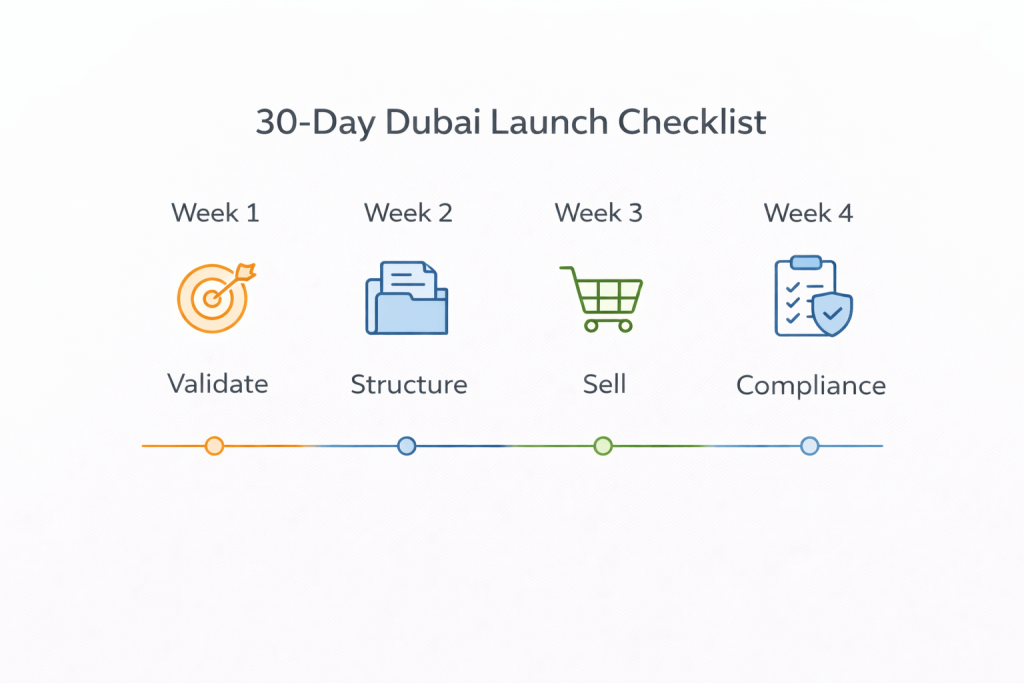
Week 1: Validate demand and pricing
- Define one clear customer segment
- Run a small test: paid ads, outreach, pilot offers
- Confirm what people buy, not what they “like”
Week 2: Structure the business correctly
- Choose jurisdiction based on revenue path
- Select licence activity based on what you’ll invoice for
- Map visas and timelines realistically
Week 3: Build the sales engine
- One primary acquisition channel
- One landing page / proposal template
- One follow-up system
Week 4: Make it bankable and compliant
- Prepare a clean documentation file
- Set up bookkeeping from day one
- Build a renewal and filing calendar
If you want this checklist turned into a step-by-step plan for your exact case, First Elite Global can map your structure, licence, visas, and banking preparation in a single consultation — then deliver an itemised roadmap you can execute with confidence.
Early warning signs your Dubai business is drifting towards failure
If you recognise two or more of these, fix them immediately:
- You don’t know your monthly burn rate
- Sales depend entirely on the founder’s daily hustle
- You discount to close deals
- You have leads but slow follow-up
- Your licence activities don’t match your actual operations
- Bookkeeping is behind and records are scattered
- Renewals and compliance tasks are handled last-minute
- You’re expanding your offer because the core offer isn’t converting
What “success” looks like for SMEs in Dubai
The businesses that last tend to do the boring things exceptionally well:
- They pick the right structure and activity from day one
- They protect cash flow with smart payment terms
- They build a repeatable sales process
- They keep compliance clean and predictable
- They stay lean until the engine proves itself
“First Elite Global made our Dubai free zone setup surprisingly straightforward. Everything from licence to visas and bank account was handled with professionalism and clear updates.”
Frequently Asked Questions
Why do businesses fail in Dubai even when demand seems high?
Because demand is fragmented. Many founders don’t validate the right customer segment, price point, and channel — or they build a cost base that assumes instant traction.
What is the most common Dubai startup failure reason?
Mismatch: the wrong setup and licence for how the business actually earns money, combined with weak cash flow control in the first 6–12 months.
Do small businesses fail in Dubai more because of rent and overheads?
Often, yes. Overcommitting to premises, staffing, and marketing before proving repeatable sales is a major reason small business failure in Dubai happens quickly.
How can I avoid Dubai business mistakes when setting up a company?
Start with your revenue path, then choose the jurisdiction and licence activity that match it. Build a runway plan, prepare for banking early, and install basic compliance discipline from day one.
Why do SMEs fail in Dubai after the first year?
The first year is often “launch energy”. The second year exposes operational reality: renewals, compliance, cash cycles, staffing needs, and whether the sales engine is truly repeatable.
Is free zone or mainland safer to avoid business failure reasons in Dubai?
Neither is “safer” by default. The safer choice is the one that matches your target customers, trading model, staffing plan, and banking readiness.
Helpful Links
- Dubai business licensing (DET) — https://www.dubaidet.gov.ae/en/licences-and-permits/business-licensing
- Invest in Dubai (official portal) — https://www.investindubai.gov.ae/en/
- UAE Corporate Tax (Ministry of Finance) — https://mof.gov.ae/en/public-finance/tax/corporate-tax/
- Corporate Tax general guide (FTA PDF) — https://tax.gov.ae/DataFolder/Files/Guides/CT/CT%20General%20Guide%20-%20EN%20-%2010%2009%202023.pdf
- VAT registration threshold (Federal Tax Authority) — https://tax.gov.ae/en/taxes/Vat/vat.topics/registration.for.vat.aspx
- Small Business Relief (FTA) — https://tax.gov.ae/en/taxes/corporate.tax/corporate.tax.topics/small.business.relief.23.aspx (FTA UAE)
- Economic Substance update (Ministry of Finance) — https://mof.gov.ae/en/news/ministry-of-finance-announces-amendment-to-cabinet-decision-on-economic-substance-requirements/
- Wage Protection System (MOHRE) — https://mohre.gov.ae/en/media-center/news/1/3/2022/mohre-wages-must-be-paid-on-time-through-the-wage-protection-system