
If you’re searching for international free zone authority IFZA, you’re likely trying to answer one question: Is IFZA the right Dubai free zone for my business and budget? This guide breaks down IFZA overview, IFZA setup, and IFZA licence options in plain English, with practical examples, decision frameworks, and a checklist you can use before you pay a dirham.
You’ll learn:
- What IFZA is and who it suits best
- How IFZA licences work (Professional, Commercial, Branch)
- How visas, office solutions, and business activities affect your total cost
- The setup path from idea → licence → banking → first invoice
- Common mistakes that cause delays, compliance problems, or bank rejections
IFZA in one minute
IFZA (International Free Zone Authority) is a Dubai free zone designed to help founders and SMEs set up efficiently with flexible activity options and scalable packages (including the ability to start with zero visas and add visas later).
What founders usually like about IFZA:
- 100% ownership (free zone structure)
- Option to incorporate remotely, with digital document submission in many cases
- Flexible activity combinations under one licence (where permitted)
- Office solutions that can stay lean early, then scale as you grow
What founders misunderstand about IFZA:
- “Cheapest” isn’t always cheapest after visas, office upgrades, approvals, and banking realities
- Picking the wrong activity can block banking, payment gateways, or operations
- “Trading” and “selling in the UAE” can involve extra steps depending on your model
Is IFZA right for you? A fast fit test
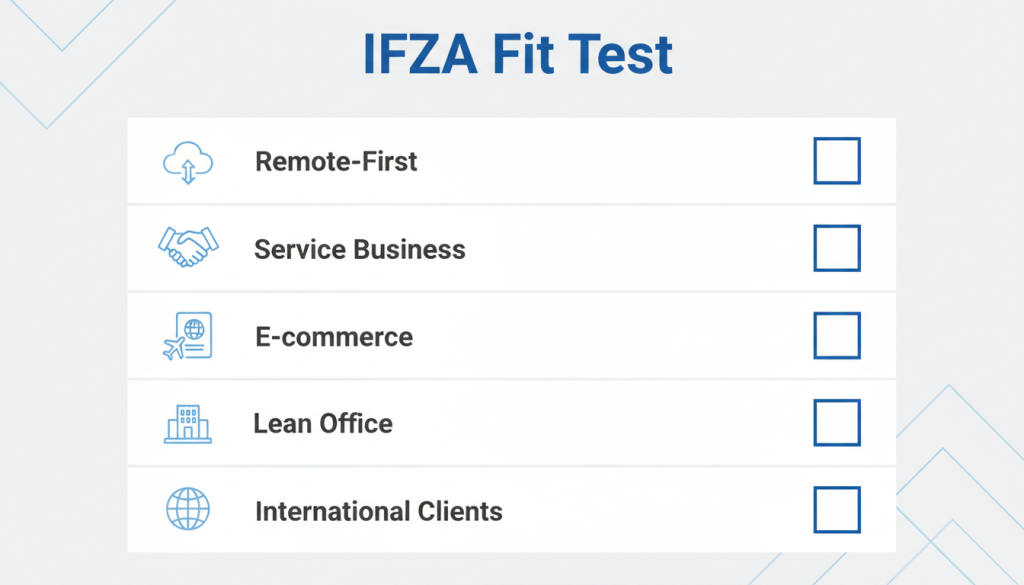
Use this quick scorecard. If you tick 4+, IFZA is often a strong contender.
IFZA is often a good fit if you:
- Want a Dubai base but expect most clients/customers to be international
- Run a service business (consulting, marketing, IT, project work) or light trading/e-commerce
- Want a lean start (minimal office costs) and plan to scale later
- Want the option to start without visas and add them when cashflow supports it
- Value speed and a straightforward setup path over “prestige-address” positioning
IFZA may not be the best first choice if you:
- Need a highly regulated activity that triggers multiple external approvals
- Require heavy warehousing/industrial operations from day one
- Will do most revenue onshore across the UAE with frequent local contracting needs
- Need a niche free zone ecosystem (industry-specific clusters) that IFZA doesn’t focus on
Practical takeaway: IFZA is usually strongest for SMEs that want speed, flexibility, and controlled costs—especially in service, tech, digital, trading, and e-commerce models.
IFZA overview: how licences work (and why the wording matters)
When people say “IFZA licence,” they often mean three separate choices that shape your setup:
- Licence type (what category you operate under)
- Business activities (your permitted scope)
- Package / visa quota / office solution (your operational footprint)
Get these aligned and everything becomes simpler: approvals, banking, invoicing, visas, renewals, and compliance.
IFZA licence types explained
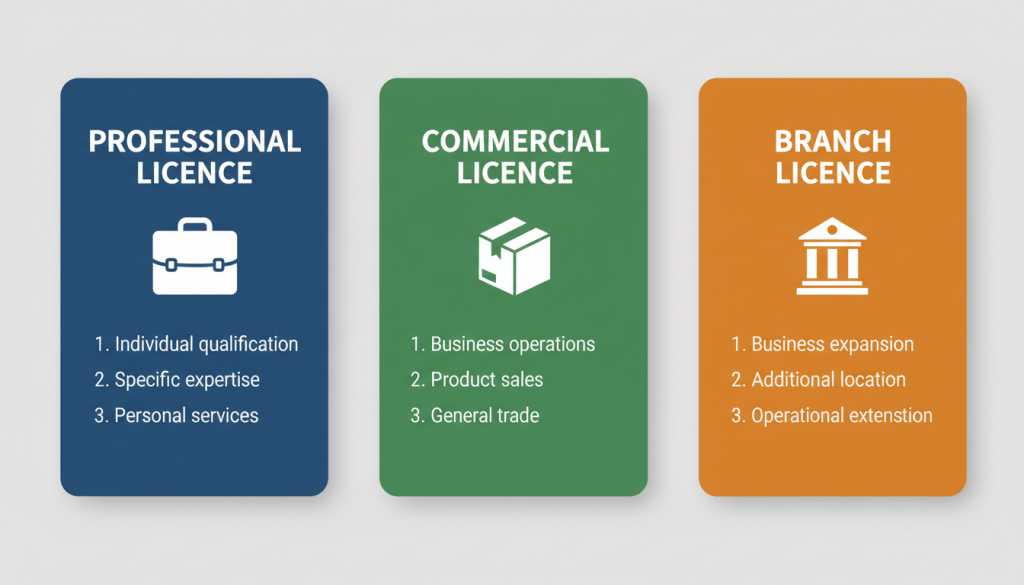
1) Professional Licence (services & expertise)
Best for businesses that primarily provide services rather than buy/sell goods.
Common examples:
- Management consultancy, marketing, design, software development
- IT services, training, coaching, project management
- Many “remote-first” agencies and freelancers scaling into companies
Why founders choose it: It’s often the cleanest fit for service invoices, contracts, and bank narratives.
2) Commercial Licence (trading, e-commerce, import/export)
Designed for businesses involved in trading goods and certain commercial operations.
Common examples:
- General trading (where permitted), product trading, import/export
- E-commerce selling (with the right activity selection)
- Wholesale models and cross-border distribution
Important nuance: If your business model includes selling into the UAE market, make sure you understand the practical route your model requires (for example, distribution arrangements, approvals, or other compliant pathways depending on the goods and sales channel). The licence is the starting point—your operating method matters.
3) Branch (for existing foreign companies)
If you already have a company abroad and want a UAE presence without a brand-new entity, a branch registration can be an option in some scenarios.
This route is typically used when:
- You want continuity of the existing brand/entity
- You need a UAE operating presence tied to the parent company
- Your banking and contracting strategy benefits from a branch structure
IFZA business activities: the make-or-break decision most people rush
IFZA offers a broad menu of business activities. In practice, your activity selection impacts:
- Whether your licence is approved quickly
- Whether you can open a corporate bank account smoothly
- Whether payment providers and marketplaces accept your company profile
- Whether you’ll need extra approvals (and how long they take)
A simple way to choose the right activities
Instead of asking “What activity sounds close?”, answer these:
- What will you invoice for? (exact service or product category)
- Where is the customer located? (UAE vs international)
- How will you deliver? (online, onsite, import/export, platform sales)
- Do you touch regulated areas? (finance, education, healthcare, food, etc.)
- Do you need visas now or later? (affects package choices and timing)
Regulated activities: don’t guess
Some activities need external approvals. If you pick a regulated activity without planning the approvals, you can lose weeks (and sometimes have to rework your licence).
Rule of thumb: If your business touches sensitive sectors, controlled products, or public-facing regulated services, treat activity selection as a professional step—not a formality.
Office options at IFZA: keep it lean, stay bank-ready
Office solutions influence cost, visa quota options, and sometimes how banks view “substance.”
A smart approach is staged:
- Stage 1: Lean office solution while validating demand
- Stage 2: Upgrade to dedicated space when headcount or client expectations justify it
- Stage 3: Add meeting room usage and visible operations as banking and contracts scale
What founders miss: Some banks and payment providers respond better when your company profile looks operationally coherent (clear activity, clear contracts, coherent web presence, and a realistic office arrangement for your model).
IFZA setup: step-by-step timeline (from idea to active licence)
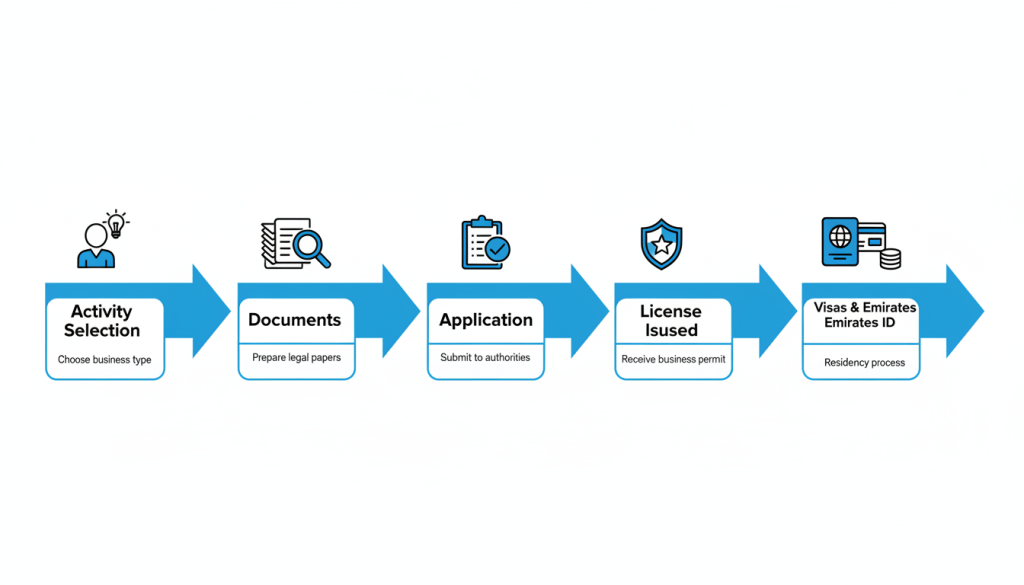
Here’s the setup path most founders follow:
Step 1: Clarify structure and activity map
- Confirm your licence type and activity selection
- Align shareholder/director details
- Decide whether you need visas now or later
Step 2: Prepare your documents (fast-track your approval)
Typically needed for most SME setups:
- Passport copy (shareholders/directors)
- Proof of address
- Basic company details and activity plan
- Additional documentation if your profile triggers compliance checks
Step 3: Submit application and issue your IFZA licence
In straightforward cases, the licence stage can be efficient once the file is complete and consistent.
Step 4: Immigration file + visas (only if you need residency)
If you’re applying for investor/employee visas:
- Entry permit step
- Medical fitness test
- Emirates ID biometrics
- Visa stamping and finalisation
Remote-first reality: Many founders incorporate remotely, then travel later only when visas or biometrics are required.
Costs: what you should budget for (and why quotes vary)
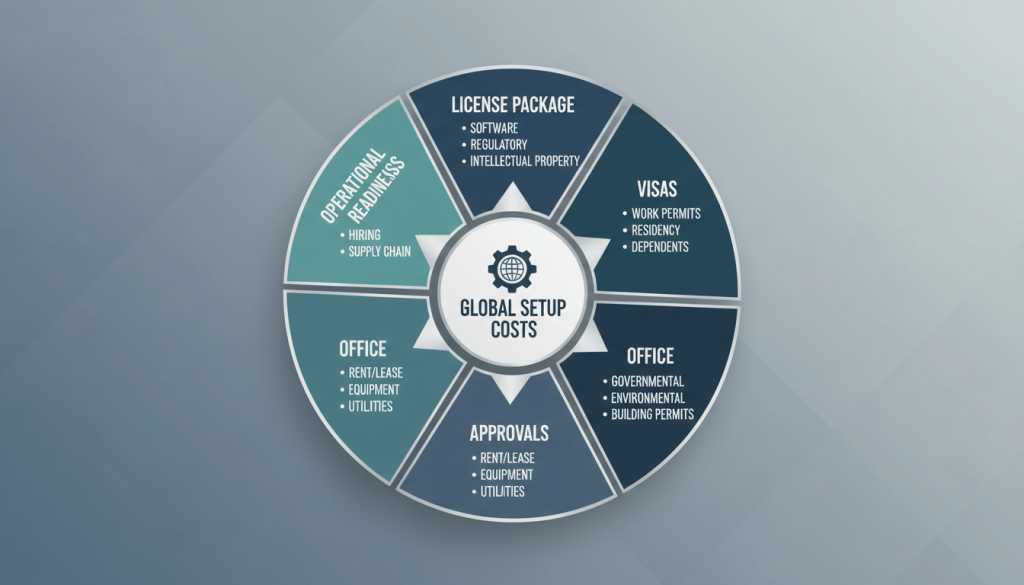
IFZA costs can look “simple” until you see the full picture. Use this breakdown to compare proposals properly.
The core cost buckets
- Licence + registration package (varies by quota/package)
- Visa-related costs (per person, plus medical/ID steps)
- Office solution / upgrades (flexi vs dedicated vs private)
- Activity or approval add-ons (regulated areas, extra permissions)
- Operational readiness (banking support, compliance alignment, document preparation)
Planning benchmarks (useful for comparing proposals)
Across the market, you’ll often see widely quoted starting points for IFZA packages—especially 0-visa and 1–4 visa quota options—but inclusions can differ materially.
Use this rule:
If two proposals have the same headline price, the cheaper one is often missing immigration file steps, establishment card handling, office inclusions, or support that you’ll pay for later.
The “true cost” question to ask
Before you proceed, get a written breakdown of:
- What is included in year 1 (and what isn’t)
- Which government fees are included vs excluded
- Visa processing inclusions and number of visas allowed
- Office solution type and whether upgrades are required later
- Renewals and any recurring items
Banking in the UAE: how to avoid the #1 post-licence bottleneck
Getting your licence is step one. Operating smoothly is step two—and banking is where many founders get stuck.
Why banks reject or delay new companies
Usually it’s not “random.” It’s one of these:
- Activity doesn’t match the business story or contracts
- Source of funds / source of income isn’t clearly documented
- Website, invoices, and documentation look inconsistent
- The business model touches higher-risk geographies or sectors
- The file lacks a clean compliance narrative
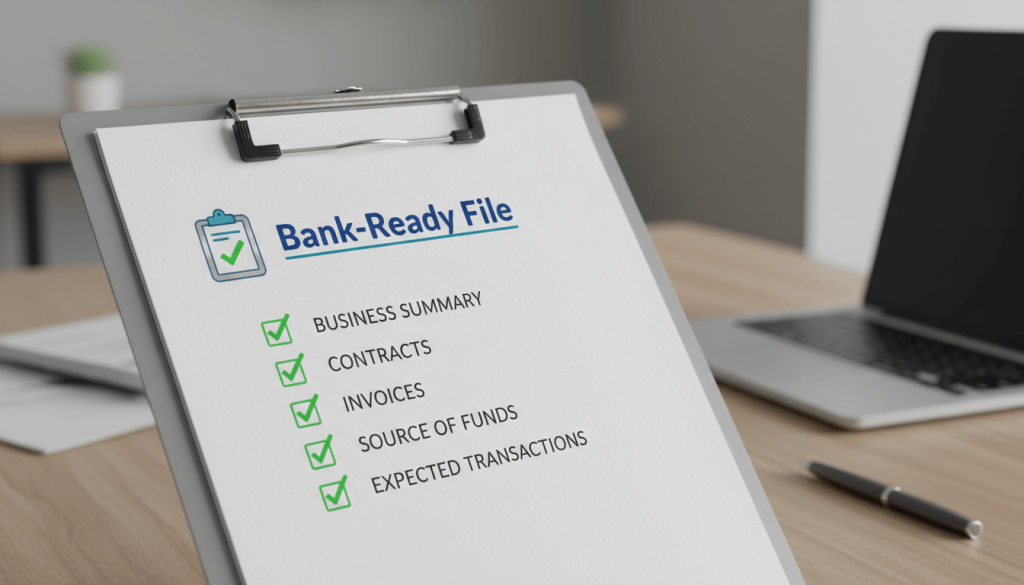
A bank-ready checklist you can use today
Before you apply, prepare:
- A 1-page business summary (what you do, who you sell to, how money flows)
- Sample client contract or proposal (even if early-stage)
- Basic invoices/POs (if you have trading history)
- Website or company profile deck consistent with your licence activities
- Proof of address and a clear shareholder CV/business background
- A realistic first-year revenue expectation and transaction pattern
Founder insight: Your bank application is not just a form—it’s a story. If the story and the licence don’t match perfectly, expect delays.
Compliance in 2026: what an IFZA company must plan for
Most founders don’t fail because of licensing. They fail because they ignore compliance until it becomes urgent.
Corporate tax (UAE)
The UAE corporate tax framework applies to businesses based on taxable income tiers, and small businesses may have relief options under certain conditions.
What to do early:
- Maintain clean bookkeeping from day one
- Separate personal and business transactions
- Understand whether your revenue is local vs international and how that affects your setup strategy
- Ask for a compliance roadmap alongside your licence proposal
VAT (Value Added Tax)
VAT registration becomes relevant when taxable supplies cross the mandatory threshold, and businesses can also register voluntarily under certain conditions.
Practical setup tip: Even if you’re below thresholds, set up invoicing and accounting properly so you can scale without scrambling later.
Ongoing obligations (often overlooked)
- Licence renewals (on time, every time)
- Updates to shareholders/activities when your business evolves
- UBO declarations where applicable
- Economic substance expectations depending on your activity profile
IFZA vs other Dubai and UAE options: a founder-first comparison
Here’s a realistic way to compare:
Choose IFZA when you want:
- A flexible, SME-friendly free zone structure
- An efficient setup path and scalable visa options
- A lean start without committing to heavy office overhead early
Consider alternatives when you need:
- A sector-specific ecosystem (e.g., specialised clusters)
- A premium “brand signal” address that matters for your industry
- Heavy logistics/industrial footprint from day one
- A structure designed primarily for onshore contracting across the UAE
Best practice: Compare jurisdictions against your business model, not general marketing claims.
Common IFZA setup mistakes (and how to avoid them)
Mistake 1: Choosing activities “close enough”
Fix: Match activities to what you will actually invoice for. This protects banking and reduces compliance risk.
Mistake 2: Underestimating visa and operational steps
Fix: Start with a full journey plan: licence → immigration file → visas → Emirates ID → banking.
Mistake 3: Assuming the lowest quote is the best deal
Fix: Compare itemised inclusions and year-2 renewal expectations.
Mistake 4: Building a company the bank can’t understand
Fix: Align your website, contracts, invoices, and business narrative with your licence activities.
Mistake 5: Treating compliance as “later”
Fix: Set up bookkeeping and a compliance calendar immediately after licence issuance.
A practical example: what an IFZA setup can look like (3 common founder profiles)
Profile A: Solo consultant (no visa first)
- Professional licence aligned to consulting activity
- Lean office solution
- Banking file prepared with portfolio, proposals, and a clean service narrative
- Add visa later once revenue stabilises
Profile B: E-commerce founder (one visa + payment gateways)
- Commercial licence aligned to e-commerce activity
- Clear supplier documentation + product categories
- Payment provider readiness (site, policies, fulfilment plan)
- Bank-ready transaction expectations prepared upfront
Profile C: Small trading team (2–3 visas, expansion plan)
- Commercial licence with tightly mapped trading activities
- Import/export clarity and documentation flow
- Office solution staged: start lean, upgrade when headcount grows
- Compliance plan built around scaling and renewals
Getting your IFZA company live without delays
If you want an IFZA setup that works beyond just licence issuance, you need three things:
- Correct activity and licence alignment
- A clean, bank-ready documentation story
- A staged cost plan that anticipates visas, renewals, and growth
That’s exactly how First Elite Global supports founders—so you don’t just “open a company,” you build an operating business in Dubai with fewer surprises.
Frequently Asked Questions
1) What is international free zone authority IFZA in Dubai?
International Free Zone Authority (IFZA) is a Dubai free zone that enables entrepreneurs and SMEs to set up a company with flexible licence options, scalable visa packages, and a streamlined incorporation process.
2) Which IFZA licence is best: Professional or Commercial?
Choose an IFZA Professional Licence if you primarily provide services (consulting, IT, marketing, etc.). Choose an IFZA Commercial Licence if you trade goods, import/export, or operate e-commerce activities. The right answer depends on what you invoice for and how you deliver.
3) Can I do IFZA setup remotely?
Many founders can complete IFZA setup remotely for incorporation steps. If you later apply for UAE residency visas, you should expect to visit the UAE for medical fitness and Emirates ID biometrics.
4) How much does an IFZA licence cost?
IFZA licence costs vary by package, visa quota, office solution, and activity/approval requirements. Always compare proposals based on inclusions (licence, registration, immigration file steps, office, and support) rather than headline price alone.
5) Can an IFZA company open a corporate bank account in the UAE?
Yes, but approval depends on the strength of your compliance file: clear business activity alignment, credible contracts/invoices, consistent company profile, and transparent source of funds/income documentation.
6) Is IFZA a good option for startups?
IFZA is often a strong option for startups that want a lean setup, flexible activity combinations, and the ability to scale visas and office space over time—especially for service, tech, e-commerce, and SME trading models.