

Registering a business in Dubai is not a single form or payment. It is a connected set of decisions and authority submissions that establishes the company, defines what it is permitted to do and results in the relevant commercial licence and formation records.
To register or start a company in Dubai, define the commercial activity, choose a suitable mainland or free-zone authority, select the legal form, reserve the trade name, obtain any required approvals, prepare the company and premises documents, and complete the licence application. Visas, immigration records, banking and tax work are normally separate post-licence workstreams.
What business registration in Dubai actually includes
The exact documents and terminology differ between licensing authorities, but the formation stage commonly covers:
- approval of the proposed business activity or activities;
- selection of the legal form and ownership structure;
- reservation or approval of the trade name;
- initial or preliminary approval where required;
- preparation or execution of constitutional documents where applicable;
- evidence of an eligible business address, facility or workspace where required; and
- issuance of the commercial licence and related formation records.
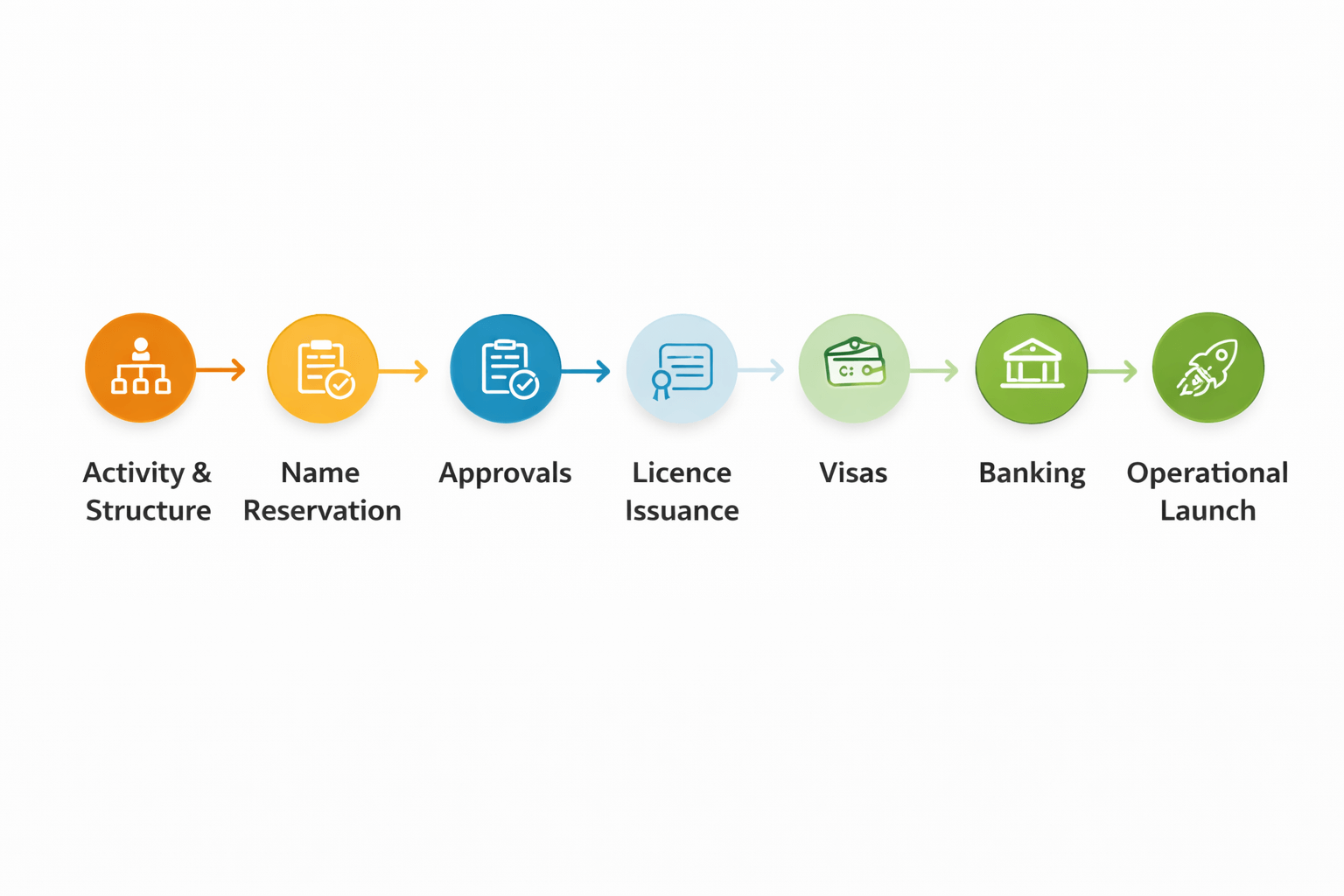
That licence establishes the company, but it does not automatically complete every task required to operate it. Immigration and labour records, residence visas, a corporate bank-account application, accounting systems, tax registrations and sector-specific operating approvals may follow.
If you have moved from general research to planning a specific application, see First Elite Global’s Dubai company-registration support.
Choose the right registration route
The useful comparison is not simply “mainland versus free zone.” It is whether the proposed authority, activities and legal form support the company’s real customers, premises, staffing, visa and compliance needs.

| Route | Often considered when | What to confirm |
|---|---|---|
| Dubai mainland | The business requires a mainland commercial presence or broad access to customers and operations in Dubai and the wider UAE. | Activity, legal form, foreign-ownership position, premises and any additional authority approvals. |
| Dubai or UAE free zone | The activity, customer model, workspace and visa requirements fit a particular zone’s rules and facilities. | Permitted activities, facility and visa package, renewal conditions, and the permissions required for any mainland operations. |
| UAE offshore company | The purpose is permitted holding, ownership, asset-related or international structuring rather than ordinary day-to-day UAE trading. | The offshore jurisdiction’s permitted purposes, registered-agent requirements, substance, banking and tax implications. |
A free-zone company is not automatically restricted to international customers, and a mainland company is not automatically the right answer for every UAE-facing business. The permitted route depends on the licensed activity and the rules, permits or additional licences applicable to the intended operation.
For a closer commercial comparison, review the dedicated guides to Dubai mainland company formation and Dubai free-zone company formation.
How to start a company in Dubai: business registration step by step
The exact order varies by activity, legal form and authority. The following sequence is a practical planning framework rather than a universal filing checklist.
-
Define the business activity
Describe precisely what the company will sell, deliver, import, manufacture, manage or provide. The activity influences the licence category, available authorities, external approvals and the transactions the business can legitimately carry out.
-
Choose the licensing authority and jurisdiction
Compare relevant mainland and free-zone routes against the operating brief. Consider customers, trading geography, premises, visas, sector rules, banking preparation and annual renewal obligations.
-
Select the legal form
Confirm whether the business will have one or several owners, whether any owner is another company, who will manage and sign for it, and whether a branch or new legal entity is the suitable structure.
-
Choose and reserve the trade name
Prepare several name options. The name must follow the selected authority’s rules, avoid restricted or misleading language, and use any legal-form suffix required for the structure.
-
Obtain initial and external approvals
Some applications require initial approval before later formation steps. Regulated or specialist activities may also require approval from a sector authority before the commercial licence can be issued or the business can begin operating.
-
Prepare the formation documents
The file may include shareholder and manager identification, constitutional documents, resolutions, ownership records and legalised or translated corporate documents. The correct pack depends on the legal form and shareholder type.
-
Meet premises or workspace requirements
Confirm whether the activity requires a mainland lease, registered tenancy, zone facility, flexi-desk, office, shop, warehouse or specialist premises. Workspace can affect both licensing and visa capacity.
-
Submit the final application and pay the applicable fees
Once the authority has the required approvals, documents and premises evidence, complete the final submission. Review the payment schedule carefully so authority charges, third-party costs, facilities and professional fees are clearly separated.
-
Receive and check the licence documents
Check the legal name, licence number, activities, owners, manager, issue and expiry details. Report any inconsistency immediately rather than allowing it to affect contracts, banking or later government records.
The UAE Government’s official guidance provides separate process information for mainland formation and free-zone formation. Always confirm the final sequence with the authority responsible for the selected licence.
Documents required for business registration
There is no single document pack for every Dubai company. Requirements change with the authority, activity, legal form, shareholder type, nationality or residency position, premises and any external regulator.
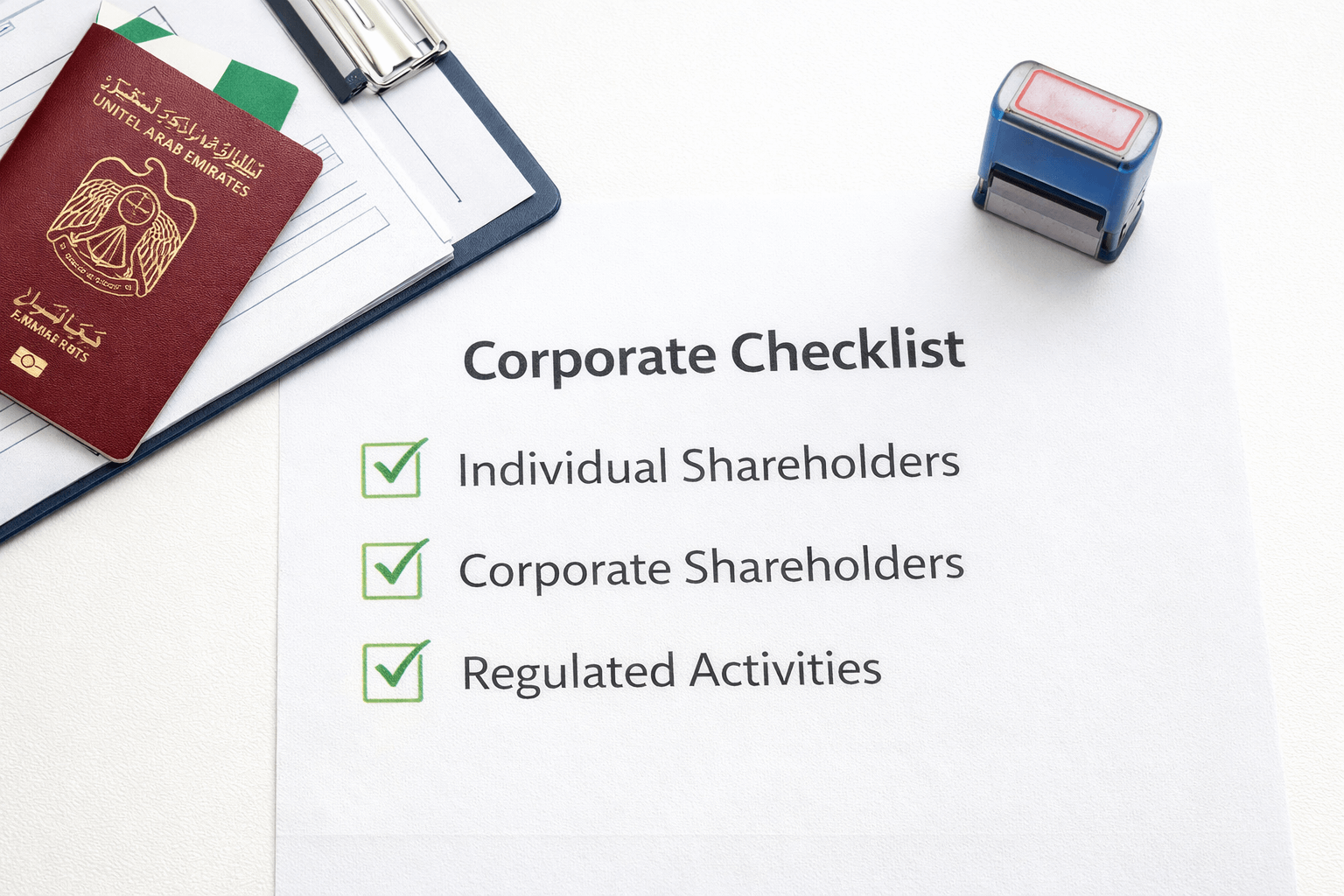
Individual shareholders
- Clear, valid passport copy
- UAE visa, entry or residency information where applicable
- Emirates ID where applicable
- Residential address and contact information
- Proposed ownership percentages
- Manager and authorised-signatory details
Corporate shareholders
- Certificate of incorporation or registration evidence
- Constitutional documents
- Ownership and beneficial-owner information
- Board or shareholder resolution
- Authorised-signatory evidence
- Legalisation, attestation or translation where required
Company and activity information
- Proposed business activities
- Several trade-name options
- Ownership and management structure
- Business plan or operating description where requested
- Professional qualifications or experience where relevant
Premises and approvals
- Lease, tenancy or workspace documentation where required
- Facility plans or approvals for relevant activities
- No-objection documents where applicable
- Sector regulator approvals
- Any authority-specific declarations or application forms
For a deeper paperwork breakdown, use the Dubai company-formation document checklist.
Business registration costs in Dubai
There is no universal registration price. The total depends on the licensing authority, legal form, activities, approvals, premises, visas, shareholder structure and the services included in the proposal.

- Authority and licence chargesTrade-name reservation, initial approval, registration, licence issuance, legal-form charges and other authority fees applicable to the file.
- Activity and regulator costsAdditional activity fees, sector approvals, inspections, permits or specialist registrations where required.
- Premises and facilitiesOffice, flexi-desk, shop, warehouse, tenancy registration, deposits and any fit-out or facility approvals.
- Shareholder documentsNotarisation, legalisation, attestation, certified translation, courier or corporate-document preparation where applicable.
- Immigration and visasEstablishment records, immigration processing, medical fitness testing, Emirates ID and visa-related charges where residency is required.
- Professional supportConsultancy, application coordination, document preparation, PRO work or other agreed services. These should be separated from government and third-party charges.
- Operational setupBanking preparation, accounting systems, tax work, insurance, customs or labour requirements depending on the business.
- Renewal and maintenanceAnnual licence and facility renewal, visa renewals, ongoing registrations, bookkeeping and compliance requirements.
The useful number is not the cheapest licence. It is the complete cost of forming, activating and maintaining the company you actually need.
What an itemised proposal should show
- the selected authority, legal form and licensed activities;
- every government or authority charge;
- workspace, tenancy or facility costs;
- the number of visas included or budgeted;
- external approvals and third-party costs;
- professional fees and their exact scope;
- what is optional or excluded; and
- the expected renewal cost categories.
Dubai’s official investment portal also explains that free-zone formation costs vary by the selected zone, licence, activity and office requirements. Treat any advertised “starting from” amount as an entry point, not as a complete quotation for your business.
How long does business registration take?
A universal completion time would be misleading. A straightforward application can progress more quickly than a file involving corporate shareholders, foreign document legalisation, specialist premises or external regulatory approvals.
Common causes of delay
- An activity description that does not match the intended business model
- A trade name that requires amendment or additional approval
- Missing, inconsistent or unclear shareholder documents
- Corporate documents that require legalisation or translation
- Premises that do not meet the activity’s requirements
- External approval from a sector regulator
- Late changes to ownership, manager, legal form or activities
Ask for two schedules: one for licence issuance and another for becoming operational. A company can be legally formed while its visas, bank-account application or sector operating approvals are still in progress.
What happens after the licence is issued?
The next steps depend on what the company needs to do. A holding structure with no staff has a different activation plan from a trading company importing goods or an employer sponsoring a team.
Establishment, immigration and employment records
If the company will sponsor owners or employees, it may need the relevant establishment, immigration and labour records before visa applications can proceed. Workspace and licence information should remain consistent across these files.
Residence visas and Emirates ID
Where residency forms part of the plan, confirm eligibility, available visa allocation and the required immigration sequence. The licence itself does not guarantee that every proposed visa will be available.
Corporate bank-account preparation
Opening a bank account is a separate bank-led due-diligence process. Banks may review ownership, signatory authority, business activities, customer and supplier geography, source of funds, expected transactions and supporting commercial evidence. Company formation does not guarantee account approval.
Read more about corporate bank-account preparation in Dubai.
Accounting, tax and commercial readiness
Set up recordkeeping, invoicing, contracts and a compliance calendar early. Depending on the business, further work may include corporate tax, VAT, customs, payroll, beneficial-owner records, insurance or sector-specific registrations.
Common registration mistakes to avoid
Choosing the lowest headline price
A low entry fee is not good value if the route lacks the activity, workspace, visa eligibility or operating permissions the company requires. Compare complete first-year and renewal costs.
Using an activity that is too broad or too narrow
The licensed activity should reflect the work the company will actually invoice. Check whether several revenue streams require additional activities or regulatory approval.
Treating free zone and mainland as simple opposites
Each authority and activity has its own rules. Assess the specific company route instead of relying on generic statements about ownership, local trading or office requirements.
Planning the licence without planning visas and premises
Workspace and facility choices can affect visa eligibility, inspections and future growth. Decide what the business needs before selecting a bundled package.
Assuming the bank account is automatic
A licence permits the company to conduct its approved activities; it does not require a bank to accept the account. Prepare ownership, business-model and transaction evidence from the beginning.
Ignoring annual obligations
Budget beyond formation. Licence and facility renewals, visas, accounting, tax filings and other ongoing requirements can matter as much as the initial registration cost.
Dubai business registration checklist
Before paying for a formation package, make sure you can answer the following questions:
- What will the company sell or provide?
- Where are its customers, suppliers and operations?
- Which authority permits the required activities?
- Which legal form suits the owners and management structure?
- Does the activity require an external regulator?
- What premises or workspace must the company maintain?
- How many owner and employee visas may be needed?
- Are any shareholders companies rather than individuals?
- Will foreign-issued documents require legalisation or translation?
- What is included, excluded and recurring in the cost proposal?
- Which post-licence tasks must be completed before trading?
If the answers are still unclear, resolve them before choosing the authority. This reduces the chance of buying a registration route that does not support the intended operation.
Frequently asked questions
What is the first step in registering a business in Dubai?
Define exactly what the company will do, where its customers and operations will be, who will own and manage it, and what premises and visas it may need. That operating brief helps determine the activity, authority and legal form.
Can a foreigner register a company in Dubai?
Foreign ownership is available across many mainland and free-zone structures. The exact position depends on the chosen activity, legal form, authority and any rules applying to strategic or regulated sectors.
Is mainland or free zone better for company registration?
Neither is automatically better. Mainland can suit businesses requiring a mainland commercial presence or broad UAE operations. A free-zone structure can suit companies whose activities, workspace, visa and customer model fit a particular zone. Compare the specific routes against the actual business.
How much does business registration in Dubai cost?
The total depends on the authority, activity, legal form, premises, visas, shareholder documents, external approvals and professional support. Request an itemised proposal separating authority charges, third-party expenses, workspace, visas and service fees.
Can I register a Dubai business without a physical office?
Some authorities and activities permit flexible workspace arrangements, while others require a particular office, shop, warehouse or specialist facility. Workspace can also affect visa eligibility, so confirm the requirement for the exact licence before applying.
Does registration include a corporate bank account?
No. Company registration and bank-account opening are separate processes. The bank independently reviews the company, owners, business model, source of funds and expected transactions before deciding whether to open an account.
What should I check when the licence is issued?
Check the legal name, activities, legal form, owners, manager, licence number, issue date and expiry information. Ensure these details match the approved application and the company’s intended operation.
Official references: Requirements can change by authority and activity. Confirm the final application steps using the Invest in Dubai activity search, the relevant licensing authority and the UAE Government’s business guidance before submitting.
