If you’re searching for the IFZA business activities list, you’re likely at the most important decision point in your company setup: choosing licence activities that match what you actually sell, how you deliver it, and where you trade. Get this right and your licence, banking, visas, invoices, and compliance flow smoothly. Get it wrong and you can lose weeks (and sometimes your momentum) to amendments, extra approvals, and avoidable rework.
This guide gives you a practical way to use the IFZA activity list to select the right activities the first time, bundle them intelligently, and avoid the most common traps that stop founders from getting licensed and operational quickly.
Why the IFZA Activity List Matters More Than People Think
Your business activity is not just a label. It defines your legal scope.
A simple rule to remember:
If it’s not listed on your licence, you shouldn’t be doing it under that company.
That one detail affects:
- Licence eligibility (commercial vs professional, add-ons, and amendments)
- Approval requirements (some activities trigger extra regulator approvals)
- Bank account success (banks review what you do, not just your company name)
- Payment processing (merchant accounts and gateways assess activity risk)
- Contracts and invoicing (clients often check your licence activities)
- Growth options (adding a new revenue stream later may require an amendment)
So yes, the activity selection stage deserves real attention.
What You’ll Find on the IFZA Business Activities List
IFZA’s activity database is structured around activity codes and descriptions. Practically, you’ll see:
- Activity name (the closest match to your business)
- A short description (what the activity covers and excludes)
- Whether it’s regulated (some activities require approvals)
- How it fits into licence types (professional vs commercial, etc.)
A quick definition
Licence activities: the official, approved activities printed on your IFZA trade licence. They define what your company is permitted to do.
How to Use the IFZA Activity List (Fast, Accurate, Low-Stress)

Instead of scrolling endlessly, use a simple method that mirrors how IFZA and banks think about your business.
Step 1: Write your business in one sentence
Use this format:
“We sell [X] to [Y] by delivering [Z] in [market].”
Examples:
- “We sell digital marketing services to SMEs, delivered remotely across the GCC.”
- “We sell consumer electronics, delivered via import and online resale.”
- “We sell HR advisory services to startups, delivered through consulting retainers.”
This sentence tells you whether you’re choosing service activities, trading activities, or a combination.
Step 2: Choose your primary revenue driver first
Your primary activity should reflect the main way you earn money today (not your future ideas).
Good primary activity choices:
- Your largest revenue stream
- The activity that best matches your contracts and invoices
- The activity you need for banking clarity
Step 3: Add only the activities you will genuinely use in the next 6–12 months
Extra activities can sound “future-proof,” but they can also:
- Create mismatches with banking or compliance checks
- Trigger approvals you didn’t plan for
- Increase amendment admin later if you picked the wrong ones
A clean licence that matches your real operations is usually the fastest path to getting operational.
Step 4: Keep activities logically connected
As a rule, bundle activities that share the same business logic:
- A service business can add closely related services (consulting + training + marketing)
- A trading business can add related trading lines (import/export + e-commerce + specific product trading)
- Mixed models are possible, but they must make sense commercially and operationally
Step 5: Check if your shortlist includes regulated activities
Some activities are flagged as regulated and may require approvals from relevant UAE authorities. If your shortlist touches areas like education, health, finance, insurance, investment, telecom, or other controlled sectors, plan for the approval step early.
If you want the fastest route, avoid regulated activities unless you truly need them.
IFZA Business Activities List: Popular Options by Category
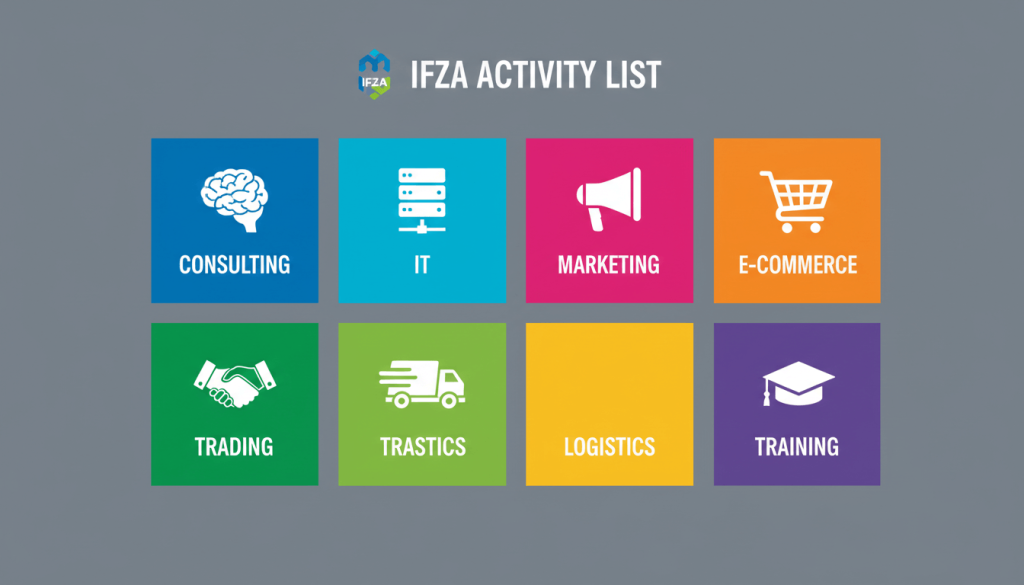
You may be looking for the full IFZA activity list in one place. The exact activity wording matters, so use the categories below to build a shortlist and then confirm the precise name, code, description and regulation status in IFZA’s official business activities database.
IFZA currently classifies activities as Non-Regulated (“Green”) or Regulated (“Amber”). Green activities do not require external approval, although property requirements can still apply. Amber activities require approval from the relevant Dubai or UAE federal entity and can also carry property requirements.
IFZA’s 2026 activity and licence mapping guidance also states that up to seven activities can be included under one licence. The first three are included in the incorporation cost, while additional activities carry an extra charge. IFZA also permits cross-business licensing, allowing compatible activities from different categories to be combined under one licence.
Below are the most commonly selected IFZA licence activities (written in plain-English category terms so you can find the closest official match quickly).
Professional Services and Consulting Activities
Typical for founders selling expertise, time, advice, or deliverables (remote-friendly).
Common activity themes include:
- Management and business consultancy
- Marketing and brand consultancy
- IT and technology consultancy
- HR and recruitment consultancy
- Operations and process advisory
- Project management services
- Training, coaching, and professional development
- Design services (branding, UX/UI, graphic design)
- Content and media services
- Events-related services (planning, management, promotion)
Best fit for: consultants, agencies, freelancers, remote-first service providers.
IT, Software, and Digital Services Activities
Common for digital products, software delivery, and technical services.
Common activity themes include:
- Software development services
- Web development and website services
- Mobile app development
- Cloud services and managed IT
- Cybersecurity-related services
- Data and analytics services
- AI/automation consulting (where permitted by activity definitions)
- SaaS operations and IT support services
Best fit for: developers, SaaS founders, IT teams, technical agencies.
Marketing, Media, and Creative Activities
Common for agencies and creators operating across multiple channels.
Common activity themes include:
- Digital marketing services
- Social media management
- Advertising and campaign services
- Branding and creative direction
- Media production services
- Photography/videography services
- PR and communications services
Best fit for: marketing agencies, media creators, creative studios.
E-Commerce and Online Selling Activities
This category is often misunderstood: “e-commerce” can cover the online selling method, while the goods you sell can require additional trading activities depending on how your licence is structured.
Common activity themes include:
- E-commerce / online selling
- Online retail operations
- Digital storefront and marketplace selling
- Import/export support (for cross-border stock movement)
Best fit for: Amazon/Shopify sellers, D2C brands, marketplace operators.
Trading, Import/Export, and Commercial Activities
Ideal when you trade physical products and may import, export, store, or distribute.
Common activity themes include:
- Import and export trading
- General trading (for broad, mixed product lines)
- Wholesale and distribution
- Specific product trading (electronics, garments, building materials, beauty products, etc.)
- Equipment trading (depending on product category)
Best fit for: traders, distributors, wholesalers, product businesses.
Logistics, Supply Chain, and Support Activities
Common as an add-on for businesses managing fulfilment or distribution.
Common activity themes include:
- Logistics support services
- Warehousing coordination (where applicable)
- Supply chain advisory
- Trading support services
Best fit for: traders scaling into fulfilment, logistics coordinators, B2B supply chain providers.
Education, Training, and Coaching Activities
Training is popular and usually straightforward, but some education-related activities can be regulated depending on the scope (especially credentialed education).
Common activity themes include:
- Professional training services
- Coaching and development services
- Corporate workshops and training delivery
Best fit for: coaches, corporate trainers, skills-based educators.
The Smart Way to Select Activities: Match What You Sell to What You Do
Use this quick matching table as a starting point when building your shortlist.
| Your business model | Primary activity direction | Add-on activity ideas (keep it tight) |
| Consultant / advisor | Business or management consultancy | Training, project management, marketing consultancy |
| Marketing agency | Marketing services / consultancy | Content services, media services, design services |
| Software / IT services | IT or software services | Web/app development, managed services, cybersecurity services |
| E-commerce seller | E-commerce activity + trading fit | Import/export, specific goods trading, general trading (if needed) |
| B2B trader | Import/export or trading | Wholesale, distribution, product-category trading |
| Coach / trainer | Training and coaching services | Consulting, workshops, program delivery |
If you want a high-confidence shortlist, the fastest path is to share your one-sentence business description and your top 3 revenue streams—then get a mapped activity set that aligns with how IFZA defines activities and how banks typically interpret them.
How Many IFZA Licence Activities Should You Choose?
Most founders do best with:
- 1 primary activity
- 1–2 secondary activities (only if you will use them soon)
This keeps your licence clean, your invoices consistent, and your banking story clear.
If you already run multiple revenue streams, a structured multi-activity plan can work well—but it should be designed, not guessed.
Regulated Activities and “Amber” Flags: What to Know Before You Apply
Some activities require approvals from additional authorities. These are often marked clearly in the activity database.
Examples of areas that commonly trigger extra approval steps:
- Financial services and investment-related activities
- Insurance and brokerage-like activities
- Education and credentialed training
- Healthcare-related activities
- Telecom and certain technology-related areas
- Other controlled or higher-risk sectors
Practical advice: If your business can operate legally without a regulated activity, you’ll usually set up faster by choosing a non-regulated alternative that still matches your real work.
Common Activity Selection Mistakes (And How to Avoid Them)

Mistake 1: Choosing an activity that sounds impressive but doesn’t match invoices
Banks and counterparties compare your contracts and invoices to your licence.
Fix: Choose the activity that best matches what you bill for.
Mistake 2: Overloading the licence “just in case”
Extra activities can complicate approvals, banking, and compliance.
Fix: Select only what you’ll use in the next 6–12 months.
Mistake 3: Picking e-commerce without matching the goods/trading logic
Selling online is the method; the goods can still matter.
Fix: Align e-commerce with the right trading scope.
Mistake 4: Accidentally selecting a regulated activity
This can introduce approvals you didn’t plan for.
Fix: Identify regulated flags early and plan accordingly.
Mistake 5: Mixing unrelated activities
A scattered activity mix can slow processing and raise questions.
Fix: Keep activities commercially connected and easy to explain.
Real-World Activity Bundles That Usually Work Well

These are practical combinations founders commonly use (exact activity names vary, so match them precisely in the IFZA activity list):
Bundle A: Remote Consulting + Training
- Consultancy (primary)
- Training/coaching (secondary)
- Project management services (optional)
Bundle B: Digital Agency
- Marketing services (primary)
- Content/media services (secondary)
- Design services (secondary)
Bundle C: IT + Software Delivery
- IT/software services (primary)
- Web/app development (secondary)
- Managed services/support (secondary)
Bundle D: E-Commerce Seller (Cross-Border)
- E-commerce activity (primary)
- Import/export trading (secondary)
- Trading activity aligned to your product category (secondary)
Bundle E: General Trading with Expansion Room
- General trading (primary)
- Import/export trading (secondary)
- Wholesale/distribution (secondary)
If you’d like, First Elite Global’s IFZA company formation service can help map your proposed activities to the appropriate licence route and flag regulated approval requirements before submission. For the wider jurisdiction, costs, visas and operating considerations, see the IFZA UAE guide.
What Happens If You Need to Change Activities Later?
Most founders evolve. That’s normal.
If your business model changes, you can typically:
- Add activities to expand scope
- Remove activities to simplify scope
- Amend an activity if your original selection was too narrow
The best time to plan for this is before you apply—so your initial licence covers the work you’ll do immediately, while keeping future amendments minimal.
A Simple “Activity Selection Checklist” You Can Use Today

Before you finalise your IFZA licence activities, confirm:
- Your primary activity matches your invoices.
- Your secondary activities match real near-term services or sales.
- Nothing important is missing (especially if you have multiple revenue streams).
- You’re not accidentally selecting a regulated activity unless you’re ready for approvals.
- Your business description is easy to explain in one sentence.
- Your trading method is aligned (online vs physical, import/export, local vs international).
If you want the fastest, lowest-risk setup, the next step is simple: book a free consultation with First Elite Global and get a personalised activity shortlist built around your business model.
Frequently Asked Questions
1) Where can I find the official IFZA business activities list?
The official IFZA business activities list is available through IFZA’s searchable activity database. Use it to match the exact activity wording and description to your business model before you apply.
2) How do I choose the right IFZA licence activities for my company?
Start with your primary revenue stream, pick one main activity that matches your invoices, then add only 1–2 related secondary activities you’ll use within the next 6–12 months. Confirm regulated flags before submitting.
3) Can I combine different IFZA activity list categories under one licence?
Yes. IFZA’s current guidance says compatible activities can be combined through cross-business licensing, including activities from different categories. IFZA also states that up to seven activities can be included under one licence, with additional charges applying beyond the first three activities.
4) What are regulated activities on the IFZA activity list?
Regulated activities are licence activities that require approvals from additional UAE authorities. They can add steps and timeline to your setup, so it’s best to identify them early.
5) What if I choose the wrong activity from the IFZA business activities list?
If the activity doesn’t match your real operations, you may need a licence amendment. This can affect banking, invoicing, and approvals. It’s better to finalise a clean shortlist before you apply.6) Do I need an e-commerce activity if I sell online?
Often yes—but selling online can also require the right trading scope depending on what you sell and how you source goods. Align the e-commerce method with trading/import-export needs.