If you’ve searched for “dubai free zone authority”, you’ve probably run into a confusing reality: there isn’t one single authority.
In Dubai, each free zone has its own licensing authority—the body that registers your company, issues your trade licence, and manages core setup steps like facility agreements and (often) visa administration. On top of that, some business activities require extra approvals from sector regulators (finance, crypto, healthcare, education, media, telecom, aviation, food, and more).
FZA meaning: in UAE business-setup terminology, FZA is commonly shorthand for Free Zone Authority. It describes the authority or regulator responsible for a particular free zone. The initials can also refer specifically to Ajman’s Free Zones Authority, so the surrounding jurisdiction or document context matters.
This guide breaks down who does what, how approvals actually work, and how to choose the right authority without wasting weeks on the wrong application.
What a “Dubai Free Zone Authority” Actually Is
A Dubai free zone authority is the organisation that governs a specific free zone and typically handles:
- Company registration (legal formation / incorporation)
- Trade licence issuance (the licence type + approved activities)
- Facility requirements (desk/office/warehouse lease or flexi options)
- Immigration administration (often including establishment card and visa quota processes)
- Renewals and amendments (licence renewals, activity additions, shareholder changes)
Think of it as your “home jurisdiction” inside Dubai.
But your free zone authority may not be the only decision-maker. Depending on what you do, you may also need approvals from a specialist regulator.
The Authority Stack: The 4 Layers That Control Your Setup
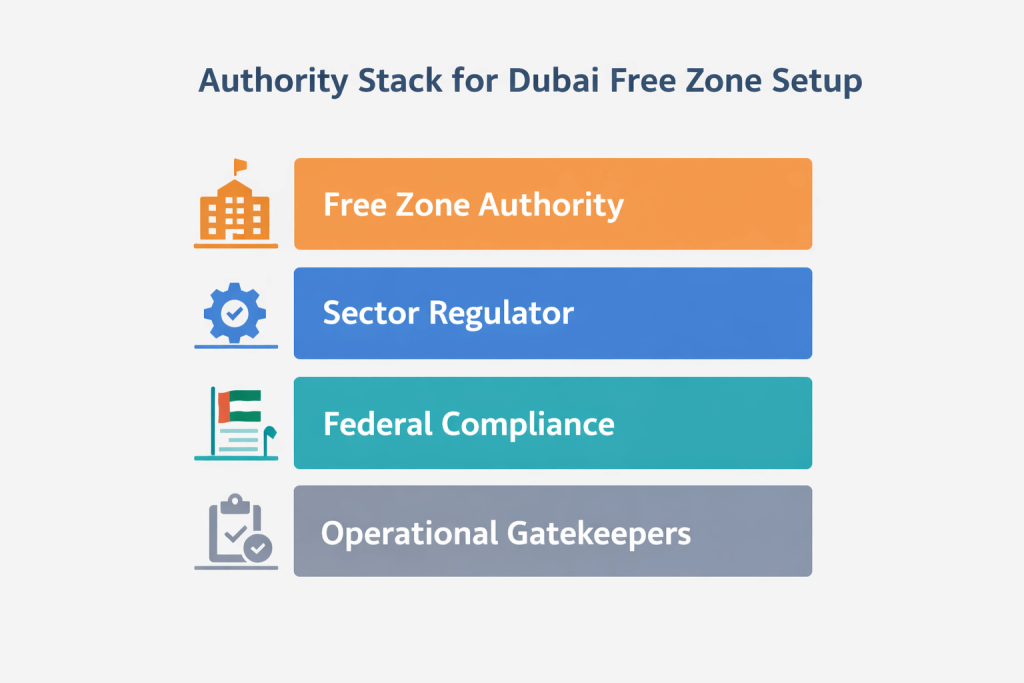
Most delays happen because founders treat setup like a single checklist. In reality, Dubai setup runs through an “authority stack”:
- Free Zone Authority (Licensing Authority)
- Incorporates your entity and issues your free zone trade licence
- Sector Regulator (If Your Activity Is Regulated)
- Approves or licences the activity itself (examples below)
- Federal Compliance Bodies (Across the UAE)
- Tax registrations, labour frameworks, ultimate beneficial owner filings, and more
- Operational Gatekeepers (Practical “Yes/No” Points)
- Banking compliance, office/warehouse readiness, immigration steps, and sometimes municipality-related requirements
If you understand this stack, you stop guessing—and your application stops bouncing between “pending” and “returned for clarification”.
Dubai Free Zone Authorities: Who Covers What
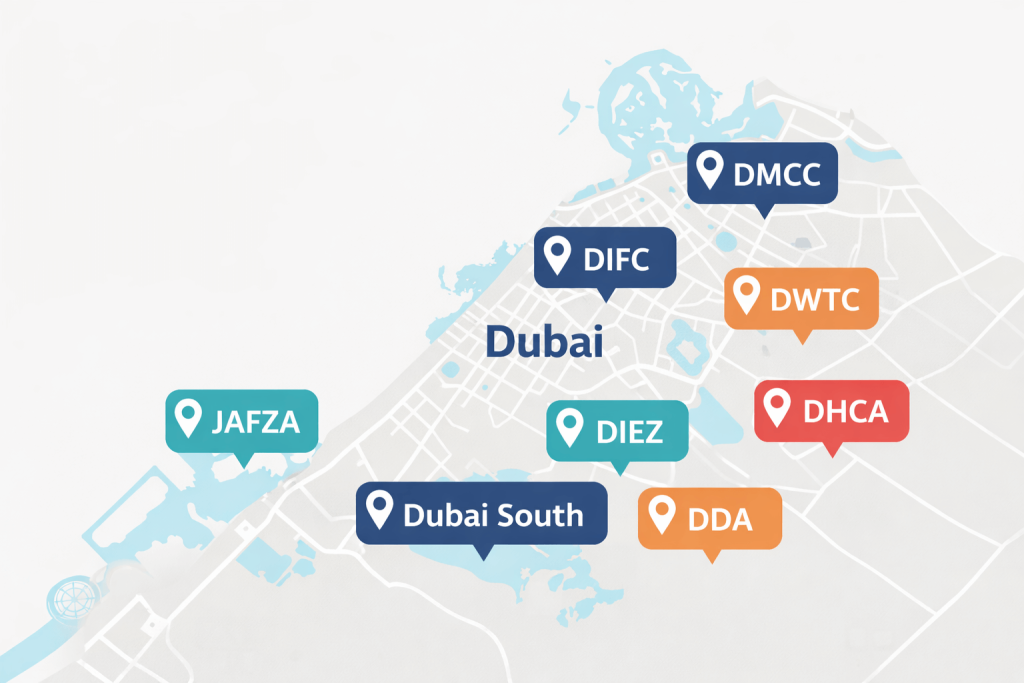
Below is a practical “who does what” map. It’s not meant to replace official activity lists; it’s meant to help you choose the correct authority for your business model.
Quick map of major Dubai free zone authorities
| Authority / Registrar | Best known for | Typical fit |
| DMCC | Trading, commodities, professional services, SMEs | Founders wanting strong reputation + broad activity options |
| JAFZA | Logistics, trading, warehousing, industrial | Businesses that need proximity to Jebel Ali Port + supply chain advantages |
| DIFC | Financial services ecosystem | Finance, wealth, fintech (especially if you need a dedicated financial regulator) |
| Dubai World Trade Centre (DWTC) Free Zone | Central Dubai location + broad activities | Firms that value address, flexibility, and multi-activity licensing |
| Dubai Integrated Economic Zones Authority (DIEZ) | Airport-linked ecosystem + tech/innovation zones | Businesses that want airport connectivity, tech clusters, or e-commerce ecosystems |
| Dubai South | Aviation/logistics corridor near Al Maktoum airport | Logistics, aviation-adjacent, trading, industrial growth plans |
| Dubai Development Authority (DDA) | Creative/tech/media cluster communities | Digital, media, education-adjacent activities in ecosystem-style zones |
| Dubai Healthcare City Authority (DHCA) | Health and wellness ecosystem | Healthcare and clinical/medical services that need a sector-aligned hub |
| PCFC / Trakhees (Special Development Zones) | Zones under Dubai World / PCFC jurisdiction | Businesses operating in designated special development zones |
If you meant “IFZA”
Many people search “dubai free zone authority” when they actually mean IFZA (International Free Zone Authority) because of the name. IFZA is a Dubai-based free zone option used by many SMEs and international founders for straightforward service/trading structures. The key is not the name—it’s whether the authority’s activity list, workspace rules, and banking compatibility match your plan.
Who Approves What: A Real-World Setup Flow
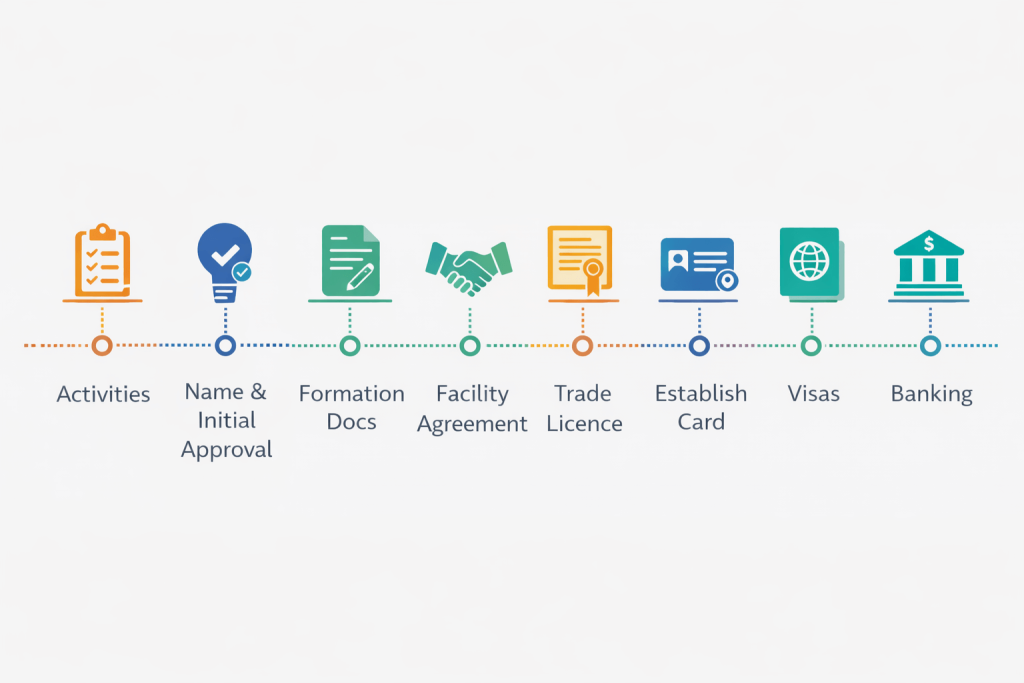
Here’s what typically happens from “idea” to “licence issued” and who is involved at each step.
Step 1: Choose your exact business activities
Decider: Free zone authority (and sometimes a sector regulator)
Why it matters: Activity wording drives approvals, visas, banking risk scoring, and what you’re legally allowed to do.
Common mistake: Picking an activity that sounds right but triggers a regulator you didn’t plan for.
Step 2: Name reservation + initial approval
Decider: Free zone authority
You submit:
- Proposed company names
- Shareholder details
- Passport copies
- Basic business description
If you pass this step cleanly, your setup can move quickly.
Step 3: Legal formation documents
Decider: Free zone authority
You’ll typically finalise:
- Memorandum / Articles or equivalent formation documents
- Shareholder resolutions (if corporate shareholder)
- UBO details (as required)
- Signatures (often e-signature depending on the authority)
Step 4: Facility agreement (desk/office/warehouse)
Decider: Free zone authority
Even when “flexi desk” is possible, the authority must accept the facility arrangement before a licence is issued (and before visas, in many cases).
Practical tip: If you care about banking, don’t treat workspace as a formality. Banks often ask for proof of premises and operational substance signals.
Step 5: Trade licence issuance
Decider: Free zone authority
Once issued, your company becomes operational inside that free zone under the approved activities.
Step 6: Establishment card + visa quota (if you need residency visas)
Decider: Free zone authority administration + immigration processing
This step controls:
- How many visas you can apply for
- Whether you can sponsor employees
- The “operational readiness” of your company for hires
Step 7: Sector approvals (only if your activity requires it)
Decider: The relevant regulator (examples next section)
This can happen before licence issuance, after licence issuance, or in parallel, depending on the authority and activity.
Step 8: Bank account + payment rails (often the true final hurdle)
Decider: Bank compliance team (not the free zone)
Your free zone authority issues your licence—but your bank decides if your structure makes sense, if your activity is acceptable, and whether your documentation is complete.
If you want to avoid banking delays, your setup should be built with:
- Clean activity selection
- Clear business model narrative
- Evidence of contracts or pipeline (when available)
- Transparent source of funds
Extra Regulators: When You Need More Than the Free Zone Authority
Some activities are regulated regardless of where you incorporate. Here are the big “watchouts” that commonly affect Dubai free zone setups.
Finance, wealth, and certain fintech activities
- If you want to operate inside a dedicated financial centre ecosystem, DIFC is often the natural match.
- Financial services are typically regulated by a financial regulator inside the ecosystem.
If your business touches: investment, asset management, brokerage, certain payment models, custody, or financial promotions—assume there is a regulator involved.
Virtual assets / crypto
Dubai has a dedicated virtual assets framework. The key detail is that where you set up matters—because the regulatory perimeter can differ by jurisdiction.
If your business touches: exchange, brokerage, custody, token issuance, staking, or virtual asset marketing—plan for licensing as a core part of the project, not an add-on.
Healthcare and clinical services
If you’re operating as a clinic, medical centre, or regulated health service:
- Expect health authority approvals
- Expect stricter requirements for premises, staffing credentials, and facility standards
Education and training
For schools, institutes, and regulated education providers:
- Expect education authority approvals
- Expect controls on curriculum, staffing, premises, and sometimes marketing claims
Food, cosmetics, and certain consumer products
If you import, store, manufacture, or sell regulated products:
- Expect product registration requirements in some cases
- Expect standards and inspection frameworks depending on product type
Media, telecom, aviation, and other special sectors
These sectors often involve:
- Additional regulators
- Specific free zones designed to support them
- Higher documentation and compliance thresholds
If you tell an authority “consultancy” but you actually run “regulated advisory”, the project slows down. Precision is speed.
How to Choose the Right Dubai Free Zone Authority (Without Guesswork)
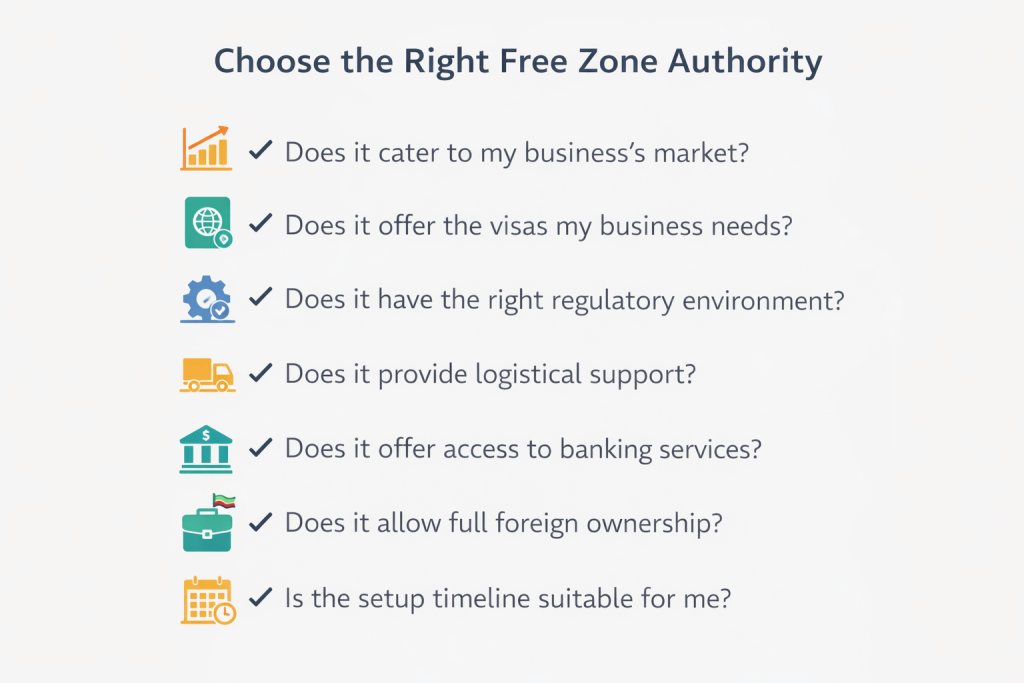
Use this decision framework before you apply.
1) Where will you actually earn revenue?
- Mostly outside the UAE: many free zone structures fit
- Mostly inside the UAE: you need a clear route to operate locally (structure + permissions)
2) Do you need visas now—or later?
Visa-heavy plans often change the “best” free zone because:
- Office requirements differ
- Visa quota rules differ
- Total cost changes dramatically
3) Does your activity trigger a regulator?
If yes, the “best” free zone may be the one that:
- already supports your sector cleanly
- has predictable approval workflows
- is familiar to banks in your space
4) Do you need warehousing, industrial space, or logistics advantages?
If yes, choose an authority designed for it. Trying to force a warehouse-dependent model into a desk-based authority is a classic failure pattern.
5) How important is banking speed?
Some authorities are easier for certain bank profiles, depending on:
- activity type
- substance signals
- documentation standards
- typical customer base
6) How complex is your shareholder structure?
If you have:
- corporate shareholders
- multiple layers of ownership
- cross-border groups
…choose an authority known for handling structured incorporations smoothly.
7) What’s your real timeline?
If you need a fast launch, pick:
- clean activity
- clean shareholder structure
- predictable facility option
…and avoid regulated activities until you’ve planned the approval path properly.
What the Free Zone Authority Controls After Licence Issuance
The authority relationship continues after incorporation. Depending on the jurisdiction and company, ongoing administration can include licence renewals, activity amendments, shareholder or manager changes, facility or lease updates, corporate-record changes and immigration-related company records.
This is why authority fit matters beyond the first application. A company that expects to add activities, hire staff, change workspace or restructure ownership should consider how those changes are handled before choosing a jurisdiction.
Common Misunderstandings That Cause Delays
“A free zone licence automatically lets me trade anywhere in Dubai.”
Not always. Free zones are designed for specific operating models. If your plan requires direct local trading or on-the-ground operations, you need a compliant route to do it.
“Corporate tax is always 0% in free zones.”
Free zones can have attractive tax positioning, but corporate tax outcomes depend on rules, qualifying conditions, and how/where revenue is earned.
“I can pick any activity now and fix it later.”
Activity changes are possible, but they can trigger new approvals, new compliance checks, and bank reviews. Selecting the right activity at the start is one of the highest-ROI decisions you’ll make.
“Workspace doesn’t matter.”
It matters for:
- visa eligibility
- inspections (where relevant)
- bank comfort
- renewal stability
Dubai Updates That Matter for Free Zone Businesses
Dubai has been actively pushing initiatives to make free zones more connected, more flexible, and more attractive to global founders.
A more connected free zone ecosystem
Dubai has launched cross-zone initiatives designed to reduce friction and help businesses move faster across the ecosystem.
Mainland operating permissions (where applicable)
Dubai has also introduced frameworks that allow certain free zone entities to obtain permissions to operate outside their zone under defined conditions—useful for businesses that want free zone efficiency but need a controlled route to serve the local market.
The important takeaway: structure first, permissions second. The right setup anticipates the permissions you’ll need later.
Real Examples: Matching Authority to Business Model

Example 1: E-commerce brand importing stock + fulfilling regionally
Best-fit logic:
- Strong logistics ecosystem + warehouse options
- Clear import/export pathways
- Banking-ready narrative (suppliers, invoices, fulfilment model)
Example 2: Solo consultant serving international clients
Best-fit logic:
- Clean professional services activity
- Low overhead workspace option
- Visa optionality (if you want residency)
Example 3: Fintech/crypto-adjacent business
Best-fit logic:
- Regulator-aligned ecosystem
- Clear licensing path
- Strong compliance posture for banking and counterparties
Example 4: Healthcare provider launching a clinic or regulated practice
Best-fit logic:
- Health ecosystem authority + regulator workflow
- Premises + staffing approvals built into the plan
- Longer timeline assumed from day one
A Practical “Pre-Application” Checklist (Use This Before You Submit Anywhere)
Before you apply to any Dubai free zone authority, prepare:
- Passport + residence details (shareholders and managers)
- Proof of address (as required)
- Company name options (with alternatives)
- A one-paragraph business model summary (what you sell, to whom, where revenue comes from)
- Confirmed activity selection (with wording that matches reality)
- Expected headcount + visa needs (now and 12 months from now)
- Budget range (licence + facility + visas + renewals)
- Banking readiness notes (source of funds, expected transaction profile)
If you want the fastest route, don’t start with forms. Start with clarity.
The Next Step (If You Want This Done Without Delays)
If you want a setup plan that matches the correct Dubai free zone authority, avoids regulator surprises, and is structured to be banking-ready, the simplest next step is to share:
- your activity
- target customers (UAE vs international)
- visa needs
- whether you need office/warehouse
You’ll get a clear authority shortlist, a realistic timeline, and a clean approval path—before you spend on the wrong application. Book a free consultation.
Frequently Asked Questions
1) What is a Dubai free zone authority?
A Dubai free zone authority is the licensing body for a specific free zone. It registers your company, issues your free zone trade licence, and manages key setup and renewal processes within that zone.
2) Is there one single Dubai free zone authority for all free zones?
No. Dubai has multiple free zones, and each zone has its own authority or registrar responsible for licensing and administration.
3) Can a free zone company do business in mainland Dubai?
In many cases, free zone companies can serve mainland clients through compliant routes (such as authorised arrangements, permits, or specific frameworks). The correct route depends on your activity, location, and the permissions available at the time of operation.
4) Do I need approvals beyond the free zone authority?
Sometimes. If your activity is regulated (finance, crypto, healthcare, education, telecom, media, aviation, and others), you may need approvals or licensing from additional regulators.
5) How do I choose the best free zone authority in Dubai?
Match the authority to your business model: where you earn revenue, whether you need visas, whether you need warehousing, whether your activity is regulated, and how important banking speed is.
6) Does “IFZA” mean Dubai free zone authority?
IFZA is a specific free zone option people often search for because of its name. It’s not the authority for all Dubai free zones—it’s one option among many, and suitability depends on your activity, visas, and operational needs.