The UAE is one of the easiest places in the region to start and grow a company, but at some point almost every entrepreneur asks the same question: how do I actually get a business loan in the UAE?
Whether you are launching a new venture, scaling an established SME or simply smoothing cash flow, understanding how banks and lenders assess a business loan in UAE can be the difference between a quick approval and a long string of rejections.
In recent years, the UAE government and Central Bank have pushed hard to improve SME access to finance through dedicated SME programmes and regulations aimed at fairer treatment by banks. At the same time, specialised lenders like Emirates Development Bank (EDB) now offer dedicated startup and small business finance of up to AED 2 million, often with mentoring and digital onboarding.
This guide walks you through everything you need to know: types of business loans in UAE, eligibility criteria, documents required, how to get a business loan step by step, and what to do if you’re a startup with limited track record.
1. Types of Business Loan in UAE
Before you look at documents and eligibility, it helps to understand what kind of finance you actually need. Banks and lenders in the UAE offer several core products for SMEs and corporates.
1.1 Term loans (classic business loan)
A term loan is the standard business loan in UAE most owners think of:
- You borrow a fixed amount (for example, to buy machinery or fit out a shop).
- You repay in monthly instalments over a fixed tenure (often 1–5 years for SMEs).
- The pricing may be fixed or variable, depending on the lender.
Some banks offer secured business loans of up to several million dirhams with tenures up to 10 years when backed by property or other collateral.
1.2 Working capital & overdraft facilities
Working capital finance is designed to cover day-to-day needs such as rent, salaries and inventory:
- Overdrafts linked to your business current account.
- Short-term revolving credit lines.
- Seasonal or invoice-backed facilities for trading businesses.
These are ideal for businesses that are fundamentally healthy but experience cash flow gaps, for example due to long receivable cycles.
1.3 Asset-backed & equipment finance
Many banks provide specialist loans against assets such as:
- Vehicles and fleets
- Construction or industrial equipment
- Commercial property
Typical structures include financing up to a high percentage of the asset value, repaid over 3–5 years, often with the asset itself as security.
1.4 Trade finance & invoice discounting
If you import, export or work heavily on credit terms, you may use:
- Letters of credit and bank guarantees
- Trust receipts
- Invoice discounting or factoring – borrowing against approved invoices to get cash early
While these aren’t always marketed as a “small business loan in UAE”, in practice they provide the same lifeline of capital.
1.5 Startup business loan in UAE
Historically, most banks wanted at least one to two years of trading history and a minimum annual turnover before granting finance.
Today, the landscape is improving:
- Emirates Development Bank (EDB) offers startup business loans in UAE of up to AED 2 million with tenures up to 72 months, plus digital business banking and mentoring.
- Specialised SME funds and government initiatives (such as Dubai SME and Mohammed Bin Rashid Fund for SMEs) offer subsidised lending and guarantees for qualifying startups.
These options are especially relevant if you’re seeking a loan for starting a new business in UAE and don’t yet meet traditional bank requirements.
1.6 Islamic business finance
Because interest (riba) is prohibited under Islamic law, Islamic banks provide Sharia-compliant business finance structures such as:
- Murabaha: the bank buys an asset and sells it to you at a marked-up price payable over time.
- Ijara: leasing structures for equipment or property.
The economics are similar to a conventional business loan in UAE, but the contracts and accounting treatment differ.

2. Eligibility Criteria: Who Can Get a Business Loan in UAE?
Eligibility varies by bank and product, but most institutions look at similar foundations. Several authoritative guides and lenders highlight common criteria:
2.1 Typical eligibility for established businesses
For a standard SME or small business loan in UAE, expect lenders to look for:
- Licensed UAE business – valid trade licence (mainland or free zone).
- Minimum trading history – often at least 1–2 years of operation.
- Existing business bank account in the UAE.
- Minimum annual turnover – many lenders benchmark around AED 1 million or higher.
- Clean credit conduct – reasonable bank statement behaviour and acceptable credit bureau report.
- Resident shareholders / signatories – with valid Emirates IDs and visas.
Banks also assess sector risk, ownership structure, OFAC/AML risk and overall business model.
2.2 Eligibility for startup business loans in UAE
For startups, the bar is different:
- Government-backed lenders such as EDB focus on sector fit, viability and founders’ experience rather than long trading history, and may provide up to AED 2 million based on a qualitative evaluation.
- Some SME funds offer interest-free or subsidised loans, often linked to approved incubators or free zone programmes.
You may still need:
- A clear, well-structured business plan and projections.
- A trade licence (or pre-approval) and basic corporate documents.
- Evidence of capital invested by founders or investors.
3. Documents Required for Business Loan in UAE
One of the biggest reasons applications get delayed is incomplete paperwork. Fortunately, banks are fairly consistent about what they ask for.
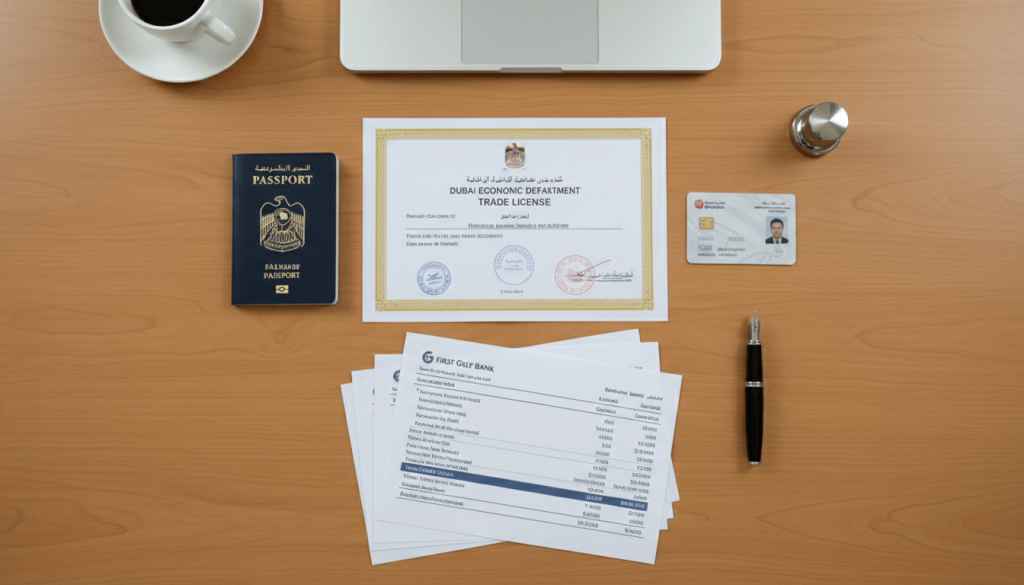
Based on UAE bank requirements and SME finance guides, the core documents required for business loan in UAE usually include:
3.1 Core KYC and legal documents
- Completed loan or credit application form
- Valid trade licence (mainland or free zone)
- Memorandum & Articles of Association (MOA/AOA) and any addenda
- Share certificates or partners’ list (where applicable)
- Passports, residence visas and Emirates IDs of all key signatories/shareholders
- Power of Attorney documents (if someone signs on behalf of the owners)
3.2 Financial documents
- Business bank statements for the last 6–12 months (all banks used by the company)
- Latest audited financial statements (often required for larger facilities)
- Management accounts or trial balance (if audited accounts not available)
- VAT registration certificate and recent VAT returns, if registered
3.3 Business and operational evidence
- Office or premises tenancy contract or Ejari / Ejari equivalent
- Major customer and supplier contracts or high-value invoices
- List of employees from MOHRE / relevant authorities (for labour-intensive sectors)
- Existing loan / liability statements (if any)
3.4 Additional documents lenders may request
Depending on your profile and sector, banks may also ask for:
- Cash flow forecasts and business plan, especially for expansion or startup funding
- Trade licences of related companies (if part of a group)
- Proof of collateral (property title deed, vehicle registration, equipment invoices)
- Insurance policies (for asset-backed loans)
Practical tip: prepare a single, well-organised digital folder with all documents clearly named. This alone can shave days off your approval time and makes your business look more professional to credit teams.
4. How to Get a Business Loan in UAE: Step-by-Step
If you’re wondering how to get business loan in UAE without getting lost in bank jargon, use this practical roadmap.
Step 1 – Define your funding need and amount
Be specific:
- Are you financing startup costs, growth, inventory, or equipment?
- How much do you actually need, and for how long?
- What is your repayment capacity based on realistic cash flow?
This clarity helps you choose between a term loan, working capital facility or specialised product.
Step 2 – Make sure your business is “bank-ready”
Before approaching lenders:
- Ensure your trade licence and corporate documents are in order and renewed.
- Open a dedicated business bank account and run all business income and expenses through it – banks heavily analyse this history.
- Keep your compliance clean: VAT, ESR, UBO filings and any regulatory requirements should be up to date.
The Central Bank’s SME Market Conduct Regulation requires banks to offer timely, transparent access to SME products and to provide clear information and debt counselling.
In Dubai, the new Dubai Unified Licence (DUL) has also made it easier and faster to open business bank accounts, cutting the average time from around 65 days to as little as five days by creating a unified digital identity for businesses.
Step 3 – Shortlist banks and lenders
Compare options for:
- Maximum loan amount and tenure
- Requirements for small business loan in UAE (turnover, years in business, collateral)
- Pricing (interest/profit rate, arrangement fees, early settlement penalties)
- Digital onboarding or relationship-manager driven process
Consider including government-backed options such as EDB for startups and strategic sectors.
Step 4 – Prepare your documents and application pack
Combine the documents listed earlier into a clean application pack. Alongside the standard forms, you should include:
- A concise business profile (what you do, who you serve, key contracts).
- Financial summary: turnover, margins, key cost drivers.
- Loan purpose note: what you will use the funds for and how this supports growth.
Think of this as your “credit story” – it should show that the loan is sensible, affordable and aligned with your strategy.
Step 5 – Submit and respond quickly to queries
Once you apply:
- Expect clarifications from the bank’s credit or risk team.
- Respond promptly with any extra documents (for example, updated bank statements or new contracts).
Delays in answering queries are a common reason applications get stuck.
Step 6 – Review the offer letter carefully
If approved in principle, the bank will issue a facility offer including:
- Approved amount and currency
- Pricing (interest/profit, fees, insurance cost if any)
- Tenure, repayment schedule and grace period
- Security and guarantees required
- Covenants and reporting obligations
If the terms are complex, it’s worth having a professional review them to ensure you understand the total cost of your business loan in UAE over the whole tenure.
Step 7 – Draw down and manage the facility
After signing, the bank will book the facility and either credit your account or pay vendors directly, depending on the structure.
Good habits:
- Monitor instalment dates and always keep sufficient balance.
- Avoid frequent over-limits or returned cheques.
- Keep the bank updated on major developments (large new contracts, new locations, or challenges).
A positive track record makes it much easier to increase limits or secure better terms later.

5. Loan for Starting New Business in UAE: What if You’re Just Launching?
Many entrepreneurs ask if they can get a loan for starting new business in UAE before they even open a bank account or start trading.
Realistically, most commercial banks still prefer:
- 1–2 years of operations
- A minimum turnover threshold
- Clean business bank statements
However, you do have options:
5.1 Government-backed and development lenders
- Emirates Development Bank (EDB) offers start-up business loans in UAE of up to AED 2 million with flexible tenures and a dedicated start-up journey, particularly in priority sectors such as manufacturing, healthcare, technology and food security.
- Programmes under the UAE’s National SME agenda and Dubai SME can provide subsidised loans, guarantees or seed funding to qualifying Emirati and resident entrepreneurs.
5.2 Alternative finance and crowdfunding
Platforms specialising in SME finance can connect your business to investors, offering business loans or revenue-based finance once you meet their eligibility thresholds, often with streamlined digital onboarding.
5.3 Practical path for brand-new startups
If you’re pre-revenue or very early stage:
- Incorporate and obtain your trade licence (mainland or free zone).
- Inject founder capital and record it properly.
- Open a business bank account and run all activity through it.
- After 6–12 months of visible trading, approach lenders for a small business loan in UAE, while also exploring EDB or SME programmes earlier if you qualify.

6. Costs, Tenure and Security: What to Expect
Every lender prices risk differently, but here’s how they typically think about a business loan in UAE.
6.1 Pricing components
- Interest or profit rate – often linked to an EIBOR benchmark plus a margin. Islamic facilities structure this as profit rather than interest.
- Arrangement / processing fees – usually a one-off percentage of the facility amount.
- Insurance – property or equipment insurance for secured loans, and sometimes credit life or key-man cover.
- Early settlement or partial prepayment fees – if you repay before maturity.
6.2 Tenure
- Working capital and overdraft facilities are usually 12 months, reviewed annually.
- Term loans and equipment finance often range from 24–72 months.
- Some secured loans stretch up to 10 years, especially when backed by property.
6.3 Security and guarantees
Lenders may take:
- Personal or corporate guarantees
- Property, vehicle or equipment charges
- Assignment over receivables or contracts
Startups and smaller SMEs will often be asked for stronger guarantees than larger, more established firms.
7. How to Improve Your Chances of Approval
Banks in the UAE are under regulatory pressure to treat SMEs fairly and provide clear information, but they still need to manage risk carefully.
You can significantly improve your approval odds by:
- Keeping clean bank statements – avoid frequent cash deposits with no narrative, cheque returns, or heavy personal spending from the business account.
- Showing stable or growing turnover – even if modest, a consistent pattern is reassuring.
- Separating personal and business finances – use your business account for all company income and expenses.
- Preparing a simple, realistic business plan – with conservative assumptions, not over-optimistic projections.
- Reducing existing debt – where possible, settle or consolidate expensive facilities before applying.
- Choosing the right product size – asking for a sensible amount relative to your turnover and assets.
8. How First Elite Global Can Help You Secure a Business Loan in UAE
Navigating different banks, free zones, documents and regulations while running a company is demanding. That’s where a specialist partner makes a real difference.
First Elite Global supports entrepreneurs and SMEs across the UAE with:
- End-to-end loan advisory – matching your profile with suitable lenders and choosing between business loan, working capital or asset-backed solutions.
- Bank-ready documentation – from business plans and financial summaries to complete document packs aligned with lender expectations.
- Coordination with company formation and visas – aligning your financing with licence type, shareholder structure and residency strategy.
- Introductions to relationship managers – helping you reach the right teams faster instead of generic call-centre routes.
- Ongoing support – reviewing offer letters, highlighting key terms and helping you plan for renewal or refinancing.
If you are exploring a business loan in UAE—whether for a new venture or scaling an existing one—reach out to First Elite Global for a tailored consultation. A short discussion can save you months of trial-and-error and significantly improve your chances of a timely approval.
FAQs: Business Loan in UAE
1. Can a foreign owner or non-resident get a business loan in UAE?
Yes, many banks lend to companies with foreign ownership, provided the business is properly licensed in the UAE and the authorised signatories hold valid residence visas and Emirates IDs. For non-resident owners, banks will usually focus more heavily on the UAE entity’s performance and may require stronger security or guarantees.
2. What is the minimum turnover required for a small business loan in UAE?
Thresholds vary, but many lenders look for annual turnover from around AED 1 million or higher for unsecured SME loans, alongside at least one year of trading and a healthy business bank account. Some government-backed and development programmes may support earlier-stage businesses with lower turnover if they meet strategic criteria.
3. Can I get a loan for starting a new business in UAE with no bank statements?
Traditional banks rarely finance pre-revenue companies with no banking history. However, you may be eligible for startup business loan in UAE through development banks such as Emirates Development Bank or SME funds that focus on early-stage companies, especially in priority sectors.
4. Are there Sharia-compliant business loans in UAE?
Yes. Islamic banks and windows offer Sharia-compliant business finance using structures like Murabaha (cost-plus sale), Ijara (leasing) or other approved contracts. Economically, these perform similarly to conventional loans but are structured to comply with Islamic principles and overseen by Sharia supervisory boards.
5. How long does it take to get a business loan approved?
For straightforward cases with complete documents, some banks issue approvals within a few days, especially for smaller ticket sizes and existing customers. More complex or higher-value facilities can take several weeks due to detailed credit analysis, compliance checks and documentation. Having a clean, complete application pack and a clear loan purpose can significantly reduce timelines.
6. Do I need a separate business bank account before applying?
In practice, yes. Lenders heavily rely on your UAE business bank statements to assess cash flow and repayment capacity. The Central Bank’s SME rules even emphasise quicker account opening for SMEs to support access to finance, and reforms like Dubai’s Unified Licence have shortened bank account opening times significantly.