If you’ve searched “offshore business” before, you’ve likely seen two extremes: content that glamorises it as a shortcut to “zero tax,” and content that treats it as automatically suspicious. The truth is more practical.
An offshore business is simply a legal structure formed in one jurisdiction and used for business, ownership, or investment connected to another. Done properly, it can help you organise international activity, ring-fence assets, and simplify cross-border ownership. Done poorly, it creates banking headaches, compliance problems, and unwanted scrutiny.
This guide breaks down the offshore company meaning in plain English, shows when an offshore structure makes sense (and when it doesn’t), and walks you through a modern offshore setup guide built around real-world compliance.
Offshore business meaning (plain English)
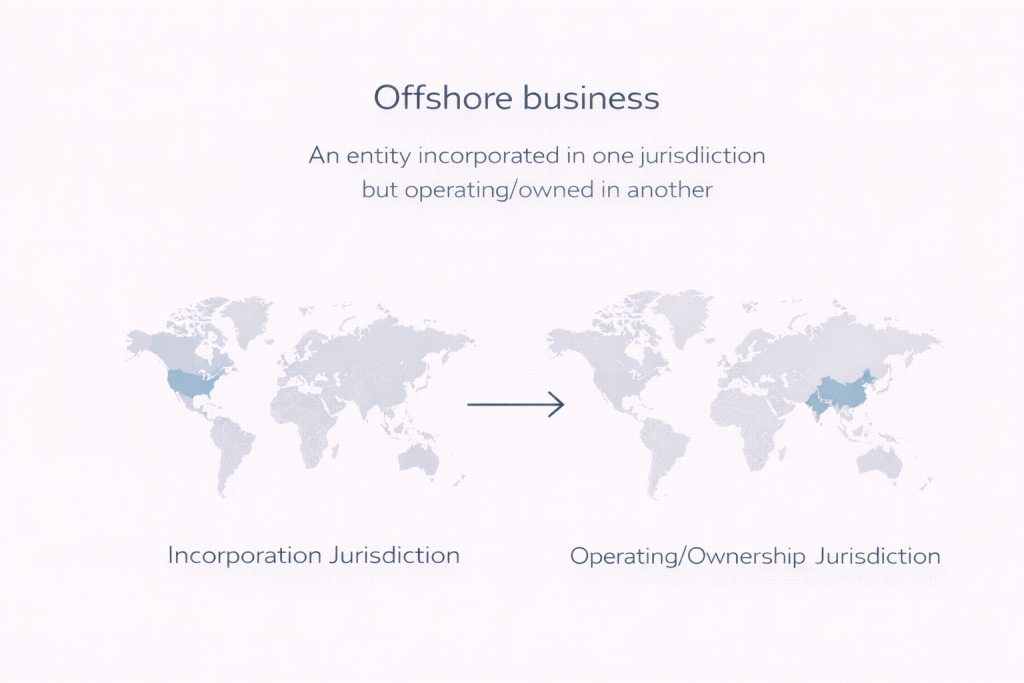
An offshore business is a company (or legal entity) incorporated outside the country where its owners live and/or where its main commercial activity happens.
That definition matters because offshore is about jurisdiction and purpose, not secrecy.
Offshore company vs offshore business vs offshore finance
- Offshore company: the legal entity itself (the “vehicle”).
- Offshore business: what you use that vehicle for (holding, investing, contracting, licensing, trading internationally).
- Offshore finance: the broader idea of managing money, banking, and investments outside your home jurisdiction.
A simple way to remember it:
Offshore isn’t a business model. It’s a structure that supports a business model.
What offshore structures are actually used for
Most legitimate offshore setups fall into a few common buckets:
1) Holding assets and investments
Offshore companies are widely used as holding companies for:
- Shares in operating companies (group structures)
- International investments and portfolios
- Intellectual property (in the right circumstances)
- High-value movable assets (where appropriate and compliant)
2) Property ownership and special-purpose vehicles (SPVs)
An offshore SPV is a dedicated company created to hold a single asset or project, such as:
- A property investment
- A joint venture stake
- A single trading contract or project
3) International contracting (outside a local market)
Some owners use an offshore company to:
- Sign overseas contracts
- Invoice foreign clients
- Manage international supplier relationships
This only works cleanly when the real management and value creation are aligned with the structure.
4) Group structuring and risk separation
A common use of an offshore structure is to separate:
- Ownership vs operations
- One line of business vs another
- Higher-risk activities from protected assets
This is less about “saving tax” and more about making risk legible and containable.
The “offshore myth” that causes the most trouble
The biggest misconception is that offshore equals “anonymous” or “untaxed.” In today’s environment, most reputable offshore jurisdictions and banks operate under strict transparency rules.
Modern offshore setups are built around three realities:
Reality 1: Beneficial ownership is known (even if not always public)
Even where public registers differ, banks and regulated service providers will require ultimate beneficial owner (UBO) information and supporting documents.
Reality 2: Banks share information internationally
If you open corporate accounts, expect tax-residency and controlling-person checks. Many jurisdictions participate in automatic information exchange frameworks, which is why “bank-ready” offshore structuring matters.
Reality 3: “Substance” and “management control” matter more than paperwork
If the structure claims profits in one place while decisions, people, and operations sit elsewhere, you risk:
- Tax challenges in your home country
- Account closures
- Audit triggers and reputational damage
Bottom line: Offshore works best as a clean ownership and control framework, not as a hiding place.
Offshore vs onshore vs free zone: the simplest comparison
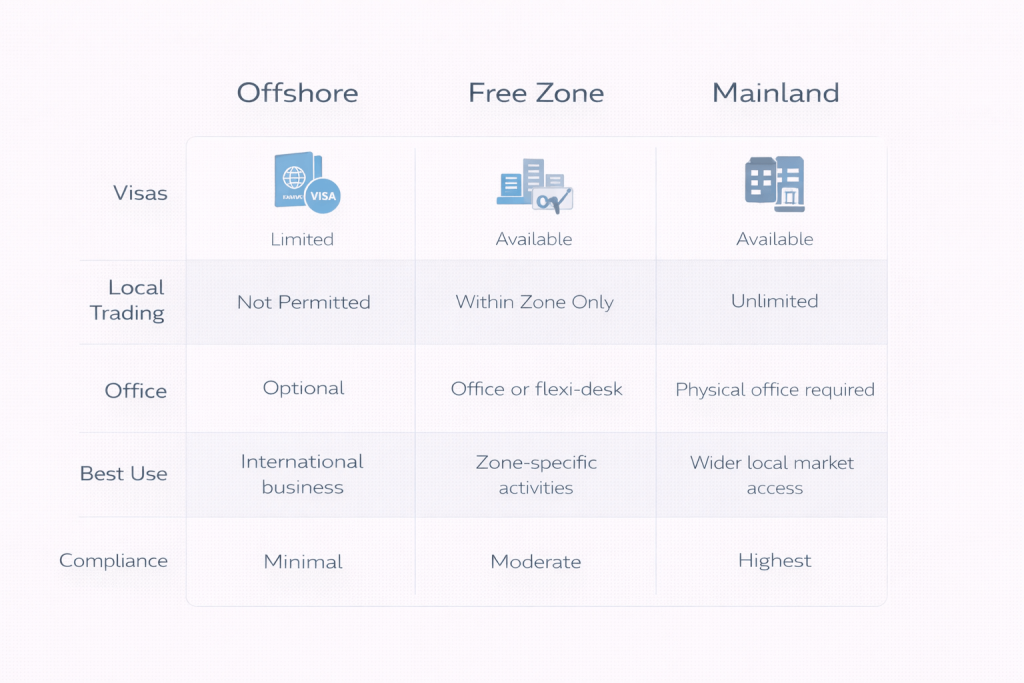
People often confuse offshore companies with free zones or mainland entities. They’re different tools.
| Feature | Offshore structure | Free zone company | Mainland company |
| Best for | Holding, structuring, international ownership | Operating with a base, visas, trade setups | Full local market access and broader operations |
| Local trading | Usually restricted | Often possible with conditions/approvals | Yes |
| Visas | Typically not the goal | Commonly available | Commonly available |
| Office requirement | Often not a full physical office | Options range from flexi to dedicated | Usually requires office/tenancy setup |
| Banking | Needs strong KYC narrative | Still needs KYC, often easier with operations | Still needs KYC, often stronger local footprint |
If your plan involves staff, visas, and a real operating presence, offshore may not be the right starting point. If your goal is ownership, holding, or structuring, offshore can be ideal.
Benefits of an offshore business (when used correctly)
A well-structured offshore setup can deliver:
Clear ownership and asset separation
You can separate personal ownership from business risk and keep assets under a dedicated legal vehicle.
Simpler international structuring
Offshore entities can streamline how you hold stakes in multiple countries—especially when paired with a properly planned group structure.
Operational clarity for partnerships and investors
A clean offshore vehicle can make it easier to:
- Bring in partners
- Allocate shares
- Document governance
- Ring-fence liabilities
Administrative efficiency
Some jurisdictions offer straightforward corporate governance, renewal processes, and predictable company law—helpful for holding entities that don’t need complex operations.
A practical insight: Offshore value is highest when you can explain the structure in one sentence.
If you can’t, a bank (or regulator) won’t like it either.
Risks, downsides, and what people don’t tell you
Offshore is not “set and forget.” Common risks include:
Banking friction (the #1 real-world problem)
The majority of offshore frustrations come down to one thing: bank confidence.
Banks want a coherent story:
- Who owns the company?
- What does it do?
- Where do clients/suppliers sit?
- Where does management happen?
- Why offshore (commercial rationale)?
- Are funds and contracts consistent with the narrative?
If the answers are vague, accounts get delayed—or denied.
Compliance obligations you must take seriously
Even if the company is “simple,” you’ll usually need:
- Renewals and registered agent support
- Proper resolutions and governance records
- Up-to-date UBO details
- Basic bookkeeping and transaction documentation
Tax misunderstandings
An offshore company’s tax position depends on:
- Where the owners are tax resident
- Where decisions are made
- Where value is created
- Whether the structure creates a taxable presence elsewhere
If your motivation is purely tax reduction, you need professional advice before you incorporate—not after.
Reputation risk
Not because offshore is inherently wrong, but because sloppy structuring looks like concealment. The fix is simple: build it cleanly and document the commercial purpose.
The offshore setup guide (step-by-step, compliance-first)
Here’s a modern offshore setup process that avoids the most common mistakes.
Step 1: Define the purpose in one sentence
Examples:
- “Hold shares in two operating companies.”
- “Own a property investment SPV.”
- “Hold IP and license it under clear contracts.”
- “Manage international contracting outside the local market.”
If your purpose is unclear, stop here and clarify it—your structure depends on it.
Step 2: Choose the right offshore structure type
Common choices include:
- Holding company
- SPV (single asset/project)
- Trading/contracting company (with careful management planning)
- Group holding with subsidiaries
Step 3: Choose the jurisdiction based on fit (not hype)
Key criteria:
- Reputation and bank acceptance
- Legal framework and governance flexibility
- Ongoing reporting expectations
- Cost predictability (setup + renewals)
- Practical suitability for your use case (holding vs operating)
Step 4: Prepare a “bank-ready” document pack early
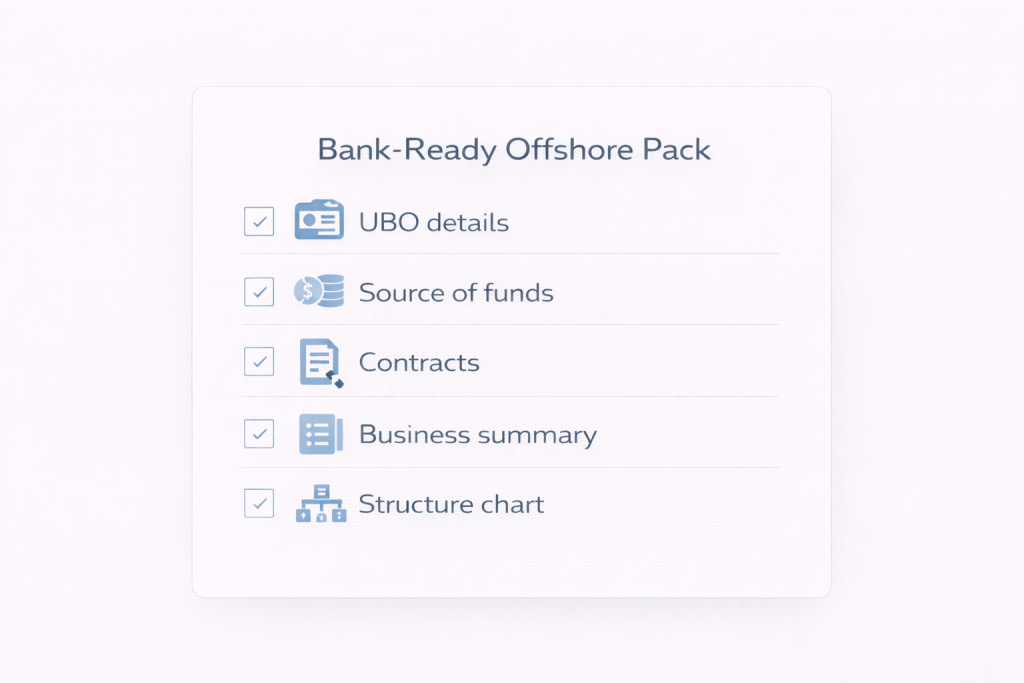
Typical items include:
- Passports, proof of address, and profiles for shareholders/directors
- Source of funds / source of wealth explanation (as needed)
- Business plan or activity summary
- Contract samples, invoices, or pipeline evidence (if trading/contracting)
- Group structure chart (if applicable)
This is where most DIY offshore setups fail: they incorporate first and scramble later.
Step 5: Incorporation and governance setup
A clean setup includes:
- Clear shareholding and director appointments
- Simple governance rules that match your real-world decision-making
- Proper resolutions and company records from day one
Step 6: Banking strategy (don’t treat it as an afterthought)
Banking is not a checkbox—it’s a process.
- Match the bank to the activity and profile
- Ensure transactions align with declared activity
- Avoid unexplained third-party flows
Step 7: Ongoing compliance and maintenance
Put a simple routine in place:
- Renewal calendar (licence/registration)
- UBO updates when changes occur
- Recordkeeping and basic bookkeeping
- Contracts and invoices saved in a structured archive
If you want this handled end-to-end: book a free consultation with First Elite Global and get a clean, bank-ready offshore plan built around your actual goals—not a generic template.
Offshore structure decision framework (a quick “fit test”)
Ask these five questions:
- Do you need to operate locally (staff, visas, local contracts)?
If yes, offshore alone is rarely the right tool. - Is the main goal holding/ownership rather than daily operations?
If yes, offshore is often a strong fit. - Can you clearly explain the commercial reason for the offshore company?
If no, restructure the plan. - Will your management and decision-making align with the structure?
If no, expect tax or banking issues. - Are you prepared for transparent KYC and ongoing upkeep?
If no, offshore will feel painful.
If you’d like, First Elite Global can map your best-fit structure in a single call and show what should be offshore vs free zone vs mainland for your specific situation.
Real-world examples (case-style insights)
Example A: Investor holding assets internationally
Goal: hold investments and isolate liability.
Typical approach: offshore holding company + clear governance + clean source-of-funds narrative.
Why it works: simple purpose, low transaction complexity.
Example B: Overseas entrepreneur needing a UAE base + visas
Goal: operate, hire, and invoice clients while building a footprint.
Typical approach: free zone or mainland operating company, with offshore only if you need a separate holding layer.
Why it works: aligns the entity with real operations.
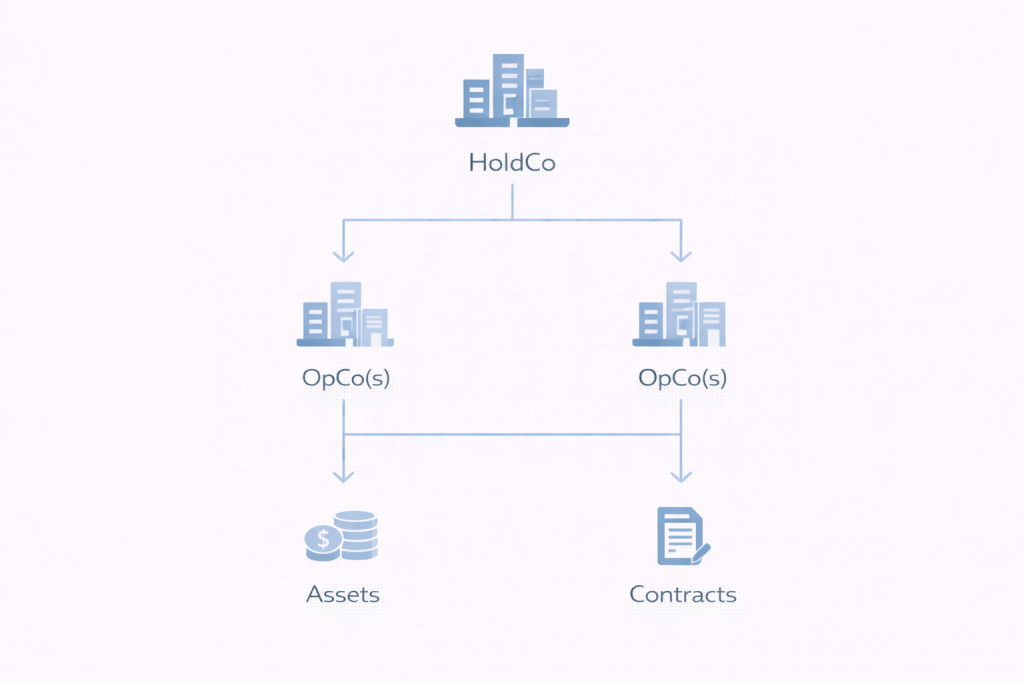
Example C: Group structure with multiple markets
Goal: hold shares across jurisdictions, simplify ownership, prepare for investment.
Typical approach: holding company (offshore or suitable jurisdiction) + operating subsidiaries + clear intercompany agreements.
Why it works: “who owns what” becomes obvious to banks and partners.
What a “done-for-you” offshore setup should include
If you’re using a provider, look for these non-negotiables:
- A proper structuring call that challenges assumptions
- A written structure summary you can show to a bank
- Transparent cost breakdown (setup + renewals)
- A bank-ready KYC pack prepared upfront
- Clear guidance on what offshore can and cannot do (no vague promises)
- A compliance checklist and renewal reminders
If you want a predictable process with clear updates and no paperwork stress, First Elite Global can handle your offshore setup from structuring through incorporation and compliance basics—so you can focus on the business outcome, not the forms.

Frequently Asked Questions
1) What is an offshore business in simple terms?
An offshore business is a company formed in one jurisdiction and used for ownership or business connected to another. It’s a legal structure, not a hidden activity.
2) Is an offshore company legal?
Yes—offshore companies are legal when used for legitimate purposes and kept compliant (proper reporting, accurate ownership disclosure, and lawful tax handling).
3) What is the difference between an offshore company and a free zone company?
An offshore company is typically used for holding and international structuring, while a free zone company is commonly used to operate with a base, access visas, and run day-to-day business activities (subject to rules and approvals).
4) Do offshore companies pay tax?
Tax depends on where owners are tax resident, where management happens, and where value is created. Some jurisdictions don’t tax foreign-sourced income, but that does not automatically remove tax obligations elsewhere.
5) Can an offshore structure help with asset protection?
It can help ring-fence assets under a separate legal vehicle and reduce operational risk spillover—when properly structured and supported by strong governance and compliant ownership records.
6) What’s the biggest mistake people make with offshore setup?
Incorporating first and thinking later—especially around banking and compliance. A bank-ready narrative and document pack should be planned before you register the company.