
Moving to the UAE in 2025 is more attractive than ever: tax-efficient income, global connectivity, and a growing number of long-term visa options for professionals, investors and families. But “how to get a UAE residence visa” – and specifically an employment visa – is still one of the most common (and confusing) questions people ask.
This guide explains, in plain English, how UAE employment and residence visas actually work in 2025: what they are, the main routes, step-by-step process, real-world processing times, typical costs, and how to avoid common mistakes that lead to delays, fines or even bans.
Throughout, First Elite Global is your partner in making the process smooth and compliant – whether you’re relocating with a job offer, setting up your own company, or looking for your “own visa” as a self-sponsored professional.
What is a residence visa in the UAE?
A residence visa is the permission that allows you to live in the UAE for more than a short visit. It is usually valid for 2–3 years for most expatriate workers, and 5–10 years for certain categories such as Golden Visa holders.
Key points:
- You must have a sponsor – usually an employer, your own company, a free zone, or a family member, unless you are on a special self-sponsored category (like certain Green or Golden visas).
- Adults 18+ must pass a medical fitness test and a security check.
- You also apply for an Emirates ID, which now serves as the main proof of residency instead of the old pink visa sticker in your passport.
The official UAE government portal lists the main residence visa categories, including: work, investor/partner, property owner, family, student, retirement, Green Visa and Golden Visa.
What is an employment visa in the UAE?
An employment visa (often called a “work visa” or “working visa”) is the route most professionals use to obtain their UAE residence visa.
It combines:
- A work permit / labour approval issued via the Ministry of Human Resources & Emiratisation (MOHRE) or a free zone;
- An entry permit to enter the UAE or change status inside the country;
- And finally, a residence visa & Emirates ID, issued after medical tests and biometrics.
Put simply:
Employment visa = your right to work, plus the residence visa that lets you live in the UAE.
If you’re searching online for how to get UAE employment visa, how much is UAE working visa, or what documents are required for UAE employment visa, this guide is for you.
Main ways to get a UAE residence visa in 2025
There are several routes to UAE residency. Here are the most common for foreign professionals and business owners:
- Employer-sponsored employment visa (standard work visa)
- Mainland company, free zone company, semi-government or government entity sponsors you.
- Most common route for salaried employees.
- Investor / partner visa via your own company
- You set up a company (e.g. in Dubai mainland or a free zone) and receive residence as a shareholder/manager.
- Ideal if you want more control over your status and future own visa options.
- Green Visa for freelancers and skilled professionals
- A self-sponsored 5-year residence visa for highly skilled workers, freelancers and investors, without the need for an employer sponsor.
- Golden Visa (5–10 years)
- Long-term residence for investors, exceptional talents, highly skilled professionals, and other categories.
- Remote Work / Virtual Work Visa
- A self-sponsored visa for people working remotely for an overseas employer; often valid for 1 year and renewable.
- Family sponsorship
- Once you have a residence visa and meet salary and housing requirements, you can sponsor your spouse, children and, in some cases, parents.
This article focuses mainly on how to get UAE residence visa through employment, with practical insights on costs, documents and timelines – plus options if you want your own visa in the UAE.
How to get a UAE employment & residence visa: step-by-step (2025)
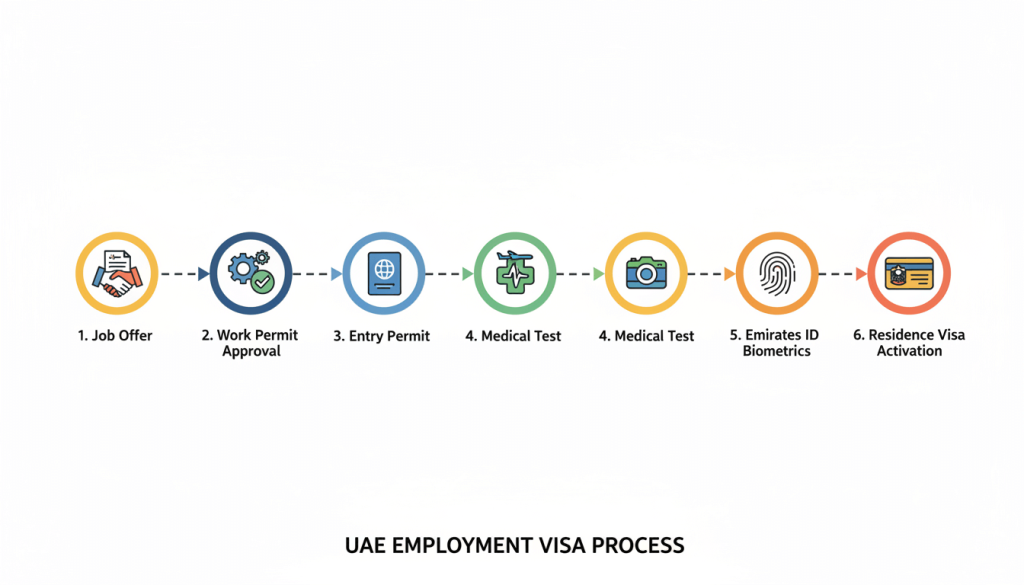
The exact process varies slightly between emirates and free zones, but the core stages are similar.
Think of it in three phases: Pre-approval → Entry → Residency & ID.
1. Secure a job offer or business structure
For a standard employment visa, you first need:
- A genuine job offer from a UAE-licensed company, government entity or free zone;
- A role that matches your skills and qualifications;
- A contract compliant with MOHRE or the relevant free zone authority.
If you plan to get your own visa in the UAE as an investor or partner, the first step is forming your company (mainland or free zone) and obtaining your trade licence. First Elite Global can help you choose the right structure and jurisdiction based on your budget and business model.
2. Work permit approval (MOHRE / free zone)
For private-sector employment, your employer applies to MOHRE for a work permit linked to your job contract. Free zones have their own portals but follow a similar logic.
Typical requirements include:
- Signed job offer and labour contract
- Passport copy (6-month minimum validity)
- Personal photo
- Education certificates (attested if required)
- Any professional licences for regulated professions
The official UAE government portal notes that work permit issuance and renewal costs range from AED 250 to AED 3,450, depending on the company’s category and compliance with Emiratisation rules.
In 2025, MOHRE is also rolling out AI-driven systems to approve work permits with minimal human involvement, further speeding up processing.
3. Entry permit: getting into the UAE or changing status
Once the work permit is approved, your sponsor requests an employment entry permit.
You may:
- Enter the UAE on this entry permit; or
- If you’re already in the UAE (e.g. on a visit or jobseeker visa), your status can be changed without leaving, subject to the latest rules.
Recent updates in 2025 allow many applicants to convert tourist visas to employment visas without exiting the country, but you must follow the correct status-change process and avoid overstays.
4. Medical fitness test
Anyone applying for a residence visa who is 18 or older must pass a medical fitness test at an approved centre.
This usually includes:
- Basic physical examination
- Blood tests (including screening for certain infectious diseases)
- Chest X-ray for pulmonary TB
You must clear the test before your visa can be issued or renewed.
5. Emirates ID application & biometrics
In parallel, you apply for your Emirates ID via ICP Smart Services, the UAEICP app, or an authorised typing centre. You then attend a biometric appointment (fingerprints + photo).
Key facts:
- The Emirates ID is now your primary proof of legal residency.
- It replaces the old residence sticker in your passport – the sticker now exists mainly as a digital record.
- For expat residents, Emirates ID validity typically matches the visa: 2 or 3 years, depending on your category.
6. Residence visa issuance (no more physical stamp)
Once your medical is cleared, your Emirates ID application is in process and all approvals are in place, the immigration authority (GDRFA or ICP) issues your residence visa.
- Instead of a stamp, your residence details are stored digitally and linked to your Emirates ID.
- Airlines and government systems verify residency electronically using your Emirates ID and passport details.
You can download a copy of your residence visa online through ICP’s smart services or the UAEICP app, which is often needed for Schengen visas or other consular applications.
At this point, your UAE residence visa is active, and you can legally:
- Live and work in the UAE
- Open bank accounts
- Rent property
- Enrol children in school
- Sponsor eligible family members, subject to salary and housing rules
Requirements and documents for UAE employment & residence visas
If you are wondering what are the documents required for UAE employment visa or what are the documents required for UAE residence visa, here’s a practical overview.
Always remember: requirements can differ by emirate, free zone and profession, and are updated regularly. The lists below are a realistic starting point, not an official checklist.
General eligibility to get a UAE residence visa
According to official UAE guidance, typical conditions include:
- Valid passport, usually with at least 6 months remaining.
- Approved sponsor (employer, free zone, government, family member, or self-sponsor category such as Green or Golden Visa).
- Minimum income / financial solvency – for certain categories, this may start from around AED 3,000 + employer-provided housing or AED 4,000 without housing.
- Clean security record and no immigration bans.
- Medical fitness test for applicants aged 18+.
Documents required for UAE employment visa
From official GDRFA and government resources, the typical documents to process an employment visa include:
From the employee
- Passport copy (6-month minimum validity)
- Passport-sized photo on white background
- Signed employment contract / job offer
- Attested degree or professional certificates (where required)
- Previous visa / cancellation copy (if you have lived in the UAE before)
- Any professional licences (doctors, engineers, teachers, etc.)
From the employer / sponsor
- Trade licence and establishment card
- Labour quota approval (where applicable)
- MOHRE work permit approval
- Salary certificate or contract showing pay and benefits
- Tenancy contract or Ejari (sometimes requested for family sponsorship later)
For family visas, additional documents include an attested marriage certificate, children’s birth certificates, and proof of income – all properly translated and attested.
First Elite Global routinely helps clients prepare, translate and attest these documents so they are accepted the first time.
Cost of UAE employment & residence visas in 2025
If you’re researching how much is employment visa in UAE or what is the cost of UAE employment visa, you will find different figures. That’s because the exact cost depends on:
- Mainland vs free zone
- Company’s MOHRE category and compliance
- Inside-country status change vs outside UAE
- Duration (2 vs 3 years)
- Age (workers 65+ can face additional surcharges)
However, we can give realistic 2025 ranges based on recent data.
Typical government fee ranges (employment visa – 2 years, Dubai example)
| Cost component | Typical 2025 range (AED) | Notes |
|---|---|---|
| Work permit issuance / renewal | 250 – 3,450 | Depends on company category (A/B/C). |
| Initial approval / application | 50 – 200 | MOHRE / portal fees. |
| Status change (if inside UAE) | ~500 – 575 | GDRFA / ICP change of status fees. |
| Medical fitness test | ~260 – 360+ | Varies by emirate and category. |
| Emirates ID (2 years) | ~270 – 310 | Card + service + typing fees. |
| Residence visa / “stamping” & services | ~370 – 560 | Emirates ID now replaces physical stamp; these are residency service fees. |
| Misc. typing, service & insurance charges | 500 – 1,500+ | Varies by provider and emirate. |
Across multiple up-to-date legal and business setup sources, UAE employment visa costs typically fall between AED 3,000 and AED 7,000 for a 2-year visa in 2025, including work permit, medical, Emirates ID and residency processing.
Who pays for the UAE employment visa?
Under UAE labour rules and widely accepted practice, the employer should pay for all employment visa costs, including:
- Work permit fees
- Medical tests
- Emirates ID
- Residence visa processing and status change
If you are being asked to pay for your employment visa, especially large sums up front, treat it as a serious red flag and seek advice before proceeding.
How much is “own visa” in UAE?
Many entrepreneurs and freelancers ask: how much own visa in UAE? or how to get your own visa in UAE without being tied to an employer.

Broadly, you have three self-oriented options:
- Investor / partner visa through your own company
- You set up a mainland or free zone company.
- Costs include trade licence, establishment card, office solutions, and then visa fees similar to those above.
- Total packages can vary widely depending on the free zone and business activity.
- Freelance / self-employment packages
- Some free zones and business centres offer freelance or self-employment visas where you hold your own residency.
- A typical 2-year freelance visa in Dubai can range from ~AED 12,500 to AED 30,000, including permit, establishment card, visa and basic services, depending on the provider and package.
- Green Visa (self-sponsored)
- For high-skilled professionals and freelancers who meet income and qualification criteria, the Green Visa can offer a 5-year self-sponsored residency without an employer.
First Elite Global can review your profile, budget and goals, then advise whether an employment visa, investor visa, freelance package, Green Visa or even Golden Visa route is the smartest way for you to secure your own visa in the UAE.
New for 2025: paying government fees in instalments
In 2025, ICP introduced a programme allowing residents to pay many ICP service fees in interest-free instalments by credit card, through participating local banks.
This can significantly ease cash flow for applicants paying their own visa costs (for example, investors, freelancers or family sponsors).
How long does a UAE employment visa take in 2025?
Another common query is how many days to process employment visa in UAE and how many days for visa stamping after medical.
Actual timelines depend on the emirate, free zone, workload and whether any security or background checks are needed. Realistically:
- Work permit & entry permit: approx. 3–7 working days in straightforward cases.
- Medical test & biometrics: usually done within 2–3 days after entry.
- Residence visa issuance & Emirates ID: often 2–10 working days after documents are submitted and medical cleared.
In practice, a typical employment + residence visa process takes around 1–3 weeks from entry (or status change) to receiving your Emirates ID, assuming no issues.
Working with a specialist like First Elite Global helps keep these timelines realistic by ensuring documents are correct, applications are filed promptly, and any queries are handled quickly.
Changing tourist / visit visa to employment visa in UAE
If you’re already inside the country, you might be asking:
- How to change tourist visa to employment visa in UAE?
- Can UAE visit visa be changed to employment visa?
As of 2025, updated rules allow many visitors to convert a tourist or visit visa to an employment visa without leaving the UAE, via in-country status change, provided:
- You secure a valid job offer and employment contract.
- The employer obtains MOHRE work permit approval.
- A status amendment application is filed before your visit visa expires.
- Relevant change-of-status and overstay fees (if any) are paid.
Since July 2025, overstaying on a residence visa incurs AED 50 per day – the same daily fine also applies in many visit/overstay scenarios – so timing your change of status is critical.
If you’re on a jobseeker visit visa (60, 90 or 120 days), you also have a defined window to secure a sponsor or exit the country.
First Elite Global can review your current visa, expiry dates and job offer to map a safe, compliant route from visit to employment and residence – avoiding last-minute fines and panic extensions.
How to check UAE work visa status and residence validity
People frequently search for UAE work visa status, how to check work visa status in UAE, or how to verify UAE employment visa with passport number. Fortunately, the UAE offers reliable online tools.
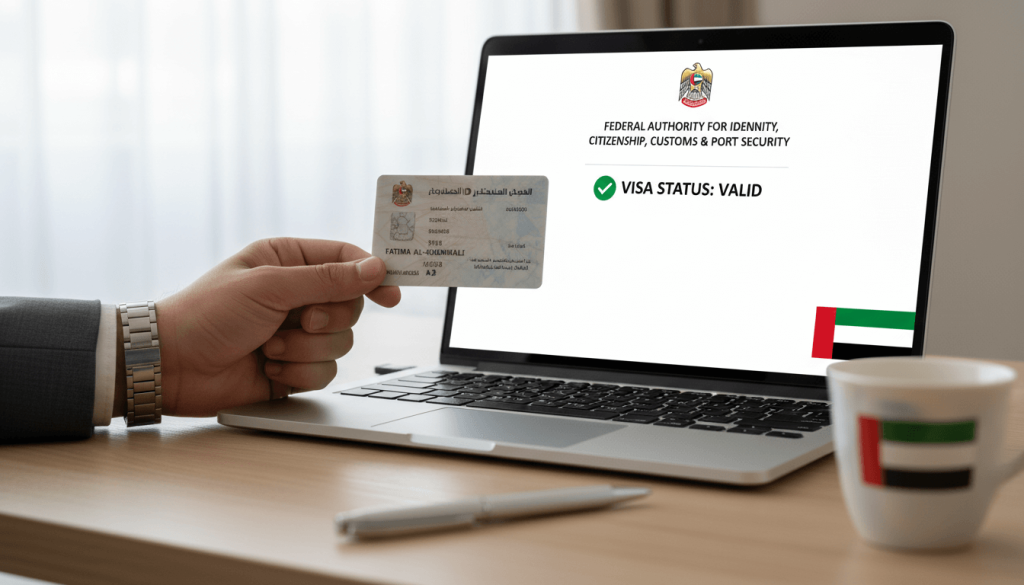
1. Check via ICP (federal – most emirates)
For visas issued in Abu Dhabi, Sharjah, Ajman, UAQ, RAK and Fujairah, you can:
- Visit the ICP Smart Services website or UAEICP mobile app.
- Use “Track visa application and validity” or similar service.
- Enter your passport number, visa file number or Emirates ID, plus nationality and date of birth.
- View your visa status, validity and personal details.
2. Check via GDRFA Dubai
For Dubai-issued visas, you can:
- Visit the GDRFA Dubai website or app.
- Use the “Visa Status” or “File Status” service.
- Enter your passport details, Unified Number (UID) or file number.
- Confirm if your employment visa is active, valid, cancelled or in progress.
3. Check work permit status with MOHRE
Employers and workers can also check the work permit and labour contract status via the MOHRE portal or app, using relevant reference numbers.
If any of these steps feel overwhelming, First Elite Global can verify your visa and work permit status for you, help correct inconsistencies, and prepare the documentation needed for job changes, family sponsorship or bank accounts.
Staying compliant: overstay rules, fines and visa scams
The UAE has significantly tightened visa compliance in recent years.
- In the first half of 2025, authorities identified more than 32,000 visa violators, highlighting how seriously residency and employment rules are enforced.
- Overstaying on residency now attracts AED 50 per day in fines, making late renewals increasingly expensive.
At the same time, ICP has warned residents and visitors about fraudulent online ads promising “quick visas” or guaranteed approvals for extra fees. Many of these are illegal consultancy schemes with no link to government channels.
To stay safe:
- Use only official portals (u.ae, ICP, GDRFA, MOHRE) or reputable, licensed business setup and immigration firms.
- Never pay large cash amounts for undocumented promises of “lifetime visas” or “guaranteed approvals”.
- Keep your passport, Emirates ID, visa copy and contact details up to date in all systems.
First Elite Global works strictly with official government portals and licensed partners, giving you transparent timelines and costs rather than risky shortcuts.
Why work with First Elite Global on your UAE employment & residence visa?
Choosing the right UAE residence route is as important as getting approval itself.
First Elite Global supports you at every step:
- Route planning: we help you decide whether an employer-sponsored, investor, freelance, Green, or Golden Visa path is genuinely best for your long-term plans.
- Business setup + visa under one roof: if you’re building your own company, we handle trade licence, corporate bank account support and partner/investor visas together.
- End-to-end paperwork management: document attestation, translations, medical bookings, Emirates ID applications and status changes are all coordinated for you.
- Compliance-first approach: we proactively align with MOHRE, ICP and GDRFA rules to avoid fines, refusals and unnecessary rework.
- Family and future planning: once your visa is in place, we guide you on family sponsorship, upgrading to Green or Golden Visa, and relocating your business or investments.
If you’re serious about relocating or securing your own long-term base in the UAE, speak to First Elite Global today for tailored advice on your specific profile, budget and timelines.

FAQs: UAE Employment and Residence Visa 2025
1. What is a residence visa in UAE and how is it different from a visit visa?
A residence visa allows you to live in the UAE for the medium to long term (typically 2–3 years, or 5–10 for special categories). It is linked to a sponsor and includes the right to have an Emirates ID, open bank accounts, sign leases and sponsor family members.
A visit or tourist visa only permits short stays for tourism, business meetings or job-seeking, and does not involve work permits or long-term residency rights.
2. What is an employment visa in UAE?
An employment visa is the combination of a work permit + residence visa issued when a UAE employer or your own company sponsors you for a job. It lets you legally work and reside in the UAE for the duration of your contract and visa validity.
3. How much does a UAE employment visa cost in 2025?
Government and service fees for a 2-year employment visa generally total around AED 3,000–7,000 in 2025, depending on company category, emirate, and whether your status is changed inside the country. This usually covers work permit, medical tests, Emirates ID and residence visa services.
Under UAE labour rules, the employer is normally responsible for paying these employment visa costs, not the employee.
4. How many days are required for employment visa processing in UAE?
A straightforward case typically takes:
- 3–7 working days for work permit and entry permit
- 2–3 days for medical and biometrics
- 2–10 working days for residence visa issuance and Emirates ID
So, 1–3 weeks from entry or status change is a realistic expectation for most applicants.
5. How can I change from tourist visa to employment visa in UAE?
You can usually change from tourist/visit visa to employment visa without exiting the UAE if:
- You secure a job offer and the employer obtains MOHRE approval;
- A status change application is submitted before your visit visa expires;
- Any required change-of-status and overstay fees are paid.
Moving early is critical: overstaying attracts AED 50 per day in fines in many residency scenarios.
6. How can I get my own visa in UAE as a freelancer or business owner?
To get your own visa (self-oriented rather than solely employer-tied), you can:
- Set up a mainland or free zone company and obtain an investor/partner visa;
- Choose a freelance or self-employment package in a suitable free zone;
- Explore Green Visa or Golden Visa options if you meet the criteria.
First Elite Global can assess which of these is realistic for your profile and help you structure it in a compliant, cost-effective way.