
Starting a business startup in Dubai can be remarkably fast—if you make the right early decisions and prepare your paperwork the way authorities and banks expect. This guide walks you through the real-world startup steps founders follow, from picking free zone vs mainland to your trade licence, visas, bank account, and your first 90 days of operations.
If you want a smoother launch with fewer delays, treat this as your working playbook: use the checklists, copy the timelines, and follow the order of steps.
Before you apply: 7 founder decisions that shape everything
Most delays happen because founders start filing before they’ve made a few key choices. Get these right first:
1) Your activity (what you will actually do)
Your activity determines:
- which authority issues your licence (and whether approvals are needed)
- which documents you must submit
- how banks assess your risk profile
Founder tip: Choose activities that match what you can prove with a CV, contracts, portfolio, or invoices. Banks and compliance teams care about consistency.
2) Free zone or mainland (and why)
This is the big one. It affects where you can trade, your workspace rules, and how easily you can scale.
3) Your licence type
Common categories include professional/services, commercial/trading, industrial/manufacturing, tourism, and other specialised types depending on the activity.
4) Shareholding and legal form
Solo founder vs partners changes your constitutional documents and approvals. Decide early:
- shareholder(s)
- manager(s)
- signatory roles
5) Visa plan (how many now, how many later)
Don’t guess. Your visa plan should reflect:
- founder visa(s)
- immediate hires
- family sponsorship plans
- office/desk requirements tied to visa quotas
6) Banking strategy (do this before you need payments)
Banking is often the longest pole. Your licence, activity, geography of clients, and source of funds all matter.
7) Your “proof pack” (what makes you credible on paper)
Prepare a simple folder that supports your story:
- CV / LinkedIn profile
- short business plan (1–2 pages)
- expected client geographies
- sample contracts or proposals
- website or portfolio
- proof of address and source of funds
If you want this mapped for your specific business model, book a free consultation with First Elite Global and we’ll produce a structured setup plan with a clear timeline and quotation.
Free zone vs mainland: how to choose the right route#
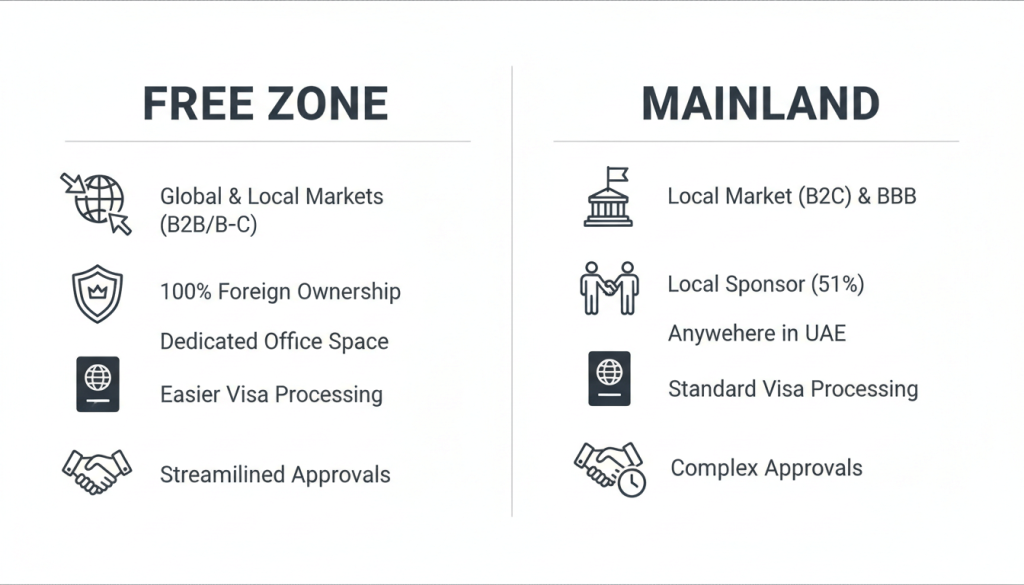
Here’s a practical comparison founders can use.
| Topic | Free zone | Mainland |
| Where you can trade | Strong for international trade and structured operations; UAE onshore rules depend on activity and model | Broad UAE market access and local contracting is typically straightforward |
| Ownership | Typically 100% foreign ownership | 100% foreign ownership is available for most activities |
| Workspace | Often flexi-desk/office packages | Often linked to tenancy rules (e.g., registered lease arrangements) |
| Visas | Visa quotas usually tied to package and workspace | Visa quotas often tied to company setup and workspace requirements |
| Approvals | Some activities are straightforward; regulated ones still need external approvals | Some activities need additional approvals depending on sector |
| Banking | Can be smooth with the right proof pack; still compliance-heavy | Can be smooth with the right proof pack; still compliance-heavy |
Choose a free zone when:
- you sell services internationally or online
- you want a packaged setup with clear inclusions
- you want a straightforward structure for holding, consulting, e-commerce, or trading (activity-dependent)
- you want a launch model that can be managed remotely until visas or banking require presence
Choose mainland when:
- your primary customers are in the UAE market
- you will sign local contracts frequently
- you’re building a local service business that operates at client sites
- your growth plan includes local hiring and onshore expansion
Quick rule: If your revenue depends on UAE-based clients and local contracting, mainland is often simpler. If your revenue is primarily cross-border or digital, free zone is often efficient.
Business startup steps in Dubai: the end-to-end process (in the right order)
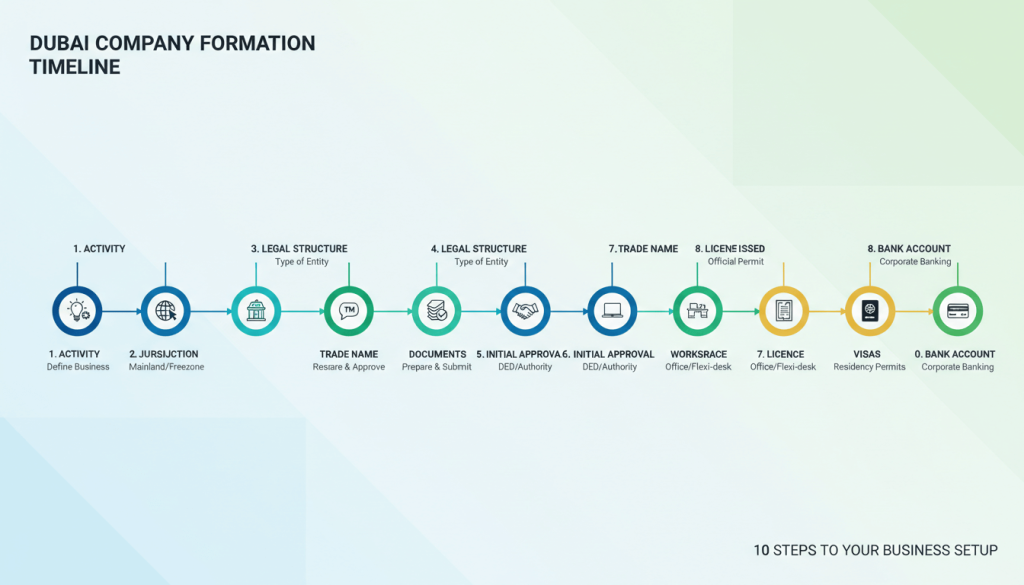
Below is the step-by-step flow used by most successful founders. The sequence matters.
Step 1: Confirm your activity and licence category
- Select the activity that matches your real work.
- Confirm whether your sector needs external approvals (common in regulated areas such as education, healthcare, finance, and certain professional services).
Avoid this mistake: choosing “close enough” activities. Small mismatches can delay approvals and make banking harder.
Step 2: Pick your jurisdiction (free zone or mainland)
Lock this in once you know:
- where your customers are
- whether you need local contracting
- your visa plan
Step 3: Decide the legal structure and shareholder split
Common setups include:
- single-owner company
- multi-shareholder company
- branch structures (for existing businesses)
If you have partners, align upfront on:
- equity split
- management authority
- profit distribution
- signing powers
Step 4: Reserve your trade name (and have backups)
Choose 3–5 options in case your first choice is unavailable or non-compliant with naming rules.
Founder tip: Keep it simple and clearly related to what you do. Avoid terms that raise extra scrutiny.
Step 5: Prepare your KYC and incorporation documents
Typical requirements include:
- passport copies (shareholders/managers)
- entry permit or residence visa copy (if applicable)
- photo(s) as required
- contact details and address information
- brief business description
- constitutional documents depending on structure
If you’re setting up with partners: expect extra documentation and signatures.
Step 6: Initial approval and pre-licensing steps
This is the stage where authorities confirm there is no objection to establishing the entity (it’s not permission to start trading yet).
Step 7: Workspace arrangement (desk, office, or lease)
Your workspace choice affects:
- visa quota
- perceived substance (especially for banking)
- ongoing compliance expectations
Options often include:
- flexi-desk packages (common in free zones)
- serviced offices
- dedicated offices
- warehouse/industrial units (for relevant activities)
Step 8: Licence issuance and company documents
Once fees are paid and documents are approved, you receive:
- trade licence
- incorporation certificates / registry extracts (varies by authority)
- company establishment documentation for immigration (as applicable)
Step 9: Immigration file setup and visa pathway (founder and team)
A typical founder visa process includes:
- entry permit/status step (depending on your case)
- medical fitness test
- biometrics for Emirates ID
- visa stamping/residence issuance (process can vary)
Plan for travel: even if your company can be formed remotely, parts of the visa process require in-person steps.
Step 10: Corporate bank account (start early)
Banking doesn’t like surprises. Move faster by preparing:
- clear explanation of your business model
- client geographies and transaction flows
- invoices/contracts (even draft agreements help)
- source of funds documentation
- website/portfolio and professional background
Step 11: Tax and compliance setup (don’t leave this to “later”)
Even lean startups should set up:
- accounting records from day one
- invoicing process
- contracts and terms
- data handling basics
- tax registrations when applicable (VAT and corporate tax obligations depend on your status and thresholds)
Setup checklist: what to have ready before you start filing
Use this checklist to reduce back-and-forth:
Personal documents
- Passport copy (clear, valid)
- UAE entry permit / residence visa copy (if applicable)
- Passport photo(s) as required
- Proof of address (home country and/or UAE, depending on case)
Company clarity
- Activity and licence type confirmed
- Jurisdiction confirmed (free zone or mainland)
- Shareholders and manager(s) confirmed
- Trade name options (with backups)
Proof pack for smoother approvals and banking
- CV / LinkedIn profile
- Short business plan (1–2 pages)
- Website or portfolio
- Draft service agreement / proposal template
- Expected client locations and payment flows
- Source of funds summary (simple and consistent)
Costs: what a business startup in Dubai typically includes
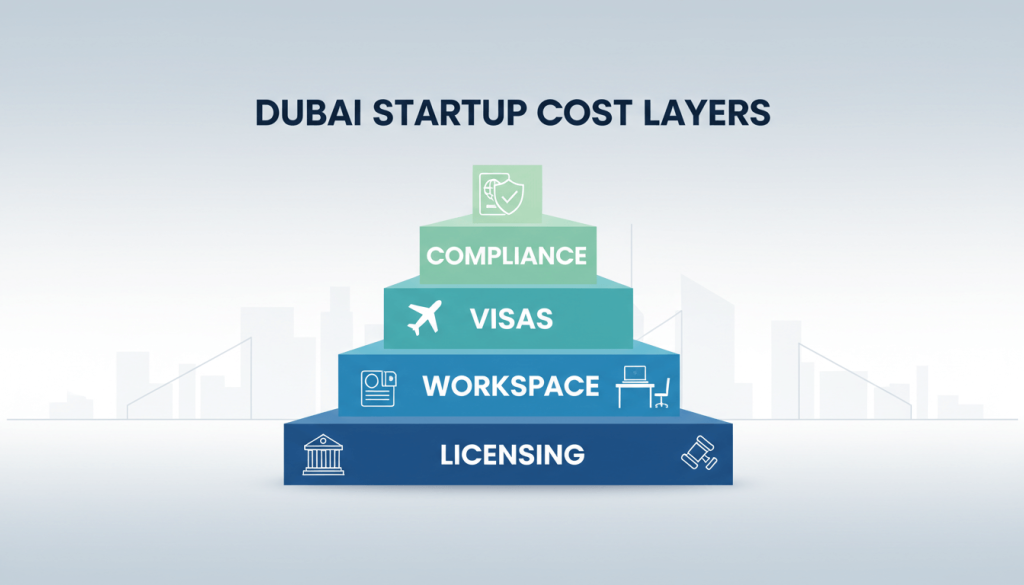
Instead of thinking “What’s the total price?”, think in cost blocks. This is how founders avoid surprises.
1) Formation and licensing costs
Usually include:
- trade name reservation and initial approval steps (as applicable)
- licence issuance fees
- registration/incorporation charges
- documentation and processing
2) Workspace costs
Depending on your setup:
- flexi-desk/serviced office packages
- dedicated office
- lease-related registration steps (where relevant)
3) Visa costs
Per person, you may see:
- entry/status steps
- medical fitness test
- Emirates ID
- visa stamping/residence issuance
- renewals later
4) Operational compliance costs (often missed)
Budget for:
- accounting/bookkeeping
- mandatory insurances depending on your activity and hiring plans
- marketing and website basics
- document translations/attestations if you’re using overseas corporate documents
A simple year-one cost builder (copy/paste)
Use this to plan your first year realistically:
- Licence + registration
- Workspace package/lease
- Founder visa(s) + Emirates ID + medical
- Staff visas (if any)
- Banking setup time and compliance preparation
- Accounting + reporting setup
- Insurance (as required)
- Marketing launch budget
If you want a clean, itemised quotation based on your activity, visa plan and jurisdiction, First Elite Global will build it for you and explain what’s optional vs essential—so you can decide with confidence.
Visas: plan them around your timeline, not your hopes

Many founders form the company quickly and then realise their visa timing doesn’t match their travel plans, bank appointments, or hiring start date.
Founder visa planning tips
- If you need to open a bank account quickly, get your proof pack ready before you apply.
- If your family will join you, plan sponsorship requirements early.
- Don’t over-buy visas “just in case” if it forces a more expensive workspace package now.
Banking: the approval-ready checklist most startups skip

Opening a business bank account is often less about your enthusiasm and more about your documentation quality.
What banks typically want to understand
- What you sell (specific, not vague)
- Who you sell to (countries, industries)
- How you get paid (invoices, contracts, payment links, transfers)
- Where funds come from (source of funds)
- Why your structure fits your activity
Build your “bank-ready” pack
Include:
- a one-page business overview
- your website/portfolio
- 3–6 sample invoices or contracts (even early-stage templates help)
- supplier/client pipeline notes (short and credible)
- source of funds evidence aligned with your story
If you’d like, First Elite Global can guide you on bank selection and prepare the documentation banks typically request so your application is coherent from day one.
A realistic timeline: what founders can achieve in 30–60–90 days
Days 1–30: Establish and become operational
- Finalise activity, jurisdiction, trade name
- Receive trade licence and company docs
- Start visa process (founder)
- Launch basic website + email + invoicing templates
- Begin outreach/sales
Days 31–60: Stabilise and build credibility
- Corporate bank account process underway
- Accounting process live (even if minimal)
- Contracts, terms, and compliance basics in place
- First hires planned (if needed)
Days 61–90: Scale the model
- Add staff visas only when justified by revenue
- Upgrade workspace only when needed
- Tighten reporting and cash controls
- Expand client acquisition channels
Common mistakes that delay founders (and how to avoid them)
- Choosing an activity you can’t evidence → align activity with CV, portfolio, and contracts.
- Starting banking after you need to invoice → begin bank preparation early.
- Underestimating approvals for regulated sectors → confirm approvals before filing.
- Ignoring visa-to-workspace logic → visa plans often shape office requirements.
- Inconsistent documents (names, addresses, signatures) → keep everything consistent across forms.
- Trying to optimise cost without considering compliance → the cheapest setup can become expensive if it blocks banking or scaling.
How First Elite Global helps founders launch with less friction
Founders come to us when they want speed, clarity, and fewer moving parts.
With First Elite Global, you get:
- jurisdiction guidance (free zone vs mainland) aligned to your revenue model
- end-to-end trade licence and incorporation handling
- PRO support for immigration steps and documentation
- visa planning for founders, staff, and family
- banking guidance and documentation alignment
- practical, clear updates throughout the process
“First Elite Global made our Dubai free zone setup surprisingly straightforward. Everything from licence to visas and bank account was handled with professionalism and clear updates.”
Ready to launch? Book a free consultation and we’ll map your setup steps, timeline and costs in a way that fits your business model.
FAQs
1) What are the first steps for a business startup in Dubai?
Start by confirming your business activity, then choose free zone vs mainland based on where you’ll trade and your visa plan. After that, reserve a trade name, prepare documents, and proceed to initial approval and licence issuance.
2) Is a free zone or mainland setup better for new founders?
It depends on where your customers are and how you will contract. If you need frequent UAE onshore contracting and local market access, mainland is often simpler. If you are international or digital-first, a free zone setup can be efficient.
3) How much does it cost to start a business in Dubai?
Costs vary by jurisdiction, activity, workspace requirements, and number of visas. A proper estimate should include licence and registration fees, workspace costs, visa costs, and basic compliance setup such as accounting.
4) How long does company formation in Dubai take?
Some straightforward setups can move quickly once documents are ready. Timelines extend when external approvals are required, when partners are involved, or when visas and banking steps are added.
5) Can I start the process remotely?
In many cases, company formation can begin remotely. However, parts of the visa process and some banking steps require in-person attendance in the UAE.
6) What documents do I need to open a corporate bank account in the UAE?
Expect to provide incorporation documents, passport copies, a clear explanation of your business model, proof of address, source of funds information, and supporting materials such as a website, contracts, or invoices.