
FZE meaning
FZE means Free Zone Establishment. In UAE business formation, it commonly describes a free-zone company with one shareholder where the relevant authority offers FZE as a distinct legal form.
What does FZE mean?
The full form of FZE is Free Zone Establishment. It is a company legal form used by certain free-zone authorities in the United Arab Emirates.
A clear example is Jebel Ali Free Zone Authority, commonly known as JAFZA. JAFZA describes an FZE as a single-shareholder limited-liability company. The shareholder can be an individual or, subject to the authority's requirements, a company.
That definition should not automatically be applied to every UAE free zone. Free zones operate under their own company regulations and do not all use the same legal-form names. Some use FZE, some use FZCO, some use FZ-LLC, and others use different labels.
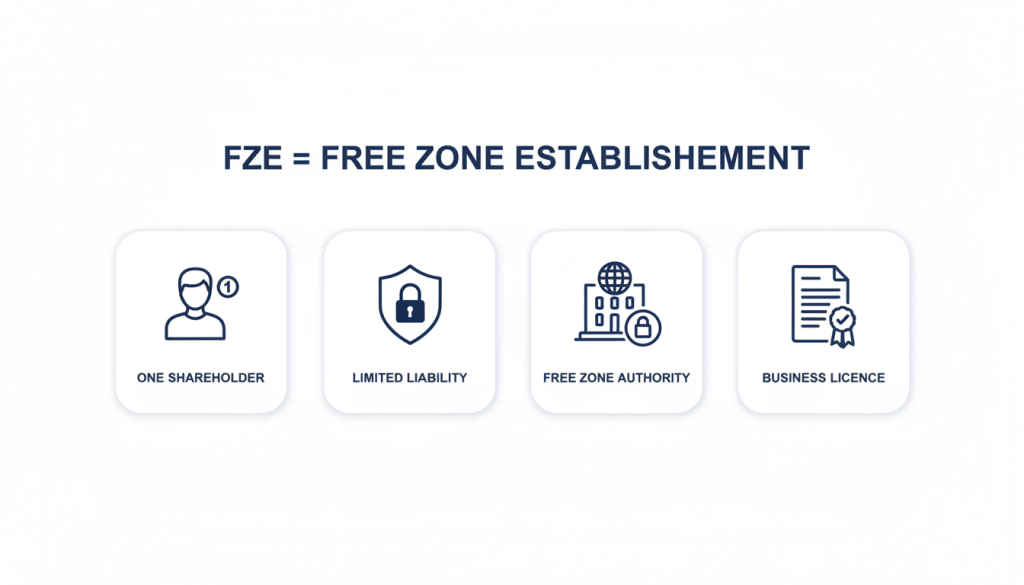
Important distinction: an FZE is a legal form, not a business licence. The legal form describes the company and its ownership structure. The licence defines the activities the company is authorised to conduct.
What is an FZE company in the UAE?
An FZE company is a company incorporated under the rules of a UAE free-zone authority that uses Free Zone Establishment as one of its available legal forms.
Where FZE is defined as a separate limited-liability company, the company has its own legal identity distinct from its shareholder. The precise rights, liability provisions, governance rules, share capital requirements and formation documents are determined by the relevant free-zone regulations.
- Jurisdiction
- The free-zone authority that incorporates and regulates the company.
- Legal form
- FZE, FZCO, FZ-LLC, branch or another entity type offered by that authority.
- Shareholder
- The individual or legal entity that owns the company. An FZE is commonly the single-shareholder form where the authority uses that terminology.
- Licence
- The activities the business is authorised to conduct. It is separate from the company's legal form.
- Facility
- The workstation, office, warehouse or other premises required or selected under the chosen free-zone package.
This distinction matters when comparing free-zone packages. A low-cost licence package does not by itself tell you which legal form will be issued, what activities are permitted, how many shareholders are allowed, what facilities are required or how the company may operate outside the free zone.
How does an FZE work in the UAE?
An FZE operates within the company and licensing framework of the free zone that registers it. The authority records the legal entity, approves its licensed activities, applies its company regulations and handles relevant amendments and renewals.
For a founder, that means four separate questions should be answered before selecting a package:
The letters FZE therefore tell you only part of the story. The free zone, activity, licence, facilities and operating model determine how the company works in practice.
Who can own an FZE?
Where the relevant free zone permits it, the sole shareholder of an FZE can be either an individual or a legal entity such as another company.
Individual shareholder
A natural person can own the FZE directly. The authority will normally require identity, contact, beneficial-owner and other due-diligence information as part of the incorporation file.
Corporate shareholder
A company can also be the shareholder where the free zone accepts corporate ownership. This normally produces a larger document file because the authority needs evidence of the parent company's incorporation, constitutional documents, ownership chain, board authority and ultimate beneficial owners.
Corporate documents originating outside the UAE may also need notarisation, legalisation or attestation depending on the authority, country of issue and application route.
An FZE should not be confused with a sole establishment merely because it has one shareholder. Where the free-zone regulations create the FZE as a separate company, it has a separate legal identity under that regulatory framework.
FZE vs FZCO: what is the difference?
The traditional shorthand is that FZE is the single-shareholder form and FZCO is the multiple-shareholder form. That description works for some authorities, including JAFZA, but it is not a reliable UAE-wide rule.
JAFZA currently describes its FZE as a single-shareholder company and its FZCO as a company with multiple shareholders. However, DMCC introduced the FZCO suffix for newly registered companies from January 2025 and its current setup guidance states that an FZCO must have a minimum of one shareholder.
| Factor | FZE | FZCO |
|---|---|---|
| Full form | Free Zone Establishment | Free Zone Company |
| Typical shareholder position | Commonly one shareholder where FZE is offered as a distinct form. | Authority-specific. Some authorities use it for multiple shareholders; DMCC currently allows at least one. |
| Owner type | Individual or corporate shareholder where permitted. | Individual and/or corporate shareholders subject to authority rules. |
| Liability | Commonly structured as a limited-liability free-zone company. | Commonly structured as a limited-liability free-zone company. |
| Best way to compare | Check the selected authority's current legal-form rules. | Check the selected authority's current legal-form rules rather than relying on the suffix alone. |
The practical rule is simple: identify the free zone first, then read that authority's current definition of FZE or FZCO.
If you specifically want to research the other structure, see the FZCO meaning and Free Zone Company guide.
FZE vs LLC: what actually changes?
FZE describes a company form used inside certain UAE free zones. LLC means Limited Liability Company and is commonly associated with mainland company formation, although free zones may also use LLC-based forms such as FZ-LLC.
The main practical difference is therefore not simply the letters after the company name. It is the jurisdiction, licensing authority, activities, operating permissions, premises and regulatory framework.
| Factor | FZE | Dubai mainland LLC |
|---|---|---|
| Jurisdiction | A UAE free zone that offers the FZE legal form. | Mainland licensing framework in the relevant emirate. |
| Ownership | Commonly a single shareholder where the authority defines FZE that way. | Can have one owner or multiple partners under the applicable company rules. |
| Activities | Activities must be approved by the selected free-zone authority. | Activities must be approved through the relevant mainland licensing route. |
| Mainland operations | Operating outside the free zone can require an applicable licence, permit or other approved route. | Structured for approved mainland activities, subject to the applicable sector and licensing rules. |
| Corporate Tax | Free-zone treatment depends on the company's status, income and applicable conditions. | Subject to the UAE Corporate Tax framework applicable to the company and its taxable income. |
The old assumption that a mainland LLC always requires a majority Emirati shareholder is no longer a reliable general rule. Ownership eligibility should be checked for the specific activity and structure.
For the onshore route, see the Dubai LLC company formation guide.
When may an FZE be the right structure?
An FZE can be a logical candidate when there is genuinely one legal shareholder and the selected free zone offers FZE as the appropriate single-shareholder form.
An FZE may fit when
- One individual or company will legally own the business.
- No co-founder or investor requires equity at incorporation.
- The selected free zone offers FZE for the intended ownership structure.
- The authority permits the proposed activities.
- The facility, visa and staffing requirements can be accommodated.
- The ownership and source-of-funds documentation is ready for review.
Reconsider the structure when
- Two or more people are genuine co-founders.
- An equity investor or partner is likely to join shortly.
- The activity requires a different legal form or external regulatory approval.
- The operating model requires facilities, staffing or mainland permissions that the proposed route does not provide.
- A different free zone uses another legal-form suffix for the same ownership pattern.
Ownership should therefore be decided before choosing the cheapest licence package. If future investment is likely, confirm in advance how the authority handles share transfers, additional shareholders, amendments or conversion to another company form.
Typical FZE requirements in Dubai
Requirements vary by free zone, activity, shareholder type and regulatory profile. The following is a preparation checklist rather than a universal list for every authority.
For an individual shareholder
- Valid passport and identity information.
- Contact and residential-address information where requested.
- UAE visa or entry-status information where relevant.
- Business profile, CV or project information if requested.
- KYC, source-of-funds and beneficial-owner information.
For a corporate shareholder
- Certificate of incorporation or equivalent registration evidence.
- Memorandum, articles or equivalent constitutional documents.
- Current shareholder and director information.
- Board resolution and authorised-signatory evidence where required.
- Power of attorney where applicable.
- Evidence tracing ownership to the ultimate beneficial owners.
- Notarisation, legalisation or attestation where required by the authority.
For the proposed business
- Proposed trade names.
- Accurate description of the intended activities.
- Required licence category.
- Any sector or external approvals.
- Facility or workspace requirement.
- Visa and staffing plan.
- Expected markets and operating model.
JAFZA's published FZE guidance is one useful example of how requirements can differ between an individual shareholder and a corporate shareholder. The selected free zone's current checklist should always control the actual application.
How to set up an FZE in Dubai
There is no single Dubai-wide FZE application because each free-zone authority controls its own incorporation process. A sensible sequence is to resolve the business model before submitting the company file.
Define the business model
List the products or services, customer markets, ownership, staffing, premises and expected operating footprint.
Shortlist suitable free zones
Compare activity availability, sector fit, facilities, visa capacity, customs requirements and operating scope.
Confirm the legal form
Check whether the authority actually offers FZE and whether its shareholder rules match the proposed ownership.
Check the activity and approvals
Verify the activity wording, trade-name requirements and any external regulator or sector approval.
Prepare shareholder documents
Complete the identity, corporate, KYC, UBO and supporting business documents required for the selected route.
Select the facility and package
Match the actual office, workstation, warehouse, visa and licence requirements rather than choosing on headline price alone.
Submit, sign and pay
Submit the application, answer authority queries, execute the required documents and pay the approved fees.
Complete post-licence work
Address immigration records, visas, tax registration, accounting, banking and other operating requirements that apply to the company.
What affects FZE cost and setup time?
There is no dependable single price or universal formation time for an FZE in Dubai. The legal-form suffix is only one component of the application.
Cost and timing can change according to the free zone, activities, shareholder type, documents, external approvals, premises, visas and continuing requirements.
- Authority
- Registration, annual licence and authority-specific administration charges.
- Activities
- Number and type of licence activities, regulated work and required external approvals.
- Facility
- Workstation, office, warehouse, retail or specialist-premises requirements.
- Visas
- Immigration records, visa capacity and employee or shareholder applications.
- Shareholder
- Corporate ownership can add document certification, attestation, translation and UBO tracing.
- Ongoing work
- Renewal, accounting, tax compliance, amendments and continuing operational requirements.
Ask for an itemised estimate that separates one-time incorporation fees, recurring licence and premises costs, visas, external approvals, optional professional work and continuing compliance.
What an FZE does not automatically guarantee
Forming an FZE does not by itself determine the company's tax outcome, bank-account approval, visa capacity or permission to conduct every activity across mainland Dubai.
Free zone does not automatically mean 0% Corporate Tax
UAE Corporate Tax treatment depends on the company's circumstances and whether the applicable free-zone conditions are satisfied. The Federal Tax Authority publishes specific guidance for Free Zone Persons and Qualifying Free Zone Persons.
The FZE suffix alone does not create a 0% tax result. Tax registration, filing and other compliance requirements must be assessed separately.
Mainland activity is not automatic
A free-zone company should not assume that its licence permits unrestricted activity everywhere in Dubai. Dubai Resolution No. 11 of 2025 provides routes for eligible free-zone establishments to conduct activities outside the free zone through applicable licences or permits, subject to the resolution's conditions and approvals.
A bank account is separately assessed
Banks conduct their own onboarding and due-diligence checks. They can review ownership, business activity, customer markets, source of funds, expected transactions, counterparties and the commercial rationale for the UAE company.
Holding an FZE licence therefore does not guarantee that a particular bank will approve an account.
Visa capacity depends on the selected route
Visa eligibility and allocation can depend on the free zone, facility, package, licence, immigration requirements and individual applicant circumstances. Check the required capacity before committing to the formation package.
How ownership can change the structure choice
These examples illustrate why the ownership plan should be established before choosing the company suffix.
Solo consultancy
One individual owns the consultancy and no equity partner is planned. An FZE may be a candidate where the selected free zone offers FZE and approves the required consultancy activity, facility and visa route.
Shared ownership
Two founders need a documented ownership split from incorporation. The correct multi-shareholder company form should be confirmed with the selected authority rather than placing one founder outside the ownership structure merely to obtain an FZE.
Overseas parent company
An overseas company will be the only shareholder. An FZE can be possible where the authority accepts a corporate shareholder, but the parent-company documents, board authority and ultimate-beneficial-owner chain will normally form part of the application.
How to search for an FZE company in the UAE
If you need to verify a UAE free-zone company before contracting, onboarding or making a payment, use official registers where available rather than relying solely on the business's website or the suffix in its name.
Use the UAE National Economic Register
The UAE Government provides the National Economic Register as an official route for enquiries relating to economic licences, activities and trade-name information.
Check the relevant free-zone authority
Some free zones maintain their own searchable registers. DMCC, for example, provides a public register of DMCC entities.
Match the exact legal name and authority
Compare the registered legal name, issuing authority and available licence information. The suffix FZE or FZCO should not be treated as sufficient proof of a company's ownership structure or regulatory status.
Open the UAE National Economic Register · View the DMCC public register
Client feedback
“First Elite Global made our Dubai free zone setup surprisingly straightforward. Everything from licence to visas and bank account was handled with professionalism and clear updates.”

Official sources for FZE rules
Free-zone rules can change and the terminology is not identical across every authority. Check the current rules of the exact free zone before submitting an application or relying on a shareholder limit.
FZE FAQs
What does FZE stand for?
FZE stands for Free Zone Establishment. It is a legal-form label used by certain UAE free-zone authorities, commonly for a single-shareholder company where that authority offers FZE as a distinct structure.
What is the full meaning of FZE?
The full meaning of FZE is Free Zone Establishment. In a UAE business context, it normally refers to a company established under the regulations of a free-zone authority.
What is an FZE company?
An FZE company is a company incorporated in a UAE free zone that uses Free Zone Establishment as an available legal form. Where the authority defines it that way, it is commonly a separate limited-liability company with one shareholder.
Is an FZE always owned by one shareholder?
FZE is commonly used as the single-shareholder company form where an authority offers it. JAFZA is a clear example. However, free-zone terminology is authority-specific, so the current regulations of the selected free zone should always be checked.
What is the difference between FZE and FZCO?
In JAFZA, FZE is the single-shareholder form and FZCO is the multiple-shareholder form. That distinction is not universal. DMCC now uses the FZCO suffix for newly registered companies and permits an FZCO to have at least one shareholder. Always compare the definitions published by the relevant authority.
Is an FZE the same as an LLC?
Not exactly. FZE is a free-zone legal-form label. LLC means Limited Liability Company and is commonly used for mainland companies, although free zones can also use LLC-based forms. The licensing authority, legal form and operating permissions are the more important distinctions.
Can a company own an FZE?
Yes, where the selected authority permits corporate shareholders. JAFZA, for example, states that its FZE shareholder can be an individual or a non-individual company. Corporate shareholders normally require additional company, ownership and authorisation documents.
Does an FZE automatically pay 0% Corporate Tax?
No. Free-zone Corporate Tax treatment depends on the company's status, income and applicable qualifying conditions. The FZE suffix itself does not determine the tax rate.
Can an FZE do business in mainland Dubai?
Not automatically in every situation. The activity and operating route must comply with the applicable Dubai and free-zone requirements. Dubai Resolution No. 11 of 2025 provides licence and permit routes for eligible free-zone establishments to conduct activities outside the free zone, subject to conditions and approvals.
How much does an FZE cost in Dubai?
There is no universal FZE price. Costs vary according to the free zone, licence activities, shareholder documents, premises, visas, approvals and continuing requirements. Compare an itemised first-year and renewal cost rather than only the headline licence fee.
How long does it take to form an FZE?
There is no single processing time across all Dubai free zones. Timing depends on the authority, document readiness, shareholder type, activity review, external approvals, facilities and authority processing.
FZE meaning in practical terms
FZE means Free Zone Establishment. In UAE company formation, it commonly describes the single-shareholder company form where a particular free-zone authority uses FZE as a distinct legal structure.
The most important point is that the acronym cannot be considered in isolation. Confirm the selected free zone, ownership structure, licence activities, operating markets, facility, visa requirements and future ownership plans before choosing the company form.
JAFZA provides a straightforward example of FZE as a single-shareholder structure. Other authorities can use different naming conventions, which is why the authority's current regulations should take priority over generic FZE-versus-FZCO definitions.
