Opening a company in Dubai can be fast and straightforward—if you pick the right licence route, prepare the right documents, and build a “bank-ready” file from day one.
This guide shows you exactly how to open a company in Dubai, including the incorporation steps, the main licence types, and a practical document checklist. You’ll also learn how to avoid the common delays that trip up founders (especially around approvals, office requirements, visas, and corporate bank accounts).
If you want the process handled end-to-end—structure, approvals, licence, visas, and bank-prep—First Elite Global can build your setup plan and execute it with you in a single, clear timeline.
What you need to open a company in Dubai (quick checklist)
Most successful setups start with five decisions:
- Your business activity (what you’ll actually do, and whether it needs special approvals)
- Where you’ll operate (Dubai mainland, a Dubai free zone, or offshore)
- Your legal structure (sole establishment, LLC, branch, etc.)
- Your visa plan (zero visas vs investor + employees, family sponsorship, etc.)
- Your banking strategy (what banks will accept for your activity, nationality mix, and transaction profile)
Get those right early, and everything else becomes execution.
Step 1: Choose the right route (mainland vs free zone vs offshore)
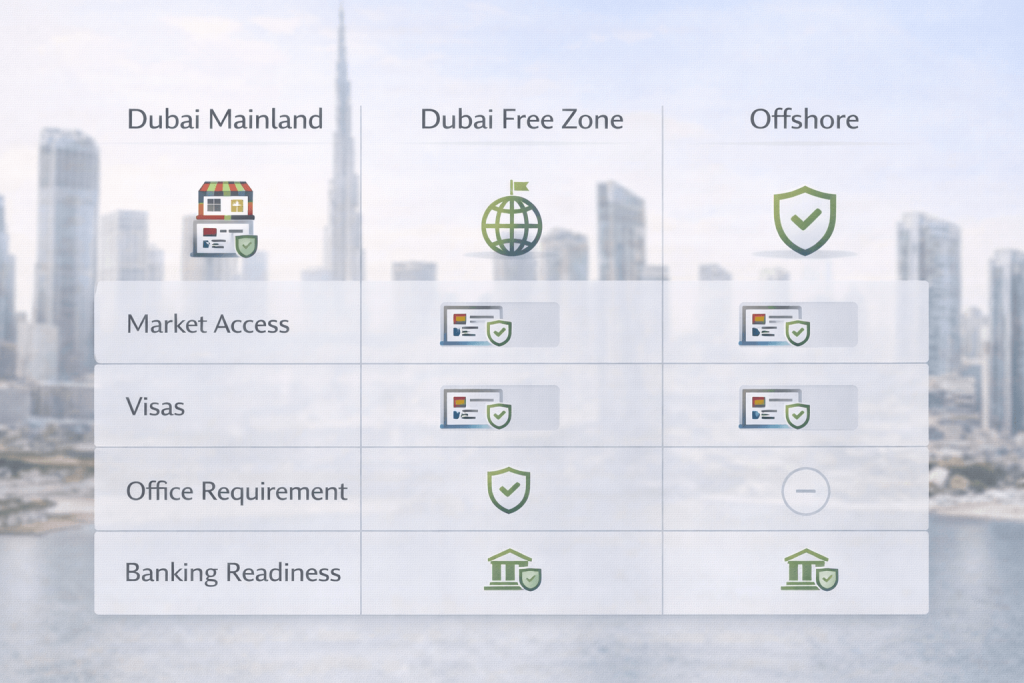
The biggest “make-or-break” decision is your jurisdiction. Here’s the fastest way to choose:
Choose Dubai mainland if you need:
- Full access to trade across the UAE market without extra operational workarounds
- A client-facing local presence (on-site services, retail, projects, government tenders, etc.)
- More flexibility on where you lease offices (subject to requirements for your activity)
Choose a Dubai free zone if you want:
- A streamlined setup designed for international trade, digital services, e-commerce, consulting, and holding structures
- Packaged options (licence + workspace + visas) that can be simpler for startups
- A sector-aligned ecosystem (e.g., trade hubs, media, tech, logistics)
Choose offshore if your goal is:
- A non-operating holding structure (assets, shares, international invoicing where permitted)
- No UAE visas, no local office, and no day-to-day UAE operations
The practical rule: build your company backwards from three constraints:
(1) where you must legally trade, (2) who needs visas, and (3) how you’ll open and run a corporate bank account.
Step 2: Pick the licence type that matches your activity
Dubai licensing starts with your activity. Your activity drives:
- The licence category
- Whether you need external approvals
- Your office/workspace requirements
- Your visa quota options
- Your banking risk profile (and how strict compliance will be)
Common licence categories you’ll see include:
- Commercial licence (trading, import/export, general trading, e-commerce trading models)
- Professional licence (consulting, marketing, management services, IT services, design, etc.)
- Industrial licence (manufacturing, processing, industrial operations)
- Tourism licence (travel/tour operations and related)
- Other activity-based categories depending on sector and emirate-level rules
Tip: If your business model includes multiple revenue streams, choose activities that match your real operations. Many delays happen when the licence says one thing but the bank account application or invoices show another.
Step 3: Decide your legal structure (and keep it simple)
Your legal form affects ownership, liability, documentation, and approvals.
Common options include:
- LLC (a standard limited liability structure used widely across mainland and free zone contexts)
- Sole establishment (often used for certain professional activities; rules vary)
- Branch (for an existing UAE company, free zone entity, or foreign parent company)
- Holding company (when the objective is ownership of assets/shares rather than trading)
Keep your first setup simple unless complexity is truly necessary. A clean structure is usually faster to approve, easier to bank, and cheaper to maintain.
Step 4: Prepare your document checklist (individual vs corporate shareholder)
Your exact checklist depends on your structure, shareholders, and whether you’re setting up remotely. As a baseline, expect:
For most individual founders:
- Passport copy (clear, valid)
- Visa/entry status documents (where applicable)
- Passport photo(s) in required format
- Contact details and residential address details
- Basic business description (what you do, who you sell to, where revenue comes from)
If you have a corporate shareholder or foreign parent:
Expect additional due diligence, typically including:
- Parent company incorporation documents
- Board resolution approving the UAE setup
- Shareholder/beneficial owner details
- Attestation/legalisation requirements depending on origin and authority expectations
- Certified legal translation where required (often into Arabic for certain submissions)
Banking note: even if the licence authority accepts minimal paperwork, banks often require deeper due diligence. Build a bank-ready file early (there’s a checklist below).
Step 5: Reserve your trade name (and avoid instant rejections)
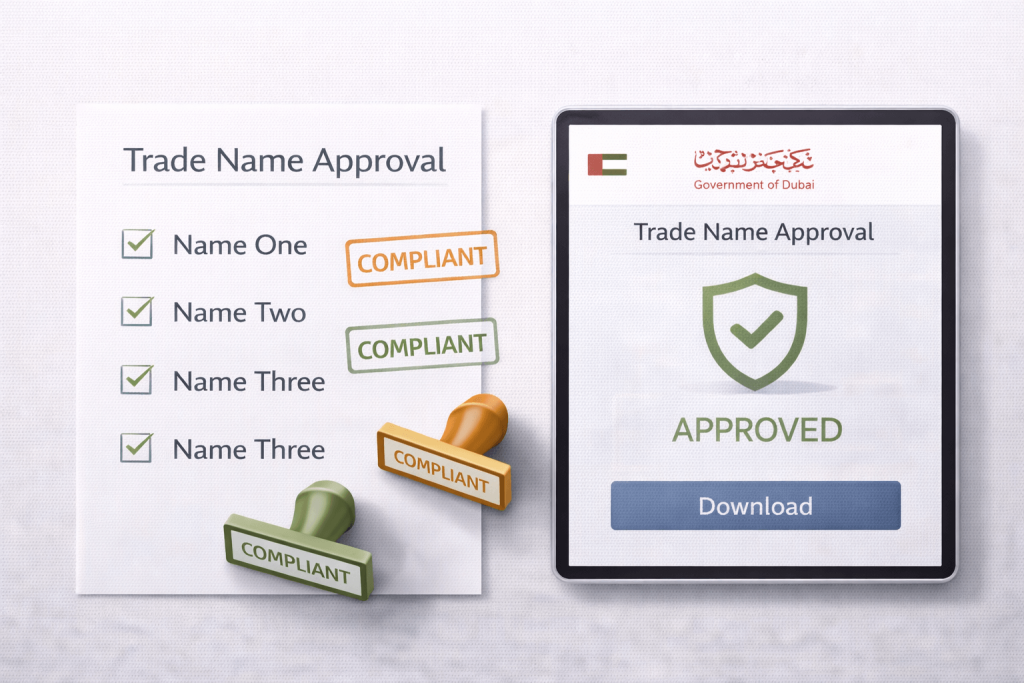
Trade name rules are strict, and rejections waste time.
A strong naming approach:
- Prepare 3–5 options in priority order
- Avoid restricted terms unless you have approvals
- Ensure the name matches your activity and legal form (suffix rules may apply)
- Avoid anything that could be interpreted as offensive or misleading
If you’re naming the company after a person, some authorities require additional proof and format rules—so check early.
Step 6: Get initial approval (the green light to proceed)
Initial approval is essentially “no objection” to form the company under the proposed activity and structure. It typically comes before final licence issuance and before some downstream steps like lease registration and certain approvals.
This stage is where you confirm:
- Your activity selection is acceptable
- Your structure matches the activity
- Your shareholder/manager details are acceptable
- Any extra approvals needed are identified early
Step 7: Draft and sign the key formation documents
Depending on your structure, you may need:
- Memorandum of Association (MOA) (common for LLC-style structures)
- A service agent arrangement (for some professional structures, where applicable)
- Manager/shareholder resolutions and appointment documents
- Specimen signatures and authorisations
This is a common delay-point when founders sign mismatched documents (wrong names, inconsistent passport details, different signatures). Consistency matters.
Step 8: Secure your business address or workspace

Dubai requires a business address. What qualifies depends on:
- Your jurisdiction (mainland vs free zone)
- Your activity
- Your visa plan
- Authority-specific rules
Common workspace paths:
- Flexible workspace / desk packages (often used by startups and service businesses)
- Serviced offices (useful for teams needing meeting space and presence)
- Traditional leased office/warehouse (often required for certain activities, headcount, or operational models)
If you choose mainland and need a formal lease registration process, make sure your office solution meets the authority’s requirements before you pay.
Step 9: Final submission, fees, and licence issuance
Once documents are complete, you submit the final application, pay the fees, and receive:
- Your trade licence
- Company registration documents (varies by jurisdiction)
- Establishment/immigration file (when visas are involved)
From here, your company is legally formed—but it’s not fully “operational” until visas and banking are handled correctly.
Step 10: Visas, Emirates ID, and getting operational
If you need UAE residency visas (for you, partners, employees, or dependents), plan for:
- Entry permits (if needed)
- Medical fitness test and biometrics
- Emirates ID application
- Visa stamping processes
- Labour/immigration formalities (for employees)
Practical advice: don’t treat visas as an afterthought. Your visa plan affects workspace requirements, costs, timelines, and banking.
The bank-ready checklist (what most guides don’t tell you)
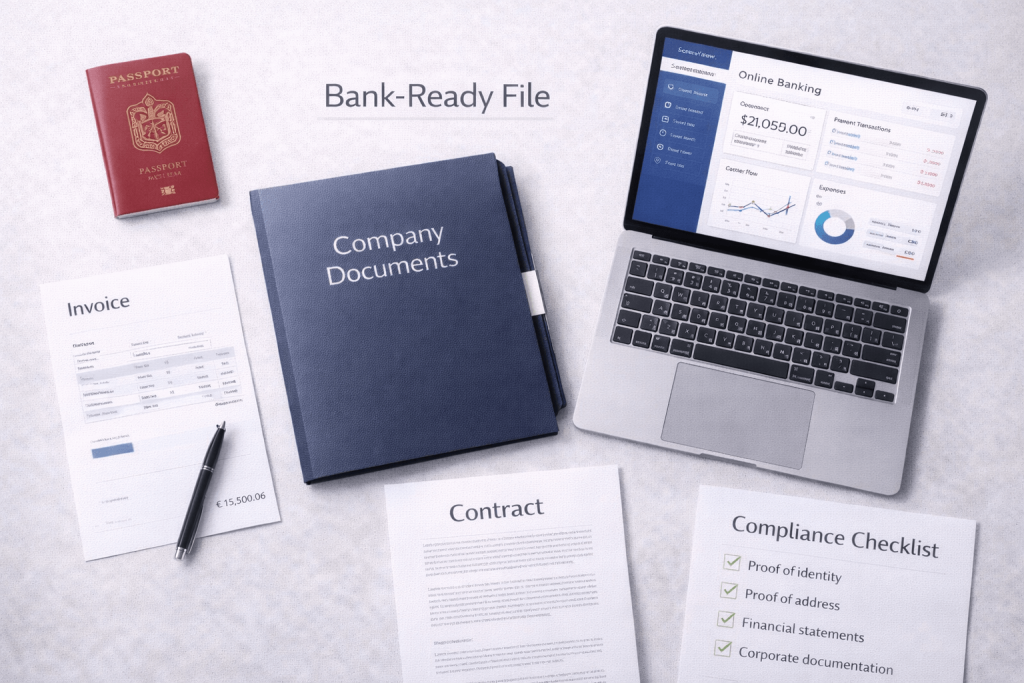
Many founders get the licence, then lose weeks (or months) trying to open a corporate bank account because the file isn’t compliance-ready.
A bank-ready setup typically includes:
1) Clear business story (in writing)
- What you do (specific, not vague)
- Who you sell to (countries, industries)
- How you get paid (invoices, contracts, payment processors)
- Expected monthly volumes and transaction types
2) Proof of commercial substance
Depending on the bank and activity:
- Website and professional email domain
- Signed client contracts (or pipeline evidence)
- Supplier agreements (if trading)
- Invoices and delivery flow (if e-commerce)
- Office/workspace evidence (even if flexible)
3) Clean shareholder/UBO file
- Consistent personal details across all documents
- Source-of-funds explanation where relevant
- Corporate shareholder documentation if applicable
4) A realistic bank strategy
Different banks prefer different profiles. The “best bank” depends on:
- Your activity category and risk level
- Nationality mix of shareholders
- Expected currency flows
- Whether you need trade finance or just payments + online banking
If you want your setup to move faster, your bank strategy should be designed at the same time as your licence route—not after.
Timeline: how long it takes to open a company in Dubai
Realistic timelines depend on three things:
- Whether your activity needs special approvals
- Whether your documentation is clean and consistent
- Whether visas and banking are part of the initial plan
A typical founder-friendly timeline looks like:
- Formation and licence: often achievable in days to a few weeks depending on route and approvals
- Visas: can add additional time due to medical, biometrics, and processing
- Bank account: depends heavily on file quality and bank compliance
If you want a predictable timeline, the key is to build one integrated plan that covers licence + visas + bank readiness together.
Costs: what you’re actually paying for (and what drives the total)
Company setup costs in Dubai are rarely one number, because the total includes multiple layers:
Core cost components
- Government fees (licence, registration, approvals)
- Workspace/lease package
- Visa quotas and immigration file setup (if needed)
- Medical + Emirates ID + visa stamping costs
- Ongoing renewals and compliance
What drives costs up
- Regulated activities and extra approvals
- Multiple shareholders or corporate shareholders
- Larger visa quotas and bigger workspace requirements
- Banking complexity (cross-border structures, high-risk activities, complex transaction flows)
A good setup plan separates:
- Mandatory costs (you can’t avoid)
- Optional upgrades (you choose based on your model)
- Avoidable mistakes (the hidden costs most founders accidentally create)
Common mistakes that slow down Dubai company formation
Avoid these and your setup becomes dramatically smoother:
- Choosing a jurisdiction that doesn’t match how you actually sell or operate
- Selecting activities that don’t align with your invoices, website, or contracts
- Submitting inconsistent identity details (names, signatures, passport scans)
- Treating banking as “step 12” instead of “step 1”
- Over-building too early (large lease, high visa quota) before you validate demand
- Using a generic “from price” package without checking what’s excluded
A practical example: picking the right setup in under 15 minutes
If you’re stuck between mainland and free zone, use this decision filter:
You should lean mainland if:
- You’ll deliver services on-site in Dubai/UAE
- You need the broadest local trading flexibility
- You want maximum freedom on office location
You should lean free zone if:
- You sell internationally or remotely (services, digital, e-commerce, trading via approved channels)
- You want a packaged setup and predictable onboarding
- You want a structure designed for startups and cross-border operations
You should lean offshore if:
- You don’t need visas
- You don’t need local operations
- You’re building a holding structure rather than a trading operation
If you want the fastest correct answer for your exact situation, a short consultation typically saves weeks of course-correction later.
“First Elite Global made setting up in Dubai surprisingly straightforward. They handled the paperwork, dealt with the free zone and bank, and kept us informed at every step.”
Ready to open your company in Dubai without guesswork?

If you want a clean, bank-ready setup plan (licence route, activity selection, document pack, visas, and banking strategy), First Elite Global can take you from idea to issued licence with a structured process and one point of contact—so you spend your time building the business, not chasing approvals.
FAQs
1) How to open a company in Dubai as a foreigner?
Most foreign founders can open a company in Dubai by choosing a jurisdiction (mainland or free zone), selecting an approved activity, reserving a trade name, getting initial approval, securing a business address/workspace, and completing final submission for licence issuance. Visas and banking are handled after (or alongside) formation depending on your plan.
2) What documents do I need for Dubai company registration?
A typical Dubai company registration requires passport copies, entry/visa status details where applicable, shareholder/manager information, and formation documents such as an MOA depending on your structure. Corporate shareholders and foreign parent companies usually require additional incorporation documents and due diligence.
3) Which is better: Dubai mainland or Dubai free zone company setup?
Dubai mainland is usually better for businesses needing full UAE market access and on-the-ground operations. A Dubai free zone setup is often better for international trade, digital services, startups, and packaged licence/workspace/visa solutions. The best option depends on where you will trade, your visa needs, and your banking profile.
4) How long does it take to open a company in Dubai?
It can range from days to a few weeks for straightforward cases, depending on the jurisdiction, approvals, and how clean your documentation is. Visas and corporate bank account opening can add additional time, especially if your compliance file is not prepared early.
5) Do I need an office to open a company in Dubai?
Yes, you typically need a business address. In free zones, this is often satisfied through workspace packages (including flexible options). On the mainland, certain activities and visa plans may require a registered lease arrangement that meets authority requirements.
6) Can I open a company in Dubai without living there?
In many cases, yes—especially for certain free zone setups where parts of the process can be handled remotely. However, if you need a residence visa or specific banking steps, you may need to be present for medical, biometrics, or bank verification depending on requirements.