
Starting a business in Dubai can be fast and straightforward—if you choose the right setup route from day one. The biggest delays (and unexpected costs) usually come from a mismatch between what you want to do and what your licence legally allows, plus avoidable issues around premises, visas, and banking.
This guide shows you exactly how to start a business in Dubai step by step, with a practical decision framework, a clear cost checklist, and real-world pitfalls to avoid—so you can launch clean, stay compliant, and scale without having to restructure later.
Step 1: Choose the right setup route (mainland vs free zone vs offshore)
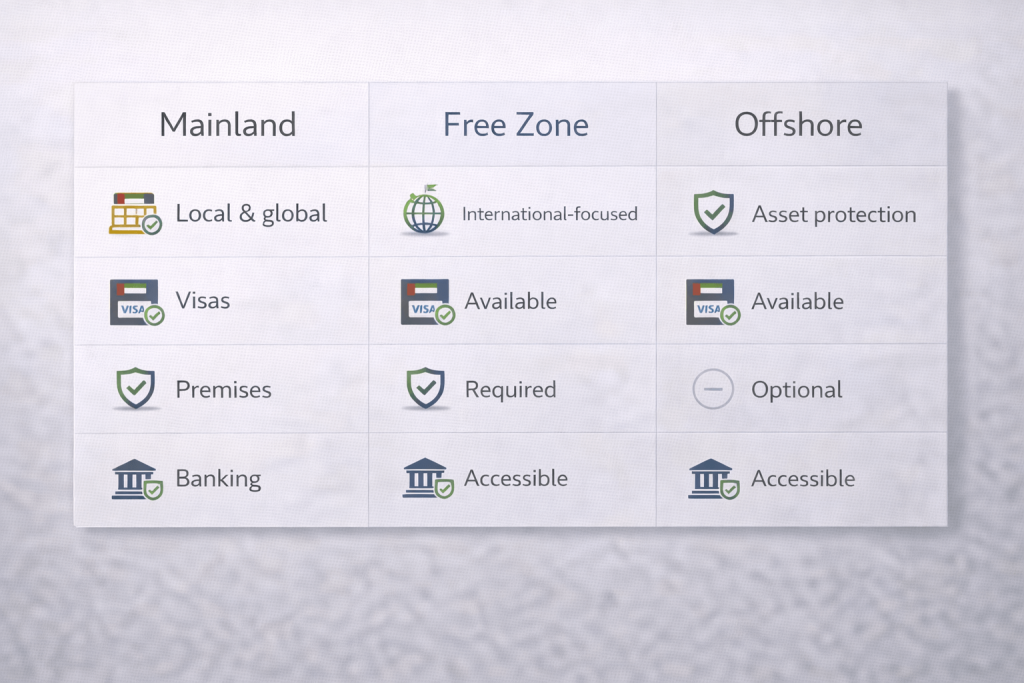
Before you pick a licence, pick the route that fits how you’ll actually operate.
Mainland (Dubai “onshore”)
Best if you need:
- Full UAE market access (sell to UAE customers, sign local contracts freely)
- A wider set of activities and fewer operational restrictions
- A structure that banks often understand quickly
Free zone
Best if you want:
- A faster, packaged setup (often with office/desk options)
- An ecosystem aligned to your sector (trading, services, tech, media, logistics, etc.)
- A setup designed around international operations, e-commerce, or regional HQ needs
Practical note: Some free zone companies can access mainland opportunities through specific permits/dual-licensing arrangements depending on the zone and activity—worth planning for upfront if mainland revenue is part of your roadmap.
Offshore
Best if you need:
- A holding/structuring vehicle (assets, shares, international contracting)
- A UAE-linked entity without operating locally like a normal trading/services company
(Offshore is usually not the first choice if visas, local premises, and local trading are essential.)
If you want a setup recommendation tailored to your activity, visa plan, and budget, request a free consultation and get a clear route map before you pay any fees.
Step 2: Define your business activity (this controls everything)
In Dubai, your business activity drives:
- The licence type
- Whether you need extra approvals
- Your visa allocation
- Banking appetite and compliance checks
- Where you can legally operate (especially for regulated sectors)
Examples of activities that commonly trigger additional approvals:
- Healthcare, education, financial services, F&B, construction/technical services, travel/tourism, and certain trading categories.
Rule of thumb: If your website, invoices, and contracts won’t match your licensed activity wording, fix it now—banks and regulators notice later.
Step 3: Choose your licence type (the core categories)
Dubai typically groups licences into broad types such as:
- Commercial (trading, general trading, import/export, retail/wholesale)
- Professional (services, consulting, creative/marketing, IT services, training)
- Industrial (manufacturing/production)
- Tourism (travel-related)
- Other specialised categories depending on activity and authority
Pick the licence that matches how revenue will be generated. For example:
- “Consulting” revenue usually aligns with professional
- Product buying/selling aligns with commercial
- Blended models may require carefully selected activity combinations
Step 4: Pick a legal structure that matches your risk and ownership plan
Common structures you’ll encounter:
- LLC (popular for many operating businesses)
- Sole establishment / sole proprietorship (often used for certain professional activities)
- Branch (for existing companies expanding to Dubai)
- Free zone entities (often framed as single-shareholder vs multi-shareholder company types depending on the zone)
Key considerations:
- Liability exposure
- Number of shareholders
- Whether you need investors later
- Whether you want to add operating entities under a holding structure
If you’re planning to scale, hire, or raise funds, design your structure for the next 24 months—not just the cheapest launch option.
Step 5: Check foreign ownership eligibility and any restrictions
Most activities allow 100% foreign ownership, but certain strategic/restricted activities may require additional conditions.
If your activity is in a sensitive or regulated sector, confirm:
- Ownership rules
- Approval path
- Compliance obligations (ongoing, not just at setup)
Step 6: Reserve a trade name (and avoid common rejection reasons)
Trade name approval is usually quick—but rejections cause avoidable delays.
Avoid:
- Offensive or culturally sensitive wording
- References to political groups or prohibited terms
- Names that imply regulated activities you’re not licensed for
- Using initials where a personal name is required (if naming after a person)
Pro tip: Prepare 3–5 name options and keep them aligned to the activity category.
Step 7: Get initial approval (your “green light” to proceed)
Initial approval confirms there’s no objection to establishing the business under your proposed:
- Activity
- Structure
- Ownership
- Trade name direction
It typically enables next steps like finalising premises, signing documents, and moving to licence issuance.
Step 8: Secure premises (office, flexi-desk, or lease—depending on the route)
Premises requirements vary by:
- Mainland vs free zone
- Activity
- Visa count
- Authority rules
Options often include:
- Physical office lease
- Serviced office
- Flexi-desk / shared desk (commonly used for lean startups, especially in free zones)
Plan premises with visas in mind: many businesses end up upgrading office solutions later purely to increase visa allocation.
Step 9: Prepare your documents (and don’t underestimate this step)
While exact requirements vary, commonly requested items include:
- Passport copy and basic personal details for shareholders/managers
- UAE entry status (where applicable)
- Company documents (if a corporate shareholder is involved)
- Articles/Memorandum (depending on structure)
- NOC or other supporting letters (case-by-case)
For branches or foreign company shareholders, you may need:
- Board resolutions
- Certificates of incorporation
- Attested and legally translated documents (often into Arabic, depending on use case)
Clean documentation is one of the fastest ways to shorten your timeline. If you want a tailored checklist for your structure, ask for a setup document pack before you start.
Step 10: Apply and collect your trade licence
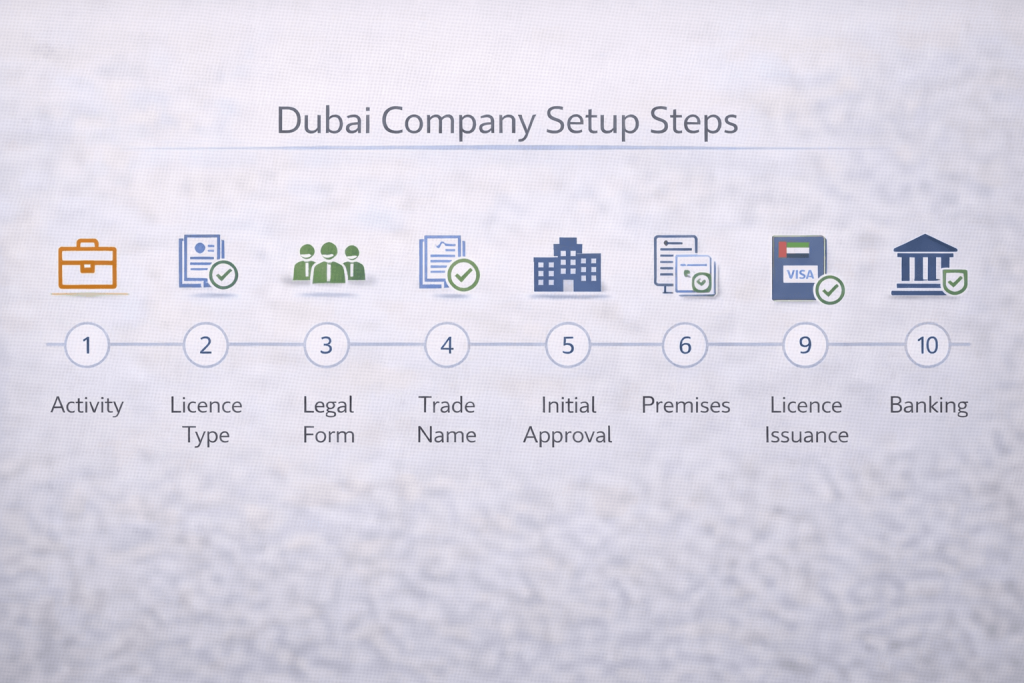
Once documents, premises, and approvals are in place:
- Submit the application through the relevant authority/portal/service centre
- Pay fees
- Receive the trade licence
In some cases, once everything is ready and approved, issuance can be very fast.
Step 11: Set up immigration files and visas (owner, staff, family)
If visas are part of your plan, your setup typically moves through:
- Establishment/immigration file creation
- Entry permit (if applicable)
- Medical test + biometrics
- Emirates ID processing
- Visa stamping/status finalisation (as required)
Visa validity often depends on the sponsoring entity type and jurisdiction.
If you want your visa processed with minimal back-and-forth, bundle it into the setup plan from day one rather than adding it after the licence is issued.
Step 12: Open a corporate bank account (plan for compliance, not just paperwork)

Banking isn’t just “submit documents and wait.” Banks assess:
- Activity and country exposure
- Transaction profile (expected inflows/outflows)
- Source of funds
- Business model clarity (contracts, invoices, website, supplier/customer proof)
What helps:
- A clear activity/structure match
- A simple ownership chain
- Clean documentation
- A credible business narrative (what you sell, to whom, and how you deliver)
If banking is critical to launch, build your setup route around bankability. A “cheap” licence that banks don’t like can cost more in delays than it saved in fees.
Step 13: Get tax-ready (corporate tax and VAT basics)
Even if your tax due is low, compliance matters.
Corporate tax (high-level)
The UAE operates a tiered corporate tax approach with a 0% band and a 9% band depending on taxable profit. Some small businesses may qualify for relief under specific conditions, but they still need to keep records and file correctly.
VAT (if applicable)
VAT registration is generally triggered by taxable turnover thresholds, with voluntary registration possible at lower levels depending on your situation.
A smart move: set up basic bookkeeping from month one—clean financials help with banking, renewals, and staying penalty-free.
Setup timeline: what to expect (realistically)
Your timeline depends on:
- Activity (regulated vs standard)
- Mainland vs free zone vs offshore
- Document readiness
- Premises and visa requirements
A practical way to think about timing:
- Planning + approvals: fast when documents are ready and the activity is straightforward
- Licence issuance: quick once approvals and premises are cleared
- Visas + Emirates ID: adds time due to medical/biometrics steps
- Banking: varies widely depending on profile and documentation strength
If you want a predictable launch date, start with a structured plan that maps approvals, documents, and banking requirements before you submit anything.
Cost checklist: what you should budget for (so nothing surprises you)
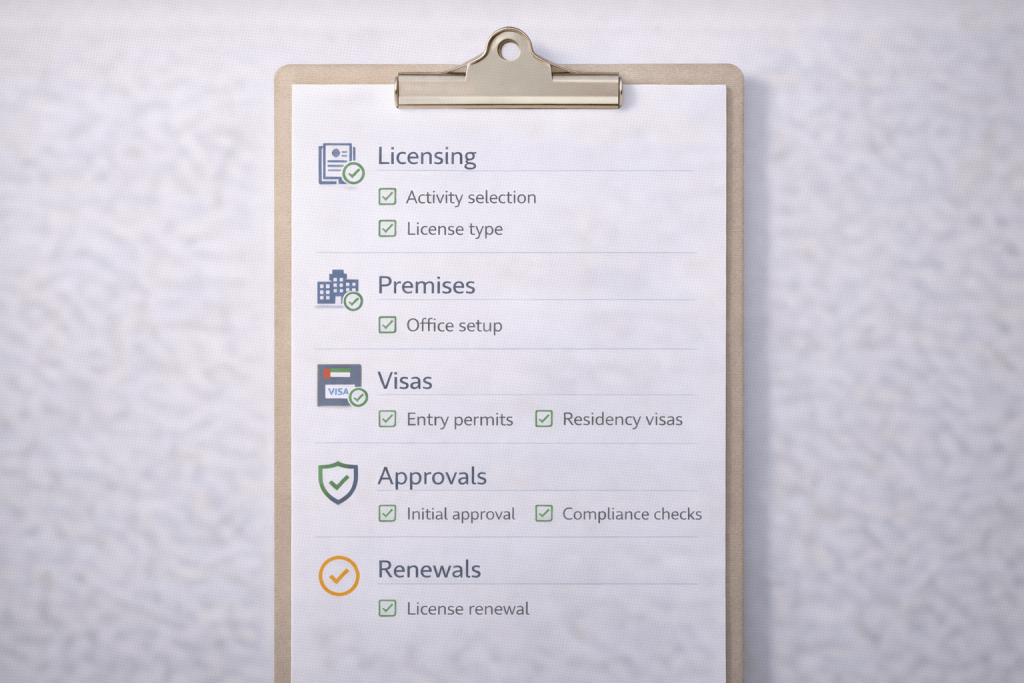
Exact costs vary by route, activity, and visa needs. Use this checklist to build a realistic budget:
One-time / setup costs
- Trade name reservation
- Initial approval and application fees
- Licence issuance fees
- Legal drafting/notary (as required)
- External approvals (if regulated)
- Establishment/immigration file opening
- Corporate documents attestation/legal translation (if required)
Premises-related costs
- Office lease / serviced office / flexi-desk package
- Security deposit (where applicable)
- Ejari/tenancy registration (where applicable)
Visa-related costs (per person)
- Entry permit/status change (if applicable)
- Medical test
- Emirates ID
- Visa stamping/finalisation
Ongoing annual costs
- Licence renewal
- Office renewal (desk/lease)
- Visa renewals (timed cycles)
- Accounting/bookkeeping
- Corporate tax and VAT compliance (where applicable)
As a rough starting point for straightforward setups, many entrepreneurs budget in the tens of thousands of dirhams once licensing, a basic premises solution, and visas are included—then adjust based on activity complexity and headcount.
If you want an exact, itemised estimate aligned to your activity and visa plan, request a free consultation and get a clear proposal that avoids hidden add-ons.
Common mistakes that delay launches (and how to avoid them)
1) Picking a route based on price, not operations
Cheap now can mean expensive later if you need mainland access, more visas, or bank acceptance.
2) Activity mismatch (licence vs real-world business)
If your marketing and invoices don’t match licensed activities, you risk compliance issues and banking friction.
3) Underestimating regulated approvals
If approvals are required, build them into timeline and budget early.
4) Treating banking as an afterthought
Banking works best when your structure, activity, and documentation are designed for it.
5) Ignoring renewal and compliance from day one
A “successful setup” is one that renews smoothly and stays compliant without panic.
Mini case examples: choosing the right Dubai setup
Case A: Consultant or agency selling services to UAE clients
Best fit is often:
- Mainland professional setup (for local contracting), or a free zone route with a clear plan for mainland access if required
- Lean premises to start, expand later for visas
Case B: E-commerce brand importing and selling products
Best fit often depends on:
- Where you’ll store stock
- Whether you need mainland retail/trading access
- Customs/import workflow and activity wording
A clean commercial structure plus strong documentation helps banking and payment providers.
Case C: Holding company for assets and international deals
Often best suited to:
- An offshore or specialised holding structure
(Usually not the right route if your priority is day-to-day local trading with visas.)
A quick “start-to-licence” action plan you can copy
- Decide your route: mainland vs free zone vs offshore
- Lock the exact business activity wording
- Select licence type + legal structure
- Reserve trade name (prepare backup options)
- Get initial approval
- Confirm premises solution aligned to visa plan
- Prepare documents and any attestations/translations
- Submit application and collect trade licence
- Open immigration file and process visas
- Prepare bank account pack (activity narrative + docs)
- Set up bookkeeping and tax readiness
- Launch operations + plan renewals

If you want this action plan converted into a personalised setup roadmap with an itemised cost sheet, book a free consultation and get a clear path from idea to licence—without guesswork.
FAQs
1) How to start a business in Dubai as a foreigner?
Choose the right setup route (mainland or free zone for most operating businesses), select an approved activity, reserve a trade name, obtain initial approval, secure premises if required, and collect your trade licence. Then process visas and banking based on your needs.
2) What are the main licence types in Dubai?
The most common categories include commercial (trading), professional (services/consulting), industrial (manufacturing), and tourism-related licences, plus specialised categories depending on activity and authority.
3) How much does it cost to start a business in Dubai?
Costs depend on the route (mainland vs free zone), activity, premises requirements, and visa count. Budget for licensing fees, premises, visas per person, and annual renewals. The fastest way to get an accurate figure is an itemised estimate aligned to your activity and visa plan.
4) Can I start a Dubai business without an office?
Some setups allow flexi-desk or serviced office solutions, especially in free zones or specific packages, while other activities and routes may require a registered physical premises. Your visa needs often influence the premises requirement.
5) How long does it take to start a business in Dubai?
Timelines vary based on activity complexity and approvals. Straightforward cases can move quickly once documents are ready, while regulated activities, visas, and banking can extend the overall timeline.
6) Do I need VAT registration to start a business in Dubai?
Not always at launch. VAT registration generally depends on taxable turnover thresholds and whether you meet mandatory criteria. Some businesses register voluntarily depending on their model.
Helpful Links
- Dubai government guide: Starting a business (mainland vs free zone, steps)
- Invest in Dubai portal (setup services, trade name, licence issuance)
- UAE Ministry of Economy & Tourism: establishing companies / steps
- Federal Tax Authority: VAT registration threshold and rules
- Federal Tax Authority: Corporate tax registration (EmaraTax)
- Ministry of Finance: corporate tax overview (rates and frameword)