Starting a business in Dubai free zone is one of the fastest ways to build a UAE base with global reach—especially if you want full foreign ownership, clear licensing pathways, and a setup process designed for international founders. The real win is not “free zone vs mainland” in theory; it’s choosing the right free zone for your activity, banking profile, visa needs, and growth plan—so you don’t have to restructure in 6–12 months.
If you want a personalised route (free zone shortlist + realistic cost snapshot + timeline), book a free consultation with First Elite Global and get a clean proposal you can act on.
What a Dubai Free Zone Company Actually Is
A Dubai free zone is a dedicated economic jurisdiction with its own authority that issues licences, registers companies, and often provides bundled packages (licence + workspace + visa eligibility).
Simple definition:
A free zone company is a UAE-registered entity licensed by a free zone authority—typically built for international trade, services, e-commerce, and sector-specific ecosystems.
Free zone vs mainland vs offshore (quick clarity)
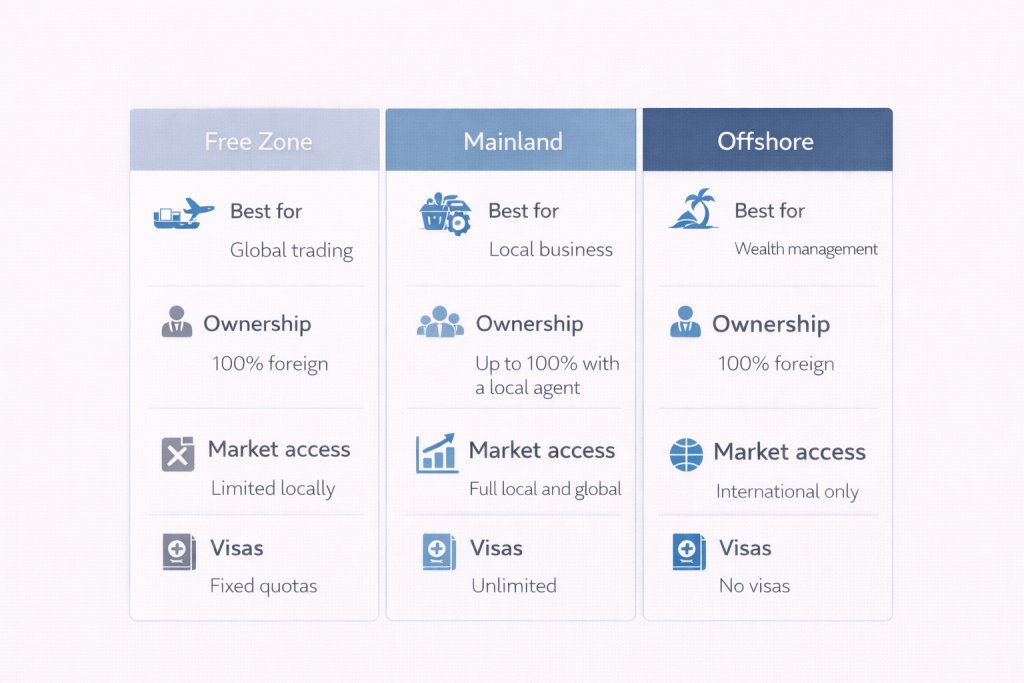
| Option | Best for | Key limitation to plan for |
| Free zone | International services, e-commerce, trading/re-export, startups, SMEs, holding + operations | Direct mainland trading usually needs a compliant route (e.g., distributor/branch/dual structure where applicable) |
| Mainland | Full UAE market access, local retail, government work, broad contracting | Often higher operating overhead; activity approvals can be stricter |
| Offshore | Asset holding, international structuring, property holding (where applicable) | Typically not designed for operational business or visas |
Rule of thumb: If revenue is primarily outside the UAE (or online), a free zone often fits. If revenue must be generated directly across the UAE market at scale, mainland tends to be the cleaner long-term play.
Free Zone Benefits That Matter in Real Life
You’ll see long lists online. Here are the benefits that actually change outcomes for founders:
1) Full foreign ownership and control
Many free zones allow 100% foreign ownership—so your cap table, IP, and governance stay clean from day one.
2) Faster setup with structured packages
Free zones are built to onboard businesses quickly, often via digital portals and step-by-step workflows. In practice, speed comes from having your activity, documents, and banking readiness aligned upfront.
3) Clear licensing categories for modern business models
Consulting, marketing, software, trading, e-commerce, media, education, logistics—free zones commonly provide activity lists that match how businesses operate today (and allow multi-activity licences in many cases).
4) Workspace options that reduce overhead
Flexi-desk and co-working packages can be ideal for lean starts—especially if you want visa eligibility without committing to a full office too early.
5) Sector ecosystems that unlock partnerships
Some free zones are magnets for certain industries (trade/commodities, logistics, tech, media, finance, aviation). This can be a hidden advantage for hiring, networking, supplier access, and credibility.
6) Practical visa pathways
A correctly structured setup can support owner visas, employee visas, and family sponsorship—without overbuying visas you don’t need yet.
Client note (from a recent free zone setup experience):
“First Elite Global made our Dubai free zone setup surprisingly straightforward. Everything from licence to visas and bank account was handled with professionalism and clear updates.”
When a Dubai Free Zone Is the Best Choice (and When It Isn’t)
A free zone is usually ideal if you are:
- A consultant, agency, or specialist service provider serving regional/global clients
- Running e-commerce, online trading, or a digital product business
- Building a trading/re-export model using Dubai as a logistics hub
- Launching a startup that needs speed, visas, and a sensible first-year cost base
- Setting up a regional HQ or project entity for Gulf expansion
A free zone may not be the best fit if you:
- Need to sell directly into the UAE mainland at scale from day one (retail-heavy, high-volume B2C)
- Need a large physical shopfront or multiple UAE branches quickly
- Operate in a heavily regulated activity that requires specific external approvals (still possible—just needs planning)
If you’re unsure, the smartest move is a 15-minute “jurisdiction fit” call that maps your revenue model and mainland exposure—before you commit to any licence.
Step-by-Step: How to Set Up a Business in Dubai Free Zone
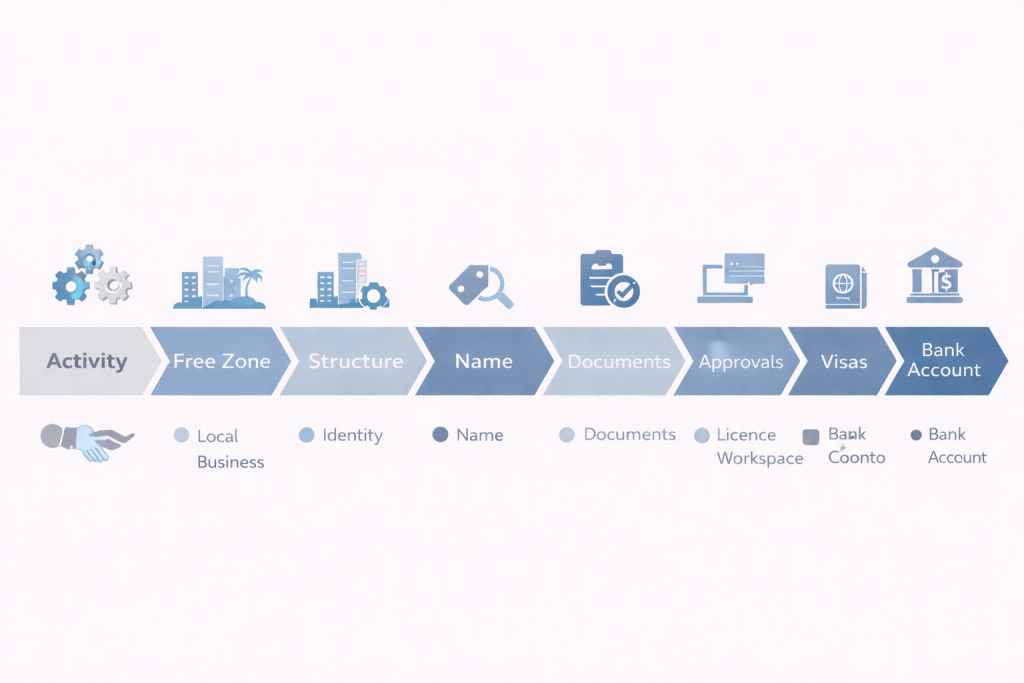
This is the practical setup path that avoids the most common delays.
Step 1: Choose the right business activity (don’t guess)
Your activity drives:
- Which free zones can license you
- Which approvals you may need
- What banks will ask during compliance checks
- What you can legally invoice for
Pro move: Write a one-sentence “what we do” plus 3–5 revenue streams. Then match the licence to how money actually enters the business.
Step 2: Pick a free zone based on your operating reality
Shortlist zones using:
- Activity fit + approval speed
- Visa needs (now vs later)
- Workspace requirement (flexi-desk vs office vs warehouse)
- Banking friendliness for your profile
- Reputation for your industry and client base
Step 3: Select the company structure
Most founders choose one of the following:
- Single shareholder entity (clean ownership)
- Multi-shareholder entity (partners/investors)
- Branch (if you already have an existing company and want a UAE presence)
Step 4: Reserve a trade name and prepare documents
Typical documents include:
- Passport copy, photo, and basic personal details
- Proof of address (often requested)
- Brief business description (sometimes a business plan for certain activities)
- Existing company documents (if setting up a branch)
Step 5: Submit the application and get initial approvals
This is where timing is won or lost. Missing details can reset review cycles—especially for regulated activities or when shareholders are based across multiple countries.
Step 6: Secure workspace and issue the licence
Your workspace choice can affect:
- Visa allocation
- Bank perception (some banks prefer certain office setups)
- Renewal costs
Step 7: Establishment card + visas (if required)
If you need residency:
- Establishment card is processed
- Entry permit is issued
- Medical and Emirates ID steps follow
- Visa stamping is completed
Founder-friendly approach: Start lean with the minimum visa plan you need, then scale when headcount and revenue justify it.
Step 8: Corporate bank account setup (the step that needs strategy)
Banks don’t just want documents—they want a coherent story:
- What you sell, to whom, and where
- How payments flow (countries, currencies, platforms)
- Contracts/invoices, website presence, supplier/buyer evidence
- Source of funds (especially for new entities)
If you want this to move faster, prepare a “banking readiness pack” before you apply.
Step 9: Post-licence essentials (to stay compliant)
Plan for:
- Licence renewal calendar
- Bookkeeping/accounting setup
- VAT registration assessment (only if required for your turnover/supplies)
- Corporate tax assessment (including whether you qualify for special free zone treatment)
- Economic substance and ownership reporting where applicable
Dubai Free Zone Cost Overview (What You’ll Pay For)
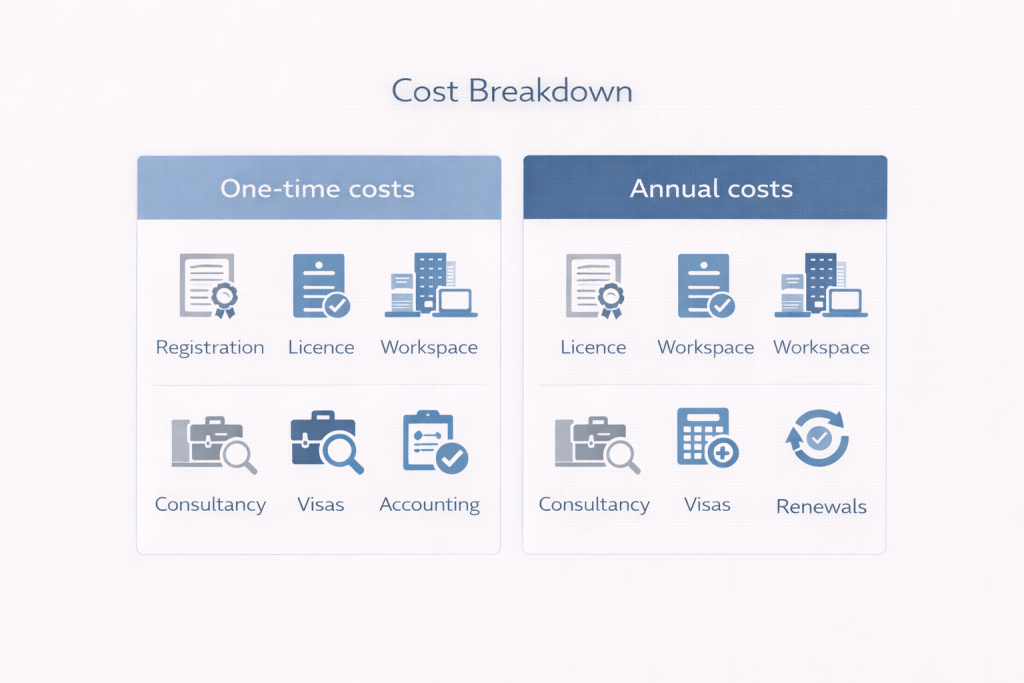
Costs vary by free zone, activity, and package. The cleanest way to budget is to split costs into one-time and annual.
One-time costs (typical categories)
- Registration / incorporation fees
- Initial approvals (if applicable)
- Establishment card (if visas are needed)
- Visa processing (per person)
- Medical + Emirates ID (per visa holder)
Annual costs (typical categories)
- Licence renewal
- Workspace renewal (flexi-desk / office / warehouse)
- Visa renewals (as they fall due)
- Accounting/audit (some zones require audited statements; plan early)
Realistic ranges founders commonly see
- Licence fees: often fall into a broad range depending on zone/activity (many founders budget in the tens of thousands of AED annually)
- Workspace: flexi-desk can be much lower than full offices; premium zones and larger space scale quickly
- Visas: plan per person, not as a lump sum—then scale as you hire
If you want a precise number, you need a precise setup: activity list, shareholder count, visa plan, and workspace preference. That’s exactly what a tailored proposal should include—itemised and transparent.
How to Choose the Right Free Zone (A Practical Scoring Framework)
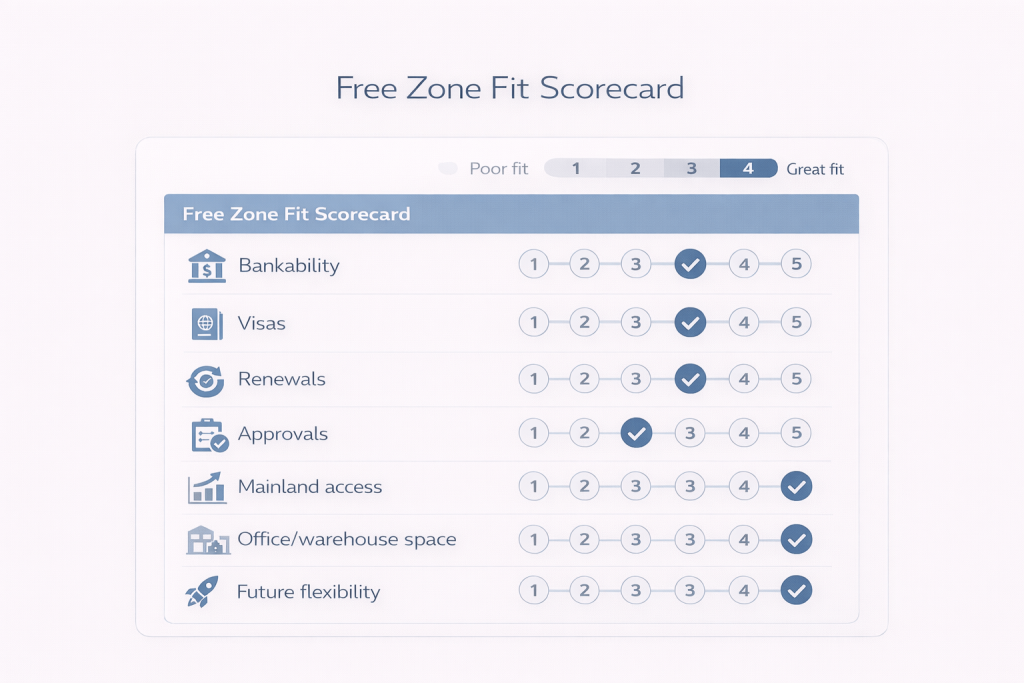
Most founders choose based on price alone—and later pay more to fix the consequences. Use this 7-point scorecard instead:
The 7-point Free Zone Fit Scorecard
- Activity match (licensed today + future-proof for next 12–24 months)
- Bankability (does the zone + structure support your banking path?)
- Visa strategy (minimum viable visas now; scalable later)
- Workspace logic (flexi-desk vs office vs operational space)
- Approval complexity (regulated activity? external approvals?)
- Renewal economics (what does “year 2” look like?)
- Mainland exposure (do you need compliant routes to sell into UAE?)
Shortcut: If you expect UAE mainland clients within 90 days, build the structure for it now—don’t “hope it works out.”
Common Mistakes That Cost Time (and Sometimes Licences)
Mistake 1: Picking the wrong activity because it “sounds close”
If your invoices don’t align with your licensed activity, compliance and banking become harder.
Mistake 2: Underestimating banking compliance
A licence is not the finish line. Banking is where many founders lose momentum. Prepare your documentation, website presence, and revenue story early.
Mistake 3: Buying more visas than you need
Overbuying visas inflates cost and complexity. Start with what’s essential, then scale.
Mistake 4: Ignoring renewal and reporting requirements
Some setups require audited accounts or specific filings. Know what applies before you choose the zone.
Mistake 5: Not planning for mainland trading correctly
Free zone companies can access the UAE market—but the route must be compliant. Get that mapped before you start selling.
Mini Case Examples (How Founders Use Free Zones)
Case 1: UK consultant launching a UAE base (fast, lean, credible)
- Professional activity licence
- Flexi-desk package
- One owner visa + later upgrade
- Banking readiness pack prepared from day one
Case 2: E-commerce brand selling internationally (UAE base, global payments)
- Trading/e-commerce activity coverage
- Clear payment flow documentation (platforms, suppliers, returns)
- Scalable visa plan for operations hires
Case 3: Trading and re-export (logistics-first)
- Zone aligned to ports/warehousing
- Strong compliance file for trade finance and banking
- Contracts and shipping documentation structured early
If you want your best-fit path, share your activity and where your customers are located—then get a recommended zone shortlist with a step-by-step timeline.
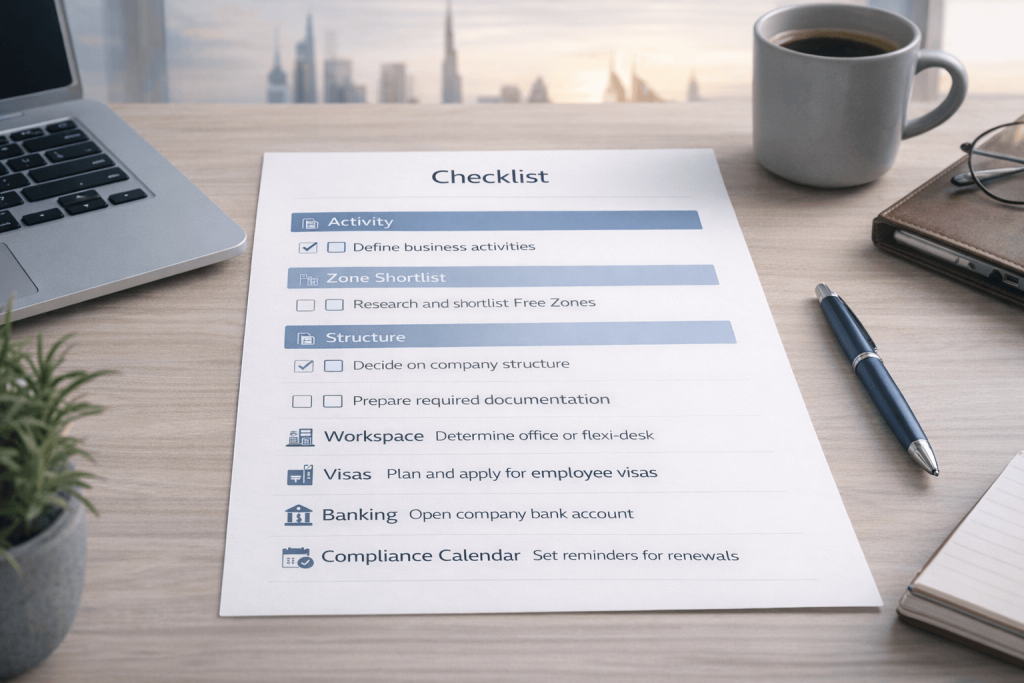
A Founder’s Free Zone Setup Checklist (Copy/Paste)
- Business activity + revenue streams written clearly
- Free zone shortlist (3 options max) with pros/cons
- Ownership structure confirmed (single/multi/branch)
- Trade name ideas prepared (3–5 options)
- Document pack ready (passport, proof of address, company docs if needed)
- Workspace decision made (flexi-desk/office/warehouse)
- Visa plan decided (now vs later)
- Banking readiness pack prepared (contracts/site/source of funds)
- Compliance calendar set (renewals, accounting, filings)
Want this turned into a done-for-you plan with accurate costs? Book a free consultation and get an itemised proposal with clear next steps.
Frequently Asked Questions
1) Can I own 100% of a business in Dubai free zone?
In most free zones, full foreign ownership is available, so you can own and control the company without a local shareholder.
2) How long does it take to start a business in a Dubai free zone?
Timelines depend on activity and document readiness, but many setups are completed within weeks when documents are correct and approvals are straightforward.
3) Can a Dubai free zone company trade in the UAE mainland?
Yes—but it must be done through a compliant route depending on your activity and setup (for example, approved distribution routes or additional structures where applicable).
4) What does a Dubai free zone licence cost?
Costs vary widely by free zone, activity, workspace package, and visa needs. A realistic budget should include both first-year setup costs and renewal costs.
5) Do I need an office for a business in Dubai free zone?
Many free zones offer flexi-desk or co-working solutions that satisfy workspace requirements for licensing—while keeping overhead low.
6) Is a bank account guaranteed after free zone company formation?
No bank account is “guaranteed.” Approval depends on compliance, documentation, business model clarity, and payment flows. Preparation makes the biggest difference.