
If you’re researching activities under general trading license in Dubai, you’re usually trying to answer one practical question: “What am I legally allowed to buy, sell, import, export, store, and distribute under one licence—without getting hit by fines, customs holds, or approvals I didn’t plan for?”
A general trading licence is designed for companies that want to trade multiple categories of goods under a single commercial licence—often ideal for import/export, wholesale distribution, retail, and multi-product businesses.
If you want a clear answer based on your exact products and sales channels, book a free consultation with First Elite Global and we’ll map the right activity mix (and any required approvals) before you spend on issuance.
What a general trading licence lets you do (in plain English)

A Dubai general trading licence typically allows your company to:
- Import goods into the UAE (subject to product rules and approvals)
- Export and re-export goods to other countries
- Buy and sell multiple product categories under one commercial licence
- Trade wholesale (B2B) to distributors, retailers, projects, and corporate buyers
- Trade retail (B2C) through a shop, showroom, or approved selling model
- Store and distribute goods from licensed premises or warehouses (where applicable)
- Supply to projects (e.g., construction, hospitality, offices) when the goods match your approved activities
The key principle: your licence must list the right activity/activities and your products must fit those activities. “General trading” is broad—but it is not a blank cheque.
What it does not automatically cover
A general trading licence is a commercial licence. It generally does not cover:
- Professional services (consulting, marketing, IT services, training, etc.)
- Manufacturing or industrial production
- High-regulation goods without approvals (see the restricted list below)
- Certain online selling models unless the correct activity is included (many businesses add a specific e-commerce/online trading activity)
If your business model mixes goods + services (common in B2B), you often need to structure it properly—either by adding the right activities, adjusting the licence type, or creating a compliant group structure.
General trading vs commercial trade licence in Dubai
A common point of confusion is the wording:
- Commercial trade licence (Dubai) is the licence category used for trading activities (buying/selling goods).
- General trading is a broad trading activity often used to trade multiple categories of goods under that commercial licence.
So, in practice, “general trading” usually sits under a commercial trade licence in Dubai, with the exact scope defined by the activities and any linked approvals.
The activity rule that decides everything
Dubai licensing is activity-driven. That means:
- Your permitted activities are defined by what’s listed on your trade licence record
- Your bank onboarding, customs setup, VAT logic, and even insurance can depend on those activities
- If you trade outside your activity scope, you risk penalties, shipment holds, or forced amendments
A simple way to think about it:
Licence activity = what you are legally allowed to do
Product category + selling channel = what you actually do
They must match.
Activities typically included under a general trading model
Below are the most common “buckets” of activities businesses operate under when using a general trading structure.
1) Import, export, and re-export trading
Ideal for trading houses, distributors, and global supply chains.
Typical transactions include:
- Buying from overseas manufacturers
- Bringing goods into UAE ports
- Re-exporting to GCC, Africa, Europe, or Asia
- Maintaining stock in a UAE warehouse for faster fulfilment
2) Wholesale (B2B) trading and distribution
Common for:
- Building materials suppliers
- Electronics distributors
- Hospitality and retail supply chains
- Corporate procurement supply businesses
You can sell to:
- Retailers and resellers
- Contractors and project companies
- Corporate clients
3) Retail trading (B2C)
Retail is possible when:
- Your activity and premises support it
- You comply with consumer and product rules
- Your jurisdiction model allows it (mainland vs free zone differences matter—see below)
4) Storage and warehousing (where applicable)
Many trading companies need:
- Stock holding
- Inventory management
- Packing/dispatch
Depending on your setup, you may:
- Lease a warehouse
- Use a logistics/3PL partner
- Operate from approved premises that match your activity requirements
5) Multi-category trading (the main advantage)
This is the reason most founders choose general trading: trading more than one product family without needing separate licences for each category—as long as the chosen activities cover them.
A practical “what can I trade?” guide
Instead of guessing, use this framework to classify your products.
Generally straightforward (subject to correct activity selection)
Often easier to license and trade when products are non-restricted and meet standards:
- Non-restricted household goods and general merchandise
- Textiles, garments, accessories (non-regulated)
- Many consumer electronics accessories (non-telecom items)
- Furniture and interiors (subject to product compliance)
- General building materials (depending on type and use)
- Many stationery and office supplies
Often needs approvals, registrations, or extra compliance
These categories commonly require additional steps—plan them early:

| Product category | Why it’s sensitive | What typically happens |
| Foodstuff (import/trading) | Safety, labelling, traceability | Municipality/food compliance steps + approved activity |
| Cosmetics & personal care | Product safety and registration | Product approvals may be required |
| Medical devices & supplies | Health regulation | Health authority approvals may apply |
| Pharmaceuticals | Strictly regulated | Special licensing and approvals required |
| Alcohol / tobacco / vape-related goods | Controlled products | Significant restrictions + approvals |
| Telecom / radio-enabled devices | Network and spectrum compliance | Type approval rules may apply |
| Precious metals / jewellery | Compliance, source-of-funds scrutiny | Higher compliance expectations (banking + trade) |
| Chemicals / industrial substances | Safety and controlled materials | Special approvals and handling requirements |
| Used goods | Consumer protection + quality | Activity and compliance depend on category |
If your product sits in the right-hand column, it does not mean you can’t do it—it means you should structure the licence and approvals correctly from the start.
Mainland vs free zone: how it changes your trading rules
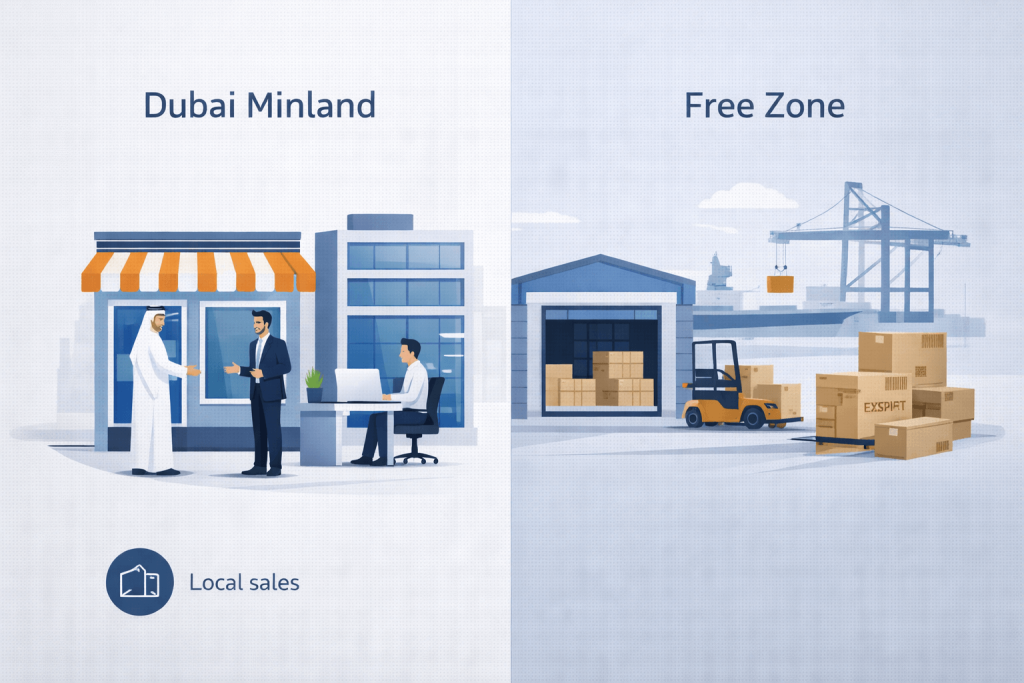
Your licence scope is not only about activities—jurisdiction affects where and how you can sell.
Dubai mainland (commercial trading model)
Mainland is usually best if you want:
- Direct access to the UAE local market
- Flexibility to sell to customers across Dubai/UAE
- A straightforward path for retail/showroom models
- More flexible operating locations (subject to rules)
Free zone (trading model)
Free zones are often ideal if you want:
- A fast setup model for international trading
- A structured base for import/export and re-export
- Access to zone ecosystems (logistics, ports, specific sectors)
However, if you want to sell widely into the UAE local market, you typically need the right compliant route (for example, a local distribution model or an onshore structure—depending on your activity and selling approach).
If you tell us your products, customers, and channels, we’ll advise the cleanest structure. Book a free consultation with First Elite Global and we’ll outline the route in one call.
The approvals reality: “general trading” still has limits
General trading is broad, but you’ll still run into approvals when:
- Your products are regulated
- Your goods require conformity certificates, testing, or special labelling
- You plan to import controlled categories through customs
- Your selling model involves sensitive sectors (health, telecom, controlled consumables)
A smart setup plan includes:
- Selecting the correct activities
- Identifying any external approvals early
- Choosing the jurisdiction that matches your trading model
- Preparing documents in a “bank-ready” way from day one
Step-by-step: how to set up a general trading licence cleanly

A solid setup process usually follows this order:
- Confirm your products and sales channels (B2B, B2C, online, import/export, stock holding)
- Select the best jurisdiction (mainland or suitable free zone)
- Reserve a compliant trade name
- Secure initial approvals
- Prepare your legal documents (company structure, shareholder docs, required forms)
- Confirm premises/lease requirements (office, flexi-desk, warehouse, showroom—depending on model)
- Obtain any external approvals (only if your goods require them)
- Issue the licence and complete establishment/immigration steps (as applicable)
- Set up your trading operations: banking readiness, supplier contracts, logistics
- Register the compliance essentials (tax and reporting obligations based on your situation)
A general trading licence can be straightforward—but only if the activity and compliance planning matches what you’ll actually trade.
Compliance checklist for trading companies (keep this handy)

Use this checklist to avoid the most common “surprise problems”:
- Your licence activities match your products and selling channels
- Your invoices and purchase orders reflect the licensed activity scope
- Product labelling and standards are in place (where required)
- Import/export paperwork is aligned with your actual goods
- Corporate tax registration is completed where required
- VAT registration is handled if you meet the conditions
- Bookkeeping is clean and consistent (banks and authorities care about this)
- Renewals are planned early (licence + visas + premises)
Common mistakes that cause delays (and how to avoid them)
- Choosing “general trading” but selling a regulated product without approvals
- Assuming online selling is automatically included
- Opening a licence that doesn’t match your customer base (local UAE market vs export-led model)
- Underestimating premises requirements (especially for warehousing/retail)
- Not preparing documents in a bank-friendly way (leading to account delays)
Why businesses use First Elite Global for trading licence setup
When trading is your model, speed matters—but clean compliance matters more. A mistake can cost you far more than the licence.
First Elite Global supports trading businesses end-to-end:
- Activity selection and structure planning
- Mainland or free zone setup (based on your trading reality)
- Licensing, visas, and operational readiness
- Guidance on banking expectations and compliance set-up
With 22+ years of experience and 50,000+ companies supported, we know where trading licences typically go wrong—and how to keep your setup smooth.
Book a free consultation and we’ll map your ideal general trading setup (activities, approvals, and practical operating plan) before you commit.
FAQs
1) What are the main activities under general trading license in Dubai?
Most general trading companies operate across import/export, wholesale distribution, retail (where permitted), and multi-category trading—provided the licence activities cover the product categories and selling model.
2) Can I trade any product under a general trading licence in Dubai?
Not automatically. Some products are regulated (e.g., food, medical items, telecom devices, controlled goods) and may require external approvals, specific activities, or additional compliance steps.
3) Is a general trading licence the same as a commercial trade license in Dubai?
A commercial trade licence is the trading licence category. General trading is a broad activity commonly used under that commercial licence to trade multiple categories of goods.
4) Do I need a separate activity for e-commerce or online selling?
Often, yes. Many businesses add an online trading/e-commerce activity to match how they sell, especially if their primary channel is digital.
5) Can a free zone general trading company sell directly in Dubai mainland?
It depends on your exact structure, activity, and selling model. Many businesses use a compliant route (such as distribution arrangements or an onshore structure) if they want broad local market access.
6) Can I add or amend activities later?
In many cases you can amend activities, but it’s better to plan correctly upfront—especially if you will import goods or need approvals, because amendments can delay operations.
Helpful Links
- Dubai DET — Business licensing (licence types and services)
- Invest in Dubai — Search business activities (check activity scope)
- Dubai Customs / Dubai Trade — Customs code registration help:
- Federal Tax Authority — VAT registration thresholds and rules
- Federal Tax Authority — Corporate tax registration service
- Ministry of Finance — Corporate tax overview
- TDRA — Type approval (telecom/radio-enabled equipment)
- UAE Ministry of Economy — Establishing businesses in the UAE (licence type overvies)