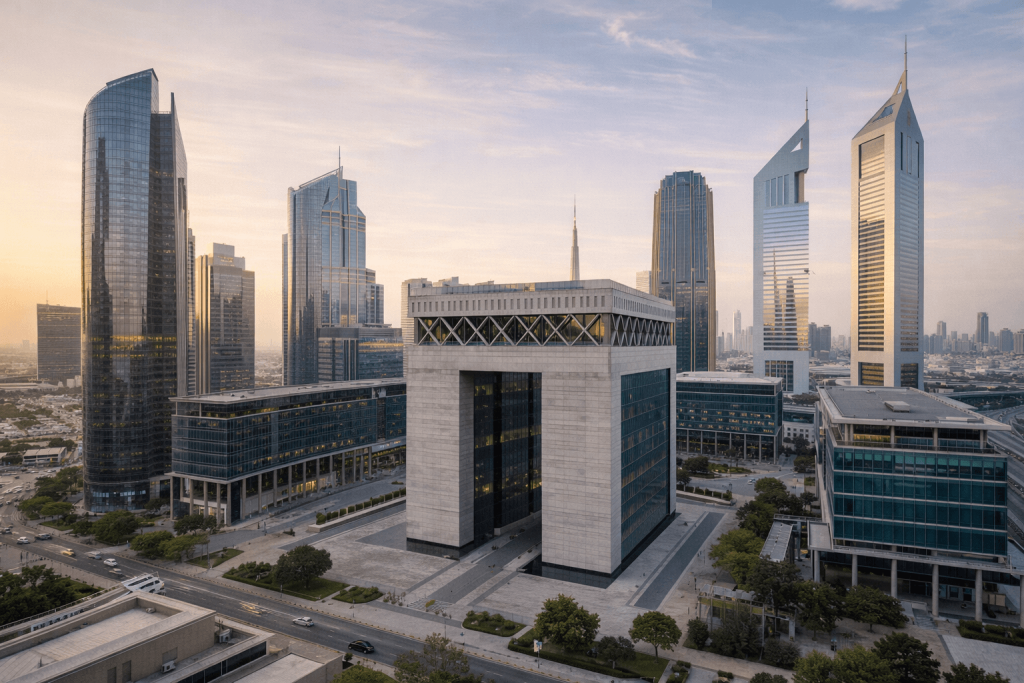
If your business relies on reputation, regulation, or high-trust counterparties, the DIFC free zone is often the first name that comes up in Dubai. It’s not “just another free zone” — it’s a purpose-built international financial district with its own commercial ecosystem, legal framework, and one of the strongest business addresses in the region.
This guide explains what the DIFC free zone is, who it suits, and what the setup journey looks like in real life — including the decisions that make the process smooth (or painfully slow). If you want a clear, practical route to incorporation without guessing, request a free consultation with First Elite Global and we’ll map the DIFC pathway around your exact activity, ownership, visa needs, and banking plan.
What the DIFC Free Zone Actually Is (In Plain English)
The DIFC (Dubai International Financial Centre) is a specialised free zone created to serve financial services and the wider professional services ecosystem around them — think banking, wealth, insurance, asset management, FinTech, legal, consulting, corporate services, and holding structures that benefit from a premium jurisdiction.
What makes it different from many other Dubai free zones is the “institutional layer” around it:
- A mature ecosystem built for regulated and high-compliance businesses
- A globally recognisable address used by international firms and regional headquarters
- A legal and regulatory environment designed for cross-border commerce
- A district-style setup: offices, coworking, meeting infrastructure, lifestyle, and events in one place
For founders, the DIFC free zone usually becomes a serious option when the question changes from “Where can I open a company?” to “Where should my company be taken seriously?”
DIFC Fit Check: Is It the Right Zone for You?

Before you compare fees or timelines, run this quick fit check. The DIFC free zone tends to suit you when you care about at least two of the following:
1) Reputation and counterparties
You need an address and jurisdiction that helps you win trust with:
- Banks and financial institutions
- Institutional investors
- Corporate procurement teams
- Family offices and HNW clients
- International partners who care about governance
2) Regulation (or proximity to it)
You’re either:
- Operating a regulated financial activity, or
- Providing services to regulated firms (legal, compliance, consulting, tech, data, audit support)
3) Ecosystem access
You want to be near:
- Financial services clusters
- FinTech programmes and innovation hubs
- Professional services networks
- Events, partnerships, talent pipelines
If none of these matter and you primarily want the lowest possible overhead, DIFC may not be the most sensible first step.
Request a free consultation with First Elite Global and we’ll tell you (plainly) whether DIFC fits your model — or whether another structure is cleaner, faster, or more cost-effective.
Who Uses the DIFC Free Zone (And Why)
Financial services firms
For many regulated activities, DIFC is the natural home in Dubai — including banking, investment management, insurance, brokerage, and related services (subject to the correct approvals).
Wealth and asset management, family offices, and foundations
DIFC is widely used for:
- Family wealth structuring
- Foundations and succession planning ecosystems
- Multi-jurisdiction holding and governance
FinTech and innovation-led companies

If you’re building products in AI, FinTech, RegTech, InsurTech, payments, identity, compliance, or enterprise finance tooling, DIFC can offer a strong home base — and it’s built to attract innovation firms, not just traditional finance.
Professional services around finance
Many non-regulated businesses choose DIFC because their clients are there:
- Management consulting and advisory
- Legal services and corporate services
- Risk, compliance, and governance support
- Specialist B2B services serving financial firms
International holding structures
Some groups use DIFC as a premium jurisdiction for:
- Regional HQ functions
- Holding arrangements
- IP and corporate governance structures (subject to tax and substance considerations)
DIFC vs Other Dubai Options: What You’re Really Choosing

Founders often compare DIFC with Dubai mainland and other major free zones (especially DMCC), but the real difference is the operating environment.
A practical comparison (high-level)
| Factor | DIFC free zone | Other Dubai free zones (e.g., DMCC) | Dubai mainland |
| Brand and institutional trust | Very high | High (varies by zone) | High (local market strength) |
| Regulated financial activity | Strong fit (subject to approvals) | Typically not the core focus | Certain regulated routes exist, case-dependent |
| Professional services ecosystem | Dense, finance-led | Sector-led and broad | Broad, market-led |
| Office environment | Premium district options + coworking | Flexible packages + varied office options | Flexible, depends on location |
| Typical budget | Premium | Often more flexible | Varies widely |
| Selling directly into local UAE retail market | Needs correct structure/permissions | Often indirect routes | Straightforward for local trading |
Translation into a decision:
- Choose DIFC when governance, brand, finance adjacency, and ecosystem density matter.
- Choose other free zones when you want flexibility, lower overhead, or sector-specific benefits.
- Choose mainland when local UAE operations and direct market access are central to your plan.
DIFC Licences and Company Types: The Choices That Matter
1) Regulated vs non-regulated activities
This is the single biggest fork in the road.
- Regulated activities: require additional scrutiny and approvals through the relevant regulator and framework.
- Non-regulated commercial/professional activities: generally follow a more standard incorporation route (still premium, but typically simpler than regulated authorisations).
2) Entity structure
Common routes include:
- A new DIFC entity (subsidiary-style setup)
- A branch of an existing company (where appropriate)
- Structures intended for holding/governance use cases (subject to eligibility and setup purpose)
Choosing the wrong structure can create headaches later with bank onboarding, visas, tax positioning, and investor due diligence.
3) Innovation-focused route
DIFC also supports an innovation-led pathway designed for tech companies building and testing new products, often paired with coworking access and a simplified commercial model (subject to criteria).
If you’re building in FinTech/AI/RegTech/InsurTech or adjacent tech categories, it’s worth evaluating whether an innovation-oriented route matches your stage and budget.
Setup Overview: How DIFC Company Formation Typically Works

Below is what the process looks like when it’s done properly — with the right sequencing (so you don’t pay for the wrong things early or trigger avoidable delays).
Step 1: Define your activity and confirm licence fit
You’ll need to align:
- What you actually do (in real wording, not marketing wording)
- The activity category and licence type
- Any additional approvals (especially if your service touches financial activity)
Common pitfall: selecting a broad activity that looks convenient, then discovering your bank or counterparties want a tighter description and clearer scope.
Step 2: Confirm ownership, governance, and signatories
You’ll typically clarify:
- Shareholding and beneficial owner structure
- Who will sign bank documents and compliance forms
- Whether you need board resolutions (for corporate shareholders)
This stage is where many applications slow down, especially with multi-layer shareholding.
Step 3: Prepare documents (the “bank-ready” version)
Even when incorporation looks straightforward, the real bottleneck is often banking and compliance, so document preparation should match what banks and authorities expect.
Typical needs include:
- Passport copies and ID documents
- Proof of address
- CVs / professional profiles for key individuals
- Company documents for corporate shareholders
- A clear business description, client profile, and expected flows
- Source of funds/source of wealth information where needed
If any documents require attestation or certified translation, handle that early — it’s a predictable delay point.
Step 4: Secure premises (office or coworking, as required)

DIFC is a real district — your premises selection is part of the setup logic. Depending on route, you may use:
- Serviced offices / business centres
- Commercial offices
- Coworking access for eligible models
Your premises decision influences:
- Total cost
- Visa planning
- Banking perception
- Operational credibility for clients
Step 5: Submit application, approvals, and registration
Once approved and registered, you receive your core company outputs (registration and licensing documentation), then move into execution.
Step 6: Visas, establishment cards, and operational readiness
This is where you convert the company into a working operation:
- Owner/employee visas (if needed)
- Medical/biometrics scheduling
- Emirates ID steps
- Immigration file handling
- HR onboarding planning (if hiring)
Step 7: Corporate bank account strategy (don’t leave this to the end)

Your bank onboarding should be planned alongside incorporation, not after it.
You’ll usually need:
- A coherent narrative of what the business does
- Client/supplier geography clarity
- Expected monthly flows
- Contracts or pipeline evidence (when available)
- Clean documentation and governance
Costs in the DIFC Free Zone: What You’re Paying For
Rather than quoting a single number (which is rarely accurate), DIFC cost planning works best as a set of “cost drivers”.
Core cost drivers
- Licence and registration fees (vary by activity type)
- Premises: serviced office vs office lease vs eligible coworking model
- Visa needs: number of visas, timing, and whether you need immediate issuance
- Compliance: audit/accounting expectations, especially for more complex structures
- Regulated route costs: additional approvals and ongoing compliance requirements
Budget planning checklist (useful before you commit)
- Do you need DIFC purely for brand and ecosystem — or do you need it for regulation?
- Can you start lean with coworking/serviced office and scale later?
- How many visas do you truly need in year one?
- Do you have a bank plan aligned to your activity and client geography?
- Will your structure be considered “simple” or “complex” in onboarding terms?
If you want a real budget, the simplest path is to share your activity, ownership structure, and visa count — request a free consultation with First Elite Global and we’ll give you a clean cost map with realistic assumptions.
Timelines: What to Expect (Without False Promises)
Timeline depends heavily on your licence category and how “bank-ready” your documents are from day one.
- Non-regulated professional/commercial setups: often move faster once documents and premises are aligned
- Regulated or high-compliance activities: typically take longer due to additional review and approvals
- Complex ownership (multiple shareholders, corporate chains, offshore holding layers): adds time in document verification and onboarding expectations
A faster outcome usually comes from sequencing and documentation — not from rushing.
Real-World Examples: How DIFC Setup Choices Play Out
Example 1: Boutique investment advisory support firm
Goal: Operate near regulated clients and win institutional trust.
Key setup choices: Clear activity scope, premium address, governance-first documentation.
Common mistake to avoid: Overstating scope in licensing language and triggering unnecessary approval complexity.
Example 2: FinTech start-up building compliance automation
Goal: Access innovation ecosystem, partnerships, and enterprise clients.
Key setup choices: Innovation-oriented pathway (where eligible), coworking access, bank strategy aligned to product revenue model.
Common mistake to avoid: Weak documentation around expected transaction flows and client geography.
Example 3: Family office services and governance structure
Goal: Long-term governance and structuring credibility.
Key setup choices: Structure clarity, strong compliance posture, thoughtful banking plan.
Common mistake to avoid: Treating the setup as a “simple licence” rather than a governance project.
Common Mistakes (And How to Avoid Them)
- Choosing the wrong activity description
If your activity doesn’t match what you do in practice, banks and counterparties can block you even after incorporation. - Ignoring premises strategy
Your premises is not just “rent” — it affects visas, credibility, and sometimes the route you can take. - Treating bank onboarding as an afterthought
You can incorporate quickly and still lose weeks (or months) if you don’t prepare a bank-ready package early. - Overcomplicating ownership without a reason
Complex shareholding is sometimes necessary — but complexity without purpose creates friction and cost.
How First Elite Global Helps You Launch in DIFC Without Guessing
Setting up in the DIFC free zone should feel structured — not like a maze of portals, changing requirements, and unclear next steps.
First Elite Global supports DIFC setup by:
- Confirming your licence route and activity positioning
- Preparing a bank-ready document plan from day one
- Coordinating premises strategy to match your stage and budget
- Managing the incorporation process and keeping momentum
- Handling visas and operational steps so you can start trading sooner
“Everything from licence to visas and bank account was handled with professionalism and clear updates.”
If you want a clean plan and a confident route through DIFC setup, request a free consultation with First Elite Global and we’ll map your next steps based on your business model.
FAQ Section
1. What is the DIFC free zone and how is it different from other free zones?
The DIFC free zone is a specialised international financial district designed for financial services and the professional services ecosystem around them. It differs from many other free zones by offering a premium institutional environment, strong governance frameworks, and a dense cluster of finance-led firms and services.
2. Can a company in the DIFC free zone be 100% foreign-owned?
In most cases, DIFC entities are structured to allow full foreign ownership, subject to the applicable rules for the chosen entity type and activity.
3. How long does DIFC free zone company formation take?
Timeframes vary based on whether the activity is regulated, how complex the ownership structure is, and how quickly premises and documents are finalised. Non-regulated setups often move faster once documentation is complete, while regulated routes take longer due to additional reviews and approvals.
4. Do I need an office to set up in the DIFC free zone?
DIFC is a district-based free zone, so premises are typically part of the setup. Options may include serviced offices, commercial offices, and eligible coworking models depending on the route and criteria.
5. Is the DIFC free zone only for financial services companies?
No. While DIFC is strongly associated with financial services, it also hosts many non-regulated firms that serve the ecosystem — including consulting, legal, tech, compliance, corporate services, and innovation-led businesses.
6. Can DIFC free zone companies access UAE corporate tax benefits?
Free zone companies are generally within the UAE corporate tax framework. Some may benefit from a 0% rate on qualifying income if they meet the conditions of a qualifying free zone regime, while non-qualifying income may be taxed at the standard rate.