Dubai Silicon Oasis free zone (DSO) is one of Dubai’s most founder-friendly choices if you want a technology-ready ecosystem, modern workspace options, and a setup process that can move quickly when your documents are clean.
But here’s the mistake many founders make: they treat DSO like “just another free zone”.
It isn’t.
DSO has a unique blend of:
- a true tech community (not just an address),
- an integrated live-work environment (useful for hiring and retention),
- and a practical pathway for startups, SMEs, and innovation-led businesses to launch lean and scale without chaos.
This guide breaks down what matters most—DSO licence options, DSO setup steps, DSO costs, visa planning, and the hidden decisions that determine whether your application flies through… or drags for weeks.
If you want a tailored DSO plan (licence + visas + workspace + bank readiness), share your activity and headcount target and we’ll map the fastest compliant route.
Dubai Silicon Oasis (DSO) in 60 seconds
Dubai Silicon Oasis free zone is a Dubai economic zone built around technology, innovation, and knowledge industries. Think of it as a “smart district” approach: business infrastructure, residential communities, and startup support built into one environment.
Best fit if you are:
- building or selling digital products/services (software, IT, data, AI, marketing tech)
- running an innovation-led consultancy
- doing e-commerce trading with a UAE base (with the right structure)
- building hardware/light industrial capability with modern facilities
- hiring internationally and you want a credible Dubai base that banks understand
Not always best fit if you are:
- opening a physical retail shop aimed at walk-in UAE customers (mainland often wins)
- bidding for certain government/semi-government contracts (mainland structure is often cleaner)
- doing highly regulated activity (you’ll need extra approvals whichever route you choose)
The 3 decisions that drive your DSO outcome (most people miss these)
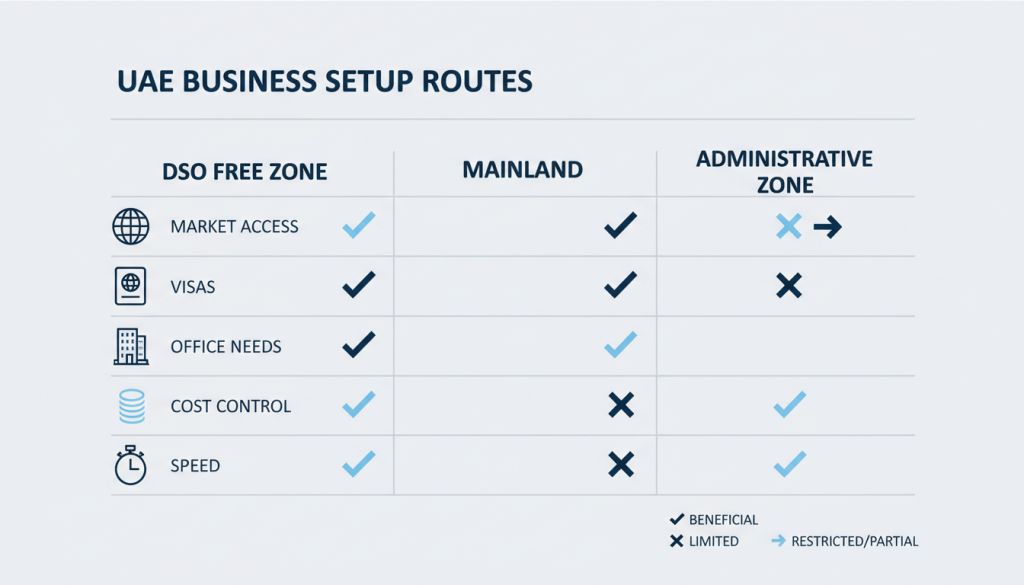
Before you choose a package, get these three right:
1) Are you truly “free zone” — or should you be in DSO’s Administrative Zone?
DSO isn’t only a free zone story. There’s also an Administrative Zone pathway where businesses can operate using a Dubai mainland (DED) licence while meeting DSO building/permit requirements in specific areas.
Why this matters:
It changes how you think about market access, compliance, and what you’re actually trying to achieve (UAE trading vs international base).
2) Does your activity match the licence category cleanly?
Most delays come from activity mismatch. Your marketing website might say one thing, your invoices another, and your application a third. DSO (and banks) notice.
3) How many visas do you need in year one (really)?
Visas are not “unlimited”. Your visa allocation is typically linked to workspace type (flexi desk vs fixed desk vs office) and the route you select. Plan visas based on:
- founders who need residency
- essential hires only
- whether you’ll sponsor dependents soon
DSO licence types explained (with practical examples)

When people search “DSO licence”, they usually mean one of these operational licence types:
Service Licence
Best for consulting and professional services where you deliver expertise—not physical goods.
Common examples:
- IT consultancy, software development, cybersecurity services
- marketing and growth services
- management consulting
- design and product services
- training and certain education-related services (subject to approvals)
Trade Licence
Best for buying/selling goods—including many e-commerce trading models.
Common examples:
- general trading (where approved)
- import/export and distribution models
- e-commerce operations (with the right product scope and compliance)
Important reality check: if your model includes direct onshore retail activity, you may need a mainland component or a structured route for UAE onshore sales. This is a strategy decision, not a paperwork detail.
Industrial Licence
Best for manufacturing, assembly, light industrial operations, and certain product development models.
Common examples:
- light manufacturing and assembly
- packaging operations
- hardware prototyping and small-scale production (subject to facility suitability)
Business Operation Permit (Administrative Zone route)
This is relevant when the business is operating in designated areas under the Administrative Zone model and holds a Dubai mainland (DED) licence, while aligning with DSO’s property/permit requirements.
Why founders like this: it can help when your commercial reality is “onshore access first”, but you still want DSO’s location and ecosystem.
Legal structure options inside DSO (what founders typically choose)
In practice, most setups fall into one of these:
- Free Zone Company (FZCO) – commonly used for new companies with one or more shareholders
- Branch – used when a UAE or foreign company wants a DSO presence without creating a new standalone entity
Pro tip: If you’re setting up with corporate shareholders, prepare for additional corporate documents, attestations, and banking-level proof of ownership. Build this into your timeline from day one.
DSO setup process: step-by-step (what “smooth” actually looks like)

A clean DSO setup typically follows this flow:
- Define your activity + licence category (service, trade, industrial, or permit route)
- Reserve your trade name and prepare the application file
- Submit your application via the DSO customer portal
- Document pre-approval (activity + security check) and invoicing
- Pay fees and submit legal documents
- Sign the lease / e-agreement (workspace ties into visas and credibility)
- Licence issuance (e-registration and e-licence)
A “speed benchmark” worth knowing
When your documents and payment are fully in, DSO can move quickly. A good process partner makes that speed achievable by preventing rework.
Data point to plan around: once all legal documents and payment are received, licence and lease issuance can be fast—if your file is complete and consistent.
Document checklist (founder-friendly version)
While exact requirements vary by activity and shareholder type, a typical DSO file includes:
For individual shareholders (most startups)
- passport copies (shareholders + manager)
- UAE status documents (if applicable)
- a short business plan or business summary
- letter of intent / project summary
- NOC (if you are a UAE resident and it applies)
- bank statement/reference letter or financial proof (in some cases)
If you have corporate shareholders (groups, holdings, overseas companies)
Expect to add:
- certificate of incorporation
- memorandum/articles and ownership proof
- board resolution authorising the setup
- attested/notarised documents (depending on jurisdiction and requirements)
If you want this to move fast, don’t “guess” your file. Build a bank-ready pack once and reuse it for licensing + banking.
DSO costs: how to estimate properly (without getting misled)
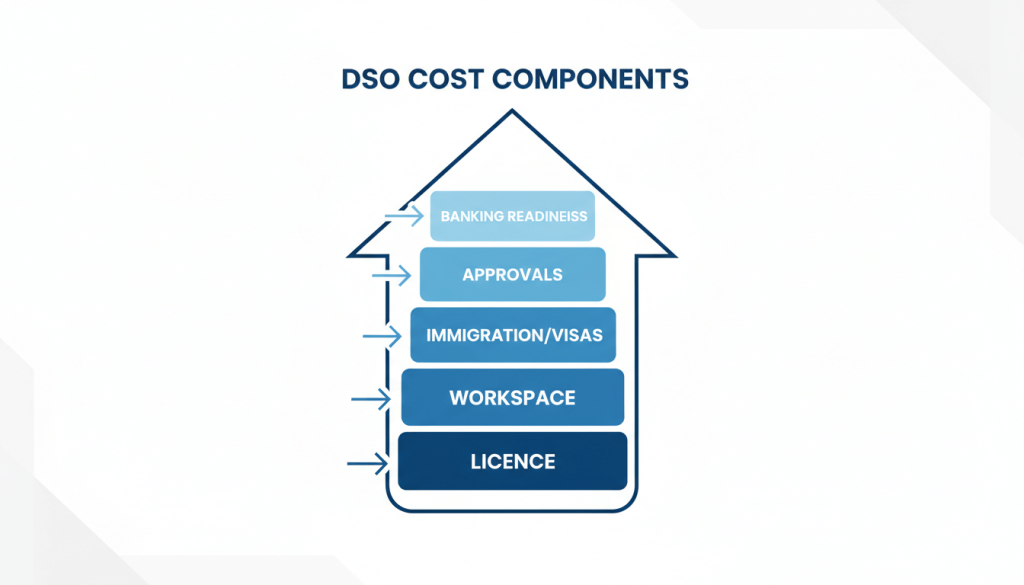
Searching “DSO costs” is frustrating because you’ll see numbers that don’t match your reality. That’s because DSO cost is not one fee—it’s a stack.
The DSO cost stack (what you actually pay for)
- Licence and registration fees (varies by activity and structure)
- Workspace (this is a major driver—flexi desk vs fixed desk vs office)
- Immigration (establishment card, entry permits, medical, Emirates ID, visa stamping)
- Approvals (only if your activity triggers additional review)
- Bank readiness (not a “fee”, but a real cost in time if you’re unprepared)
Workspace pricing examples (useful for budgeting)
If you’re launching lean, coworking-style setups can be a cost-effective way to secure a legitimate base while keeping overhead tight. Typical coworking options in the DSO ecosystem include flexi desk, fixed desk, and private office models—often priced annually and often linked to visa eligibility.
The right way to budget:
Instead of chasing the cheapest headline figure, request a costed plan that includes:
- year-one total cost (licence + workspace + visas)
- year-two renewal reality (what stays, what drops)
- banking and compliance readiness (to avoid delays)
If you share your activity, shareholder count, and visa target, we’ll send a clear DSO cost plan with the fastest compliant setup route.
Visas in Dubai Silicon Oasis: plan them like a business decision
A DSO setup is often chosen because founders want:
- investor/founder residency
- visas for essential hires
- the ability to sponsor dependents later
Here’s the key: your visa plan and workspace plan are linked.
A practical visa strategy for year one
- Start with founder residency + 0–2 essential staff
- Use a workspace that supports that visa allocation
- Upgrade only when revenue and hiring justify it
The “visa trap” to avoid
Over-allocating visas early can:
- increase overhead
- complicate banking (bigger profile than your turnover supports)
- create renewals that feel expensive later
Why founders pick Dubai Silicon Oasis free zone (beyond the brochure)

Here’s what actually tends to matter in the real world:
1) A tech-forward ecosystem that helps hiring
Being based in a recognisable innovation district makes it easier to recruit talent and build credibility with partners.
2) Workspace range: start lean, scale properly
DSO is not “one office type”. It offers:
- coworking and desk options
- plug-and-play offices
- boutique buildings
- warehouse/light industrial facilities (for the right licence types)
3) An integrated environment (useful for retention)
When staff can live nearby and access amenities, commuting friction drops—and retention improves.
4) A setup route that can be efficient with a clean file
Speed is rarely about the authority alone. It’s about the quality of your application, clarity of activity, and readiness of your documents.
Corporate tax and VAT: what DSO founders must understand (plain English)
UAE tax rules have evolved. You don’t want to build a structure based on outdated assumptions.
Corporate tax (high-level)
- UAE corporate tax applies broadly, including to free zone entities.
- Free zone companies may benefit from 0% corporate tax on qualifying income if they meet the conditions for the relevant status and comply with the rules.
- Non-qualifying income may be taxed at the standard rate.
Founder takeaway: Choose your structure based on your real operating model (customers, invoicing, substance), not on vague “tax-free” claims.
VAT (high-level)
VAT registration becomes mandatory if you exceed the relevant thresholds under UAE rules. Even below threshold, some businesses register voluntarily depending on their model.
Founder takeaway: If you’re trading goods, invoicing locally, or scaling quickly, build VAT readiness early so you’re not scrambling later.
Banking in practice: the biggest delay risk (and how to reduce it)
Many founders think the licence is the hard part. Often, the corporate bank account is.
To make banking smoother, prepare:
- a clear business summary (what you sell, who you sell to, where money comes from)
- contracts or invoices (if you have them)
- a clean ownership structure chart
- proof of address and source of funds documents
- a simple, consistent website aligned to your licensed activity
If you want, we can match your company profile to the bank route that fits your risk level—so you don’t waste weeks applying to the wrong place first.
3 real-world setup scenarios (so you can see the differences)
Scenario A: Software consultancy (founder + 1 hire)
Best fit: Service licence + lean workspace
Key priorities: activity clarity, bank-ready profile, realistic visa planning
Common mistake: applying under one activity while marketing under another
Scenario B: E-commerce trading (import + online sales)
Best fit: Trade licence + compliance-ready product scope
Key priorities: import/export clarity, VAT readiness, onshore sales strategy
Common mistake: assuming “free zone trading” automatically means seamless mainland retail
Scenario C: Light manufacturing / assembly
Best fit: Industrial licence + facility alignment
Key priorities: unit suitability, approvals, realistic lead times
Common mistake: choosing a desk package when your operational footprint requires industrial infrastructure
Dubai Silicon Oasis setup checklist (copy/paste)
Use this to self-audit your readiness:
- My website and pitch match my chosen activity
- I have 2–3 compliant trade name options
- I know whether I need service, trade, industrial, or permit route
- I have passport copies and status documents for all shareholders/manager
- I have a simple business plan / project summary
- I’ve planned visas for year one (not year five)
- I’ve chosen workspace based on operations + visas + credibility
- I have a basic banking readiness pack (ownership chart + source of funds proof)
- I understand the renewal and compliance obligations
If you want this done as a structured plan, share your activity and visa target and we’ll deliver a clear route map with a costed timeline.
Ready to launch in Dubai Silicon Oasis?
Dubai Silicon Oasis free zone is a strong choice when you want innovation infrastructure, credible workspace options, and a pathway built for founders who want to start lean and scale clean.
If you want a clear answer to “What’s the right DSO licence, what will it cost, how long will it take, and what do I need?”, send:
- your activity (what you actually do)
- number of shareholders
- visas needed in year one
- whether you’ll trade with UAE customers
…and we’ll come back with the most efficient compliant setup plan.
Frequently Asked Questions
1) What is Dubai Silicon Oasis free zone (DSO) best for?
Dubai Silicon Oasis free zone is best for technology-led businesses, digital services, innovation consultancies, and companies that want a credible Dubai base with flexible workspace options and a strong ecosystem.
2) How long does a DSO setup usually take?
DSO setup timelines depend on your activity, shareholder type, and document readiness. A clean file can move quickly, while mismatched activities or incomplete corporate documents can extend timelines.
3) What DSO licence do I need: service, trade, or industrial?
A service licence suits consulting and professional services, a trade licence suits buying/selling goods (including many e-commerce models), and an industrial licence suits manufacturing/assembly. Your exact activity determines the correct route.
4) What affects DSO costs the most?
DSO costs are driven mainly by your licence type, workspace choice (desk vs office vs industrial space), number of visas, and whether your activity requires additional approvals.
5) Can a Dubai Silicon Oasis free zone company sell to mainland UAE customers?
It depends on your business model and how you structure market access. Many businesses use a compliant route for onshore sales (e.g., mainland component or structured distribution approach) when direct mainland trading is required.
6) How many visas can I get with a DSO setup?
Visa allocation typically depends on your package and workspace type. Plan visas realistically for year one, then scale as your operations grow.