A freezone visa is one of the fastest ways to become a UAE resident while keeping your business structure clean and scalable. It’s popular with founders, consultants, remote-first teams, and international traders because it typically combines:
- a trade licence (your legal business)
- an immigration file (your company’s ability to sponsor visas)
- a residency visa for you (and sometimes your team)
But here’s the part most guides miss: the “visa cost” you see advertised is rarely the full cost. What matters is what’s included (and what isn’t), how many visas you actually need, and whether your chosen free zone package matches your real plan for the next 12–24 months.
This guide breaks it down clearly: requirements, the real step-by-step process, cost drivers, and practical package comparisons—so you can plan accurately and avoid expensive surprises.
If you want a tailored breakdown for your situation, First Elite Global can map the best-fit free zone package and a realistic end-to-end budget in one call.
Quick clarity: what a “freezone visa” actually is
In everyday language, people use “free zone visa” to mean UAE residence visa sponsored through a free zone company. In practice, you’ll usually fall into one of these categories:
- Owner / Partner (Investor) visa: you’re sponsored by your own free zone company
- Employee visa: you’re sponsored as staff of the free zone company
- Dependent visas (after your residency is active): spouse, children, and eligible family members
The visa gives you the ability to legally reside in the UAE, access services tied to residency, and apply for an Emirates ID (which becomes your primary ID for banking, tenancy, SIM, and most daily administration).
Who the freezone visa is best for (and who should think twice)
Best fit
A freezone visa is usually a strong fit if you:
- want UAE residency tied to a business structure
- serve international clients, online markets, or B2B customers
- want a package approach (licence + visa allocation + workspace option)
- want the flexibility to add staff visas later as you grow
Think twice (or structure carefully) if you:
- need to trade directly retail on the UAE mainland from day one
- require large visa quotas immediately (many packages start lean)
- operate in regulated sectors needing special approvals
- expect frequent switching between employers/entities (your visa is tied to your sponsor)
A good advisor will sanity-check this upfront and recommend free zone vs mainland vs a hybrid approach based on how you’ll actually operate.
Free Zone Visa Requirements (the real checklist)
While each free zone has its own portal and internal rules, most free zone residency applications require the same core inputs.
Personal documents (typical)
- Passport copy (good validity remaining is strongly recommended)
- Passport-style photo (white background)
- Entry status details (inside/outside UAE at time of application)
- Previous UAE visa / UID details (if you’ve had visas before)
- Basic personal details for immigration and Emirates ID registration
Company-side requirements (what many people overlook)
- Active free zone trade licence (or approved application in progress)
- Immigration / establishment file for the company (often called an establishment card)
- Visa quota allocation tied to your package and workspace type (desk/office)
- Signed company documents (as required by the free zone)
- Medical fitness + Emirates ID steps completed by the applicant during the process
Health and compliance items that can affect timelines
- Medical fitness results and required follow-ups (if any)
- Health insurance requirements (commonly relevant, especially in Dubai)
- Name matching across documents (a top cause of delays)
If you want this handled end-to-end, First Elite Global typically coordinates the full chain—free zone approvals, immigration file setup, entry permit, medical, Emirates ID steps, and residency stamping—without you chasing different departments.
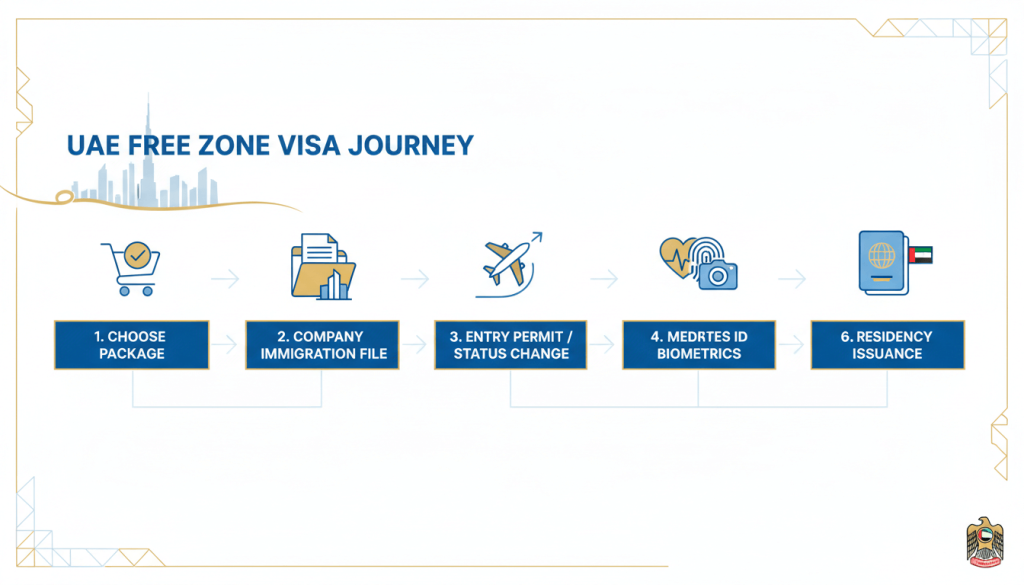
The Freezone Visa process (step-by-step, in plain English)
Below is the process in the order it usually happens. Some free zones bundle steps; others split them.
Step 1: Choose the right free zone package (licence + visas + workspace)
This is where most “cheap” packages become expensive later.
A well-matched package should clarify:
- licence type and allowed activities
- how many visas are included or permitted
- whether a flexi-desk/office is included or required
- renewal costs and upgrade paths
Step 2: Open the company immigration file (the company’s ability to sponsor)
Your company needs an immigration setup so it can sponsor you (and later, employees). This is often separate from the licence fee.
Step 3: Entry permit or status change (depending on where you are)
- If you’re outside the UAE: you usually enter on an entry permit
- If you’re inside the UAE: you typically do a status change without exiting (rules depend on your current status and sponsor)
This is one of the biggest “hidden cost” areas because the route can differ by your situation.
Step 4: Medical fitness test
This is a required step for most adult residence visa applicants. Timing depends on appointment availability and emirate.
Step 5: Emirates ID application + biometrics
You’ll submit the Emirates ID application and (if required) complete biometrics at an approved centre.
Step 6: Residency issuance / visa stamping (finalisation)
Once approvals are complete, your residency is finalised and your Emirates ID is processed/issued.
How long does a freezone visa take?
Timelines vary by free zone, your current location (inside/outside UAE), and appointment availability, but a realistic planning range is:
- Fast cases: around 1–2 weeks after company approval (when appointments are readily available)
- Typical cases: 2–4 weeks end-to-end
- Longer cases: when there are document mismatches, special approvals, or peak appointment backlogs
The best way to avoid delays is to get the package and document set right before submission—most “slow” cases are preventable.
Costs of a Freezone Visa in UAE (what you’re really paying for)
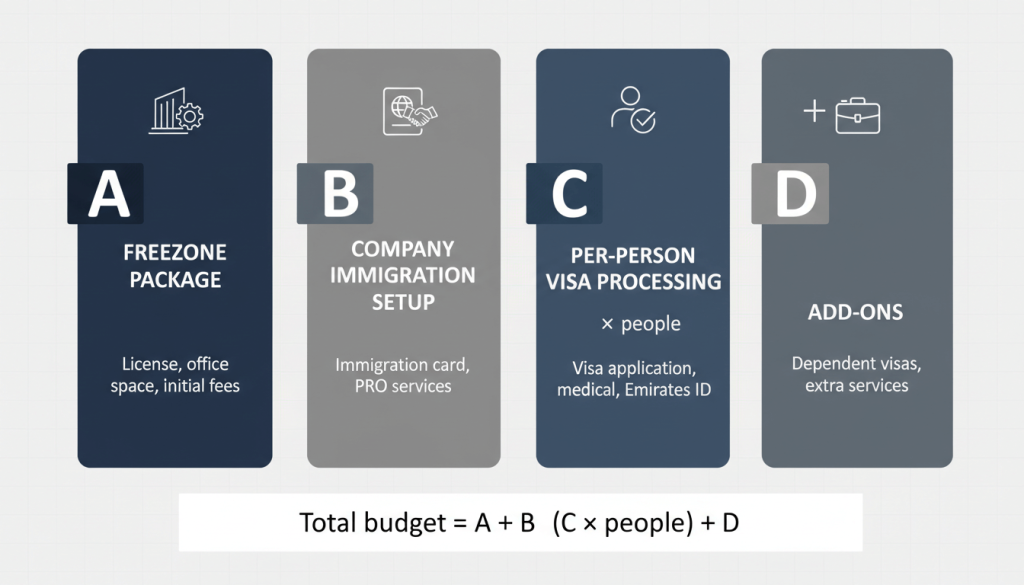
Instead of focusing on a single number, plan using cost buckets. That’s how you avoid surprise invoices mid-process.
Bucket A: The free zone package (business setup cost)
This may include:
- licence fee (and activity permissions)
- shared workspace or flexi-desk (sometimes required for visa quota)
- initial approvals and onboarding
Packages can look similar on paper but differ massively in renewals, visa allocation rules, and what’s included.
Bucket B: Company immigration setup
Often separate from the licence:
- establishment / immigration card
- related registrations the company needs to sponsor visas
Bucket C: The visa processing chain (per person)
Common components:
- entry permit or status change route
- medical fitness test
- Emirates ID application and processing
- final residency issuance
Bucket D: Add-ons that change the total
These are the usual cost inflators:
- urgent/express processing options (if available)
- additional approvals for regulated activities
- dependents (each person has their own processing chain)
- insurance requirements
- office upgrades to unlock more visa quota
- amendments and resubmissions due to document errors
A practical budgeting model you can use today
Use this simple formula when comparing offers:
Total first-year budget =
- Free zone licence package
- Company immigration setup
- (Visa processing costs × number of people)
- Any required workspace upgrades
- Insurance and compliance needs (if applicable)
If a quote doesn’t clearly show these buckets, it’s not transparent enough to rely on.
Visa packages compared: what “1 visa included” often means
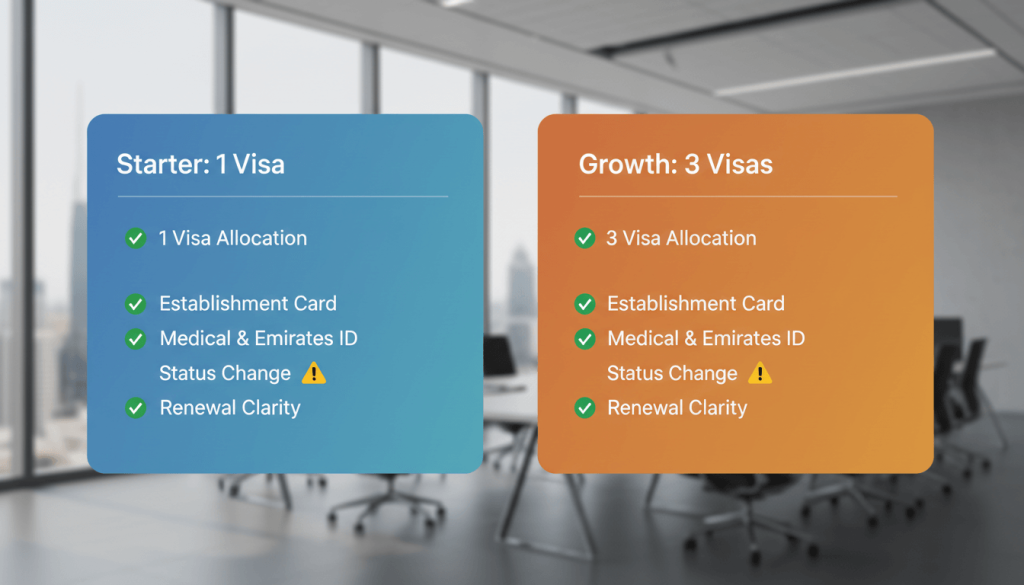
Many founders choose a package marketed as “licence + 1 visa”. That can be perfect—if you understand the fine print.
What it often includes
- one visa allocation (permission to apply)
- base application handling via the free zone portal
What it may not include (and you should confirm)
- immigration/establishment card fees
- medical test and Emirates ID processing
- status change route (if you’re inside UAE)
- dependent visa support
- amendments and resubmissions if documents are rejected
- renewals and upgrade costs
A good package isn’t just the cheapest—it’s the one that matches your next steps (banking, hiring, family sponsorship, office needs).
Freezone visa eligibility: who usually qualifies?
Eligibility depends on sponsor category and free zone policy, but broadly:
Owner/partner route
Often suitable if you:
- are setting up a free zone company as shareholder/partner
- can meet the free zone’s documentation and compliance requirements
- can complete medical/ID steps as required
Employee route
Often suitable if:
- you have an approved role under the free zone company
- the company has visa quota and the right setup to sponsor staff
Family sponsorship later
Once your residency is active, you may be able to sponsor eligible dependents (subject to current rules and requirements).
Common mistakes that cause delays (and how to avoid them)
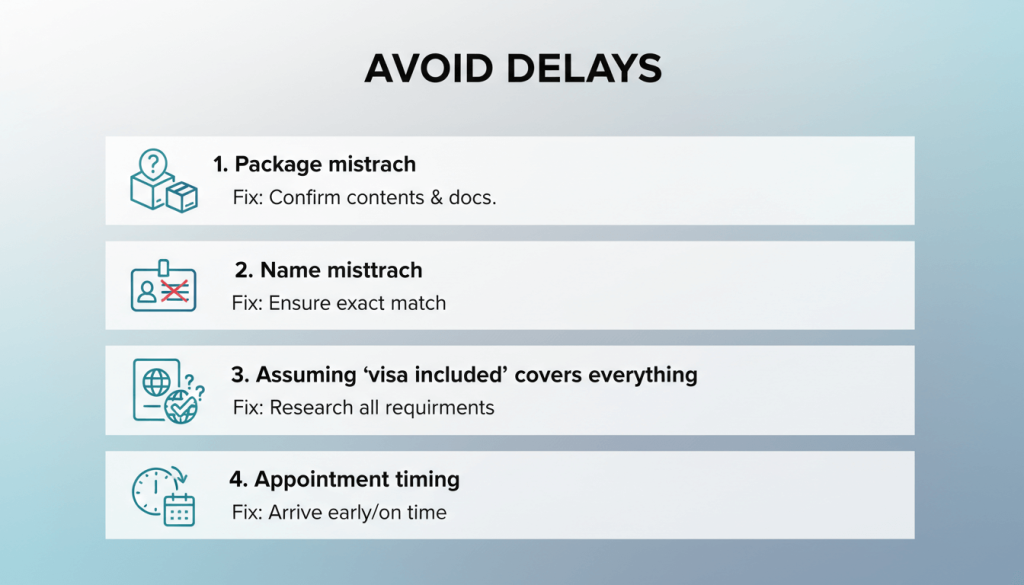
1) Choosing a package that can’t support your real plan
Example: you want 2–3 visas within 6 months, but you buy a package that requires expensive office upgrades to add visas.
Fix: choose the package based on your 12–24 month plan, not today’s minimum.
2) Name mismatches across documents
Even small differences (spacing, order of names) can trigger rework.
Fix: standardise your name format before submission and keep it consistent across all steps.
3) Assuming “visa included” covers medical and Emirates ID
It often doesn’t.
Fix: ask for a written cost breakdown across the full chain.
4) Underestimating appointment lead times
Medical fitness and biometrics availability can shift.
Fix: submit early, book appointments immediately when eligible, and avoid last-minute renewals.
Free zone visa vs mainland visa: the simple decision rule
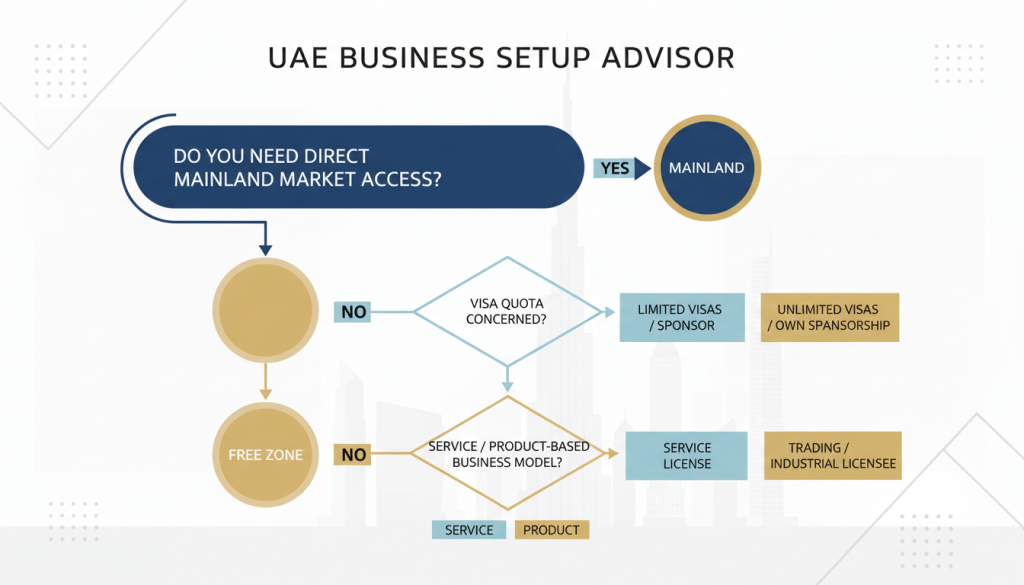
If you need full UAE mainland market access and expect higher headcount, mainland can be more practical.
If you want a streamlined setup, international operations, and structured packages, free zones are often the cleanest path.
If you’re unsure, the quickest way to get clarity is a short consultation where your activity, target customers, visa needs, and budget are checked together. First Elite Global can recommend the most sensible route and show you the trade-offs plainly.
Real-world examples (to make this concrete)
Example 1: Solo consultant relocating to UAE
Goal: residency + ability to invoice international clients
Best-fit: lean free zone package with 1 visa allocation, minimal workspace requirement
Key watch-outs: renewal pricing, banking support, ability to add dependent later
Example 2: E-commerce founder with a small team
Goal: 2–4 visas within the first year
Best-fit: package that supports visa quota scaling without punitive office upgrade costs
Key watch-outs: activity approvals, logistics needs, warehouse vs desk requirements
Example 3: Trading business using UAE as a hub
Goal: import/export structure + residence + staff visas
Best-fit: free zone aligned with trading and logistics
Key watch-outs: substance/operations planning, banking documentation readiness
A credibility checkpoint before you pay anything
Before committing to a free zone visa package, make sure you can answer “yes” to these:
- I know exactly how many visas I can apply for under this package
- I know what’s included vs excluded in visa processing (medical, Emirates ID, status change)
- I know the renewal cost range and what triggers an upgrade
- I’ve checked whether my activity needs external approvals
- I have a realistic timeline plan for entry permit, medical, and ID steps
If you can’t answer these confidently, you’re not ready to pay yet.
Getting it done smoothly (without chasing portals)
“First Elite Global made our Dubai free zone setup surprisingly straightforward. Everything from licence to visas and bank account was handled with professionalism and clear updates.”
If you want the same outcome, the smartest next step is simple: talk through your activity, how many visas you need, and whether you’re inside or outside the UAE right now. You’ll get a clear route, a realistic timeline, and a transparent breakdown—before you commit.
Frequently Asked Questions
1) What is a freezone visa in the UAE?
A freezone visa is a UAE residence visa sponsored through a free zone company. It typically allows you to live in the UAE legally, complete medical fitness and Emirates ID steps, and maintain residency under your company sponsorship.
2) How much does a freezone visa cost in the UAE?
Freezone visa costs vary by free zone, whether you’re applying from inside or outside the UAE, and what your “package” includes. The best way to budget is to separate: (1) the free zone licence package, (2) company immigration setup, and (3) per-person visa processing costs (medical, Emirates ID, residency issuance).
3) How long does it take to get a free zone residency visa?
Many applications complete within 2–4 weeks end-to-end once the company setup is approved, but timelines vary based on appointments, document accuracy, and whether special approvals are required.
4) Can I sponsor my family on a free zone residency visa?
In many cases, once your UAE residency is active, you may be eligible to sponsor dependents (such as spouse and children), subject to current requirements and approvals.
5) Are visa packages the same across all free zones?
No. Visa packages differ in visa quota rules, workspace requirements, renewal pricing, included services, and what parts of the visa processing chain are bundled versus billed separately.
6) Can a free zone visa holder work in the mainland UAE?
Your residency is tied to your sponsor. Working arrangements depend on the legal structure and approvals. If you need broad mainland market access or higher headcount, you may need a different structure or additional permissions.