
Opening a business in Dubai can be fast—if you make the right decisions early. The mistakes that slow founders down are almost always the same: choosing the wrong jurisdiction, picking an activity that triggers extra approvals, underestimating visa and office requirements, and approaching banking without a “bank-ready” file.
This guide shows you how to open a business in Dubai the practical way: the exact setup steps, how the Dubai company formation process works, what drives your Dubai business setup cost, and how to go from idea to trade licence, visa, and bank account without backtracking.
The 10-step roadmap (save this)

- Define what you sell + where you’ll sell it (UAE market, international, or both)
- Choose your setup route (mainland, free zone, or offshore)
- Select your business activity (and confirm if it’s regulated)
- Pick a legal structure (e.g., LLC, sole establishment, branch)
- Reserve a trade name (and align it with naming rules)
- Get initial approval (and any external approvals if required)
- Secure an address (office, flexi-desk, warehouse—depending on rules)
- Issue the trade licence (pay fees, sign incorporation documents)
- Complete immigration steps (establishment card, entry permit, medical, Emirates ID)
- Open your corporate bank account (with a bank-ready compliance pack)
If you want this mapped to your exact activity and budget, book a free consultation and get a personalised setup plan in writing.
Step 1: Choose the right route (mainland vs free zone vs offshore)

The best route depends on three questions:
- Will you trade directly inside the UAE (B2C, local contracts, on-site services)?
- Do you need UAE residence visas now—or can you delay visas until revenue starts?
- Do you need a physical office/warehouse, or will a flexi-desk work at the beginning?
Mainland company (Dubai mainland)
Best for:
- Selling directly to UAE customers (B2C, retail, restaurants, local service delivery)
- Winning UAE tenders, issuing local invoices broadly, operating across the UAE
- Businesses that need flexibility on where they operate
Typical considerations:
- Office/space requirements may apply depending on activity
- Some activities trigger extra approvals (sector regulators, municipalities, etc.)
Free zone company (Dubai free zone)
Best for:
- Consulting, tech, marketing, e-commerce, trading, import/export, holding structures
- Founders who want a streamlined setup experience and a clear package structure
- International-first businesses that don’t need walk-in retail on day one
Typical considerations:
- Rules for selling into the UAE market vary (often solved via a distributor, local arrangements, or selecting the right structure)
- Visa allocation and workspace rules differ by free zone
Offshore company
Best for:
- Holding assets/shares, group structuring, IP ownership
- International invoicing outside the UAE (depending on structure and compliance)
Not ideal for:
- Operating day-to-day inside the UAE or using it mainly for visas
Shortcut decision rule:
If your business requires local UAE selling + operational flexibility, start with mainland.
If you want speed + a clean package + international-first operations, start with a free zone.
If you want holding/structuring without local operations, consider offshore.
Step 2: Pick the right business activity (this drives approvals, cost, and timing)
Your activity selection affects:
- Which authority issues your licence
- Whether you need external approvals
- Your banking risk profile
- Whether you’ll need office/warehouse requirements
Common licence categories you’ll see
- Commercial (trading, import/export, products)
- Professional (services like consulting, IT, design, marketing)
- Industrial (manufacturing/processing—often premises-heavy)
- Tourism (travel-related—often approval-heavy)
Pro move: choose the minimum viable activity set first. You can expand activities later—but starting too broad can trigger approvals you don’t actually need yet.
Step 3: Choose a legal structure that matches your plan (not just your budget)
Most founders default to “whatever is cheapest.” A better approach is: choose the structure that keeps you flexible for banking, visas, and growth.
You’ll typically choose between:
- LLC-style entities (common for trading and scalable operations)
- Sole establishment / professional setups (common for solo service providers)
- Branch (if you already have a parent company and want a Dubai presence)
- Holding/offshore structures (for ownership and structuring)
If you’re unsure, a quick review call can save weeks—because the “wrong” structure often shows up later during banking or visa processing.
Step 4: Reserve your trade name (and avoid instant rejection)
Trade name rules are stricter than most founders expect. Rejections often happen because:
- The name includes restricted terms
- The name doesn’t match your activity
- The name violates cultural/public guidelines
- Personal-name businesses require proof and may restrict initials/abbreviations
Best practice: prepare 3–5 name options and keep them aligned with your activity.
Step 5: Initial approval (and any external approvals)
Initial approval is the “green light” that your company can proceed—subject to completing documents, address requirements, and any extra approvals tied to your activity.
You may need additional approvals if you’re in areas like:
- Healthcare, education, food, construction/technical services
- Financial services, insurance, legal-related activities
- Tourism and travel-related operations
Tip: If approvals apply, plan your timeline around them. Most delays in the Dubai business registration process happen here—not at the licence payment stage.
Step 6: Secure your business address (office, flexi-desk, warehouse)
Your address requirement depends on:
- Mainland vs free zone rules
- Your activity type
- Visa quota needs
- Whether inspections apply
Common paths:
- Flexi-desk for lean service businesses (often a smart start)
- Serviced office if you want credibility and meeting space
- Warehouse/industrial premises for logistics/manufacturing or storage-heavy trading
Reality check: many founders overspend here in year one. Start lean, then upgrade once revenue is predictable.
Step 7: Issue the licence (company registration in Dubai becomes “real” here)
Once approvals and address requirements are satisfied:
- Incorporation documents are signed
- Fees are paid
- Your trade licence is issued
- Your company can legally invoice and operate within its permitted scope
Core document checklist (varies by route and shareholders)

Have these ready early to avoid back-and-forth:
- Passport copies (all shareholders/managers)
- Entry status/residence documents where applicable
- Basic company details (activities, structure, shareholding)
- Address/lease documents (if required)
- Parent-company documents (for branches), and attestations if applicable
Step 8: Visas and immigration (only buy what you need now)
If you need UAE residence visas, plan for a sequence like:
- Establishment/immigration file setup (authority-specific)
- Entry permit (if you’re outside the UAE)
- Status change (if applicable)
- Medical fitness test
- Emirates ID biometrics
- Visa stamping/issuance
The costly mistake: buying too many visas before you have revenue. A lean first year is often: owner visa first, then add staff visas as contracts arrive.
Step 9: Corporate bank account (the “bank-ready pack” approach)

Banking is rarely delayed because “Dubai is slow.” It’s delayed because the application file is incomplete or unclear.
What a bank-ready pack usually includes
- Clear ownership structure and shareholder profiles
- A simple, credible business model summary
- Contracts/invoices (even initial ones), or pipeline evidence
- Source of funds explanation (clean, consistent, documented)
- Website/online presence (even a simple landing page helps)
- Expected countries you will send/receive funds from
Pro tip: Treat bank compliance like an investor pitch: clear story, clean documents, consistent numbers.
Step 10: Compliance setup (so you don’t get surprised later)
Once your trade licence is issued, set up the boring stuff early—because it protects you:
- Accounting and bookkeeping (from month one, not month twelve)
- Corporate tax and VAT awareness (deadlines matter)
- Invoice templates, contracts, and PO process
- Licence renewal calendar and document storage
Simple rule: your first 90 days should include “compliance hygiene,” even if revenue is still ramping.
Dubai business setup cost: what you actually pay for (and how to keep it lean)

Instead of searching for one “price,” budget by components. Your Dubai company formation cost is driven by:
- Licence fees (varies by jurisdiction and activity)
- Name reservation and government charges
- External approvals (if your activity is regulated)
- Workspace (flexi-desk vs office vs warehouse)
- Visas (entry permit, medical, Emirates ID, stamping)
- Corporate bank account onboarding support (if you use a guided process)
- Ongoing compliance (bookkeeping, filings, renewals)
Example budgets (illustrations to help you plan)
1) Solo consultant, lean free zone setup (0–1 visa):
- Goal: invoice internationally + build pipeline
- Typical pattern: flexi-desk + minimal activities + owner visa only if needed
2) UAE-facing service business, mainland setup (1–3 visas):
- Goal: sell locally, work on client sites, scale staff gradually
- Typical pattern: approvals checked upfront + office requirement planned early
3) Trading business with storage needs:
- Goal: import/export, stock holding, logistics
- Typical pattern: commercial activity + warehouse option + stronger banking file
Want a precise estimate? Share your activity, number of visas, and whether you need local UAE selling. You’ll get a clear costed plan—line by line—before you commit.
Timeline: how long it takes to open a business in Dubai
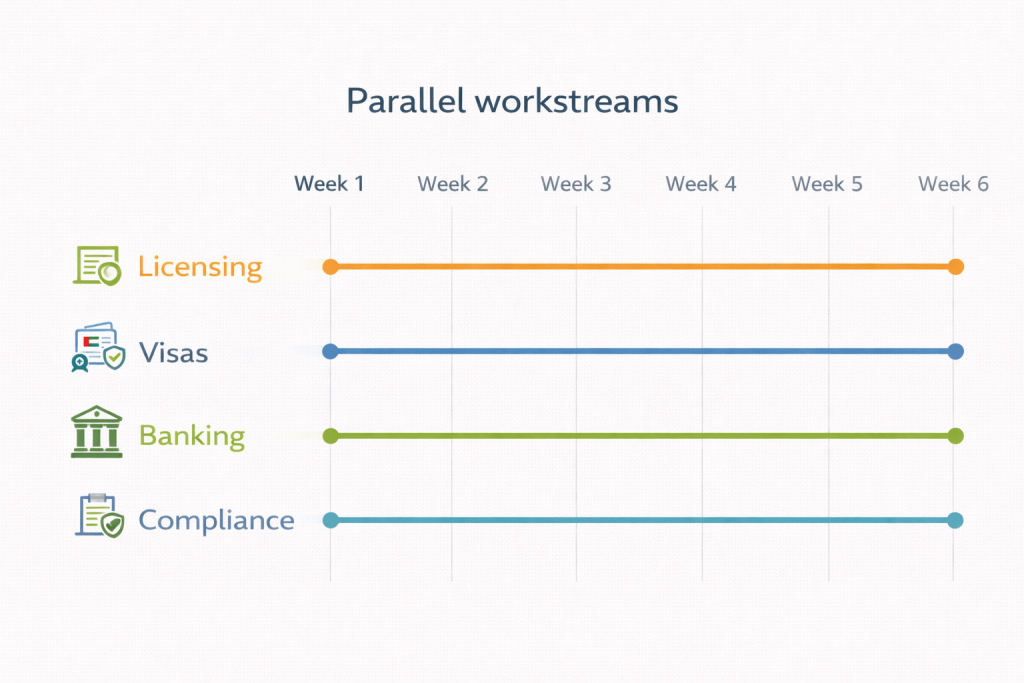
In straightforward cases, your trade licence can be issued quickly once documents are ready and approvals are clear. The variables that extend timelines are:
- External approvals (regulated activities)
- Address/lease requirements
- Immigration processing (if you need visas immediately)
- Banking readiness (compliance questions, country exposure, source of funds)
Best way to speed it up: treat documents, approvals, immigration, and banking as parallel workstreams—not a single queue.
The most common mistakes (and how to avoid them)
- Picking an activity that triggers approvals you don’t need
- Choosing a jurisdiction based on a headline price, not market access
- Overbuying visas before revenue is stable
- Signing an expensive office lease too early
- Applying for banking without a clear business story and documents
- Mixing personal and business transactions from day one
- Ignoring bookkeeping until renewal time
- Leaving compliance tasks to the last minute
- Building a structure that can’t scale (or can’t pass KYC cleanly)
- Trying to “DIY everything” and losing weeks on avoidable loops
If you want to avoid these entirely, one planning call at the start is usually the cheapest step in the whole process.
A simple way to choose correctly (a quick self-check)
Answer these and you’ll know your best route in 5 minutes:
- Will you sell directly to UAE customers in the next 90 days?
- Do you need a UAE residence visa now—or later?
- Do you need a physical location for inspections, stock, or walk-in clients?
- Are you in a regulated sector?
- Which countries will you invoice, receive payments from, or send money to?
Bring your answers to a free consultation and you’ll get a recommended structure, timeline, and cost plan that matches your real goal—not a generic package.
FAQs
1) How to open a business in Dubai as a foreigner?
Choose mainland or a free zone based on where you’ll sell and whether you need visas. Then select an activity, reserve a trade name, get approvals, issue your licence, arrange visas (if needed), and open a corporate bank account.
2) What’s the difference between a Dubai mainland and free zone company?
Mainland is typically best for broad UAE market access and operating across the UAE. Free zones are often best for speed, package clarity, and international-first operations, with rules that vary for UAE local selling.
3) How much does it cost to open a business in Dubai?
Dubai business setup cost depends on your activity, jurisdiction, approvals, workspace, and visas. Plan by components (licence + address + visas + compliance) rather than hunting for a single “price.”
4) How long does the Dubai company formation process take?
Straightforward cases can move quickly once documents and approvals are clear. Timelines extend with regulated approvals, office requirements, visas, and bank compliance questions.
5) Do I need a UAE residence visa to start a company?
Not always. Many founders set up first and apply for visas based on actual need. If visas are part of your plan, factor immigration steps into your timeline early.
6) Can I open a corporate bank account right after the trade licence is issued?
Often yes, but approval depends on a clean “bank-ready” file—ownership clarity, business model, and documented source of funds. Preparing this before you apply speeds up the process.
Helpful Links
- Invest in Dubai — Business setup overview
- Invest in Dubai — Mainland company setup + essential documents
- Dubai Department of Economy & Tourism — Business Licensing
- UAE Government portal (u.ae) — Steps to start a business on the mainland
- UAE Ministry of Economy & Tourism — Establishing business in the UAE
- Federal Tax Authority — Corporate Tax registration service
- Federal Tax Authority — VAT registration thresholds and rules
- Invest in Dubai — Dubai Unified Licence guide