Starting or registering a business in the UAE is more straightforward when you treat it like a controlled process: pick the right jurisdiction, match your activity to the correct licence, build a clean document pack, and submit a file that’s consistent from start to finish.
What slows most founders down isn’t “the UAE” — it’s unclear decisions (mainland vs free zone vs offshore), mismatched activities, missing approvals, and last-minute document chasing. This guide shows you the full licence process, documents required, timelines, costs, and the checks that keep your application moving.
Start Here: The 3 Decisions That Determine Your Cost, Timeline, and Flexibility
1) Choose where to register: Mainland vs Free Zone vs Offshore

Think of this as your operating model — not just a location.
Mainland (onshore) registration is typically best when you want:
- Full access to the UAE market (local clients, local contracts, broad trading flexibility)
- A wide range of activities and office options
- Easier alignment for certain regulated or government-facing work (where applicable)
Free zone registration is typically best when you want:
- A fast incorporation path and a packaged setup experience
- A defined activity list with a clear licence bundle (often including visas and workspace options)
- A structure designed for international business, services, e-commerce, or sector ecosystems
Offshore registration is typically best when you want:
- A holding / structuring entity (assets, shares, international contracting) rather than a customer-facing UAE business
- A clean corporate wrapper for ownership and long-term planning (where suitable)
Quick fit check (copy/paste):
- If you need to trade widely inside the UAE → mainland is usually the default.
- If you need a lean setup with visas and a known package → free zone is often the fastest path.
- If you need a holding company, not a UAE operating business → offshore may fit.
2) Select the business activity and licence type
Your activity controls:
- Which authority approves you
- What your licence is called (and what you can legally do)
- Whether you need extra approvals (common in finance, education, healthcare, legal services, media, travel, food, and certain tech activities)
Rule of thumb: never “approximate” the activity. Choose the activity that matches your invoices, website, and contracts — that alignment is what keeps banks and compliance checks calm later.
3) Decide the legal structure and ownership plan
Common setups include:
- LLC-style operating company (most typical for trading and services)
- Branch (if you already have a parent company and need a UAE presence)
- Single-owner structure vs multi-shareholder structure (affects documentation and approvals)
Your ownership choices also affect:
- Signature authority and resolutions
- Whether you’ll need notarisation/attestation for overseas corporate shareholders
- Banking readiness (banks care about who controls the company and how funds flow)
How to Start or Register a Business in UAE: Step-by-Step Process
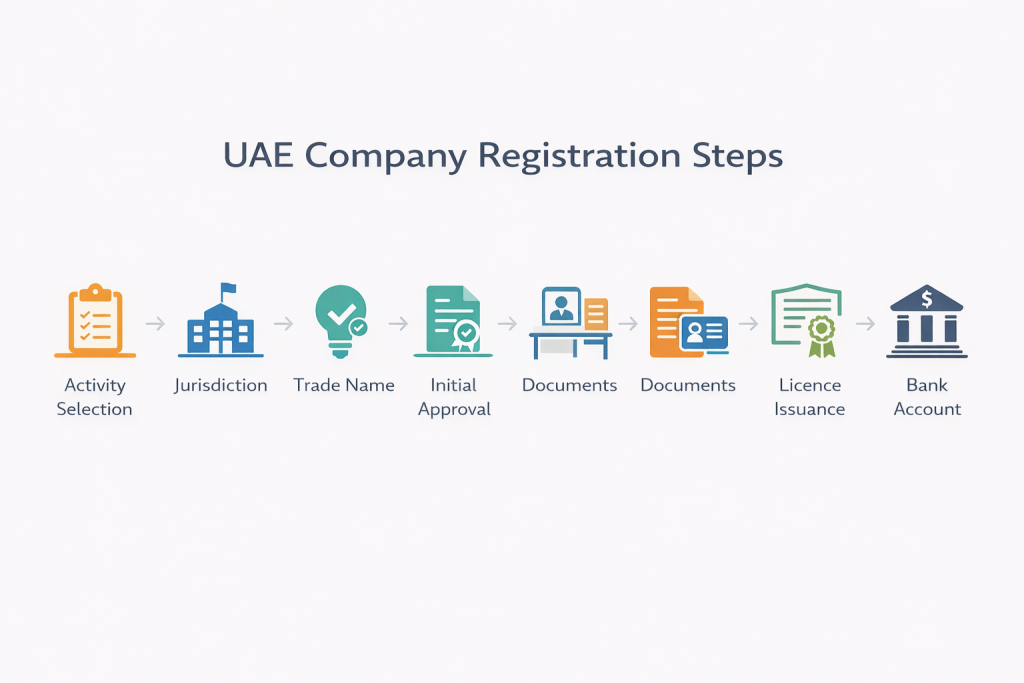
Below is the end-to-end registration steps flow that covers most mainland and free zone applications. Your exact sequence may vary slightly depending on the emirate, authority, and activity — but the building blocks are consistent.
Step 1: Define the activity (and confirm if it’s regulated)
- List what you sell, who you sell to, and where the work is delivered.
- Confirm whether the activity needs external approvals (the #1 hidden delay).
Step 2: Pick your jurisdiction and authority
- Mainland authority in your chosen emirate or a specific free zone authority.
- Decide whether your work requires a physical office, flexi-desk, warehouse, or virtual arrangement (where allowed).
Step 3: Reserve the trade name
A strong trade name is:
- Compliant (no restricted terms without approvals)
- Close to your brand (so marketing and banking don’t conflict later)
- Consistent across documents and online presence
Pro tip: reserve 2–3 variations in order of preference so you don’t lose a week to name ping-pong.
Step 4: Initial approval / pre-approval
This is where your application is “greenlit” to proceed — but you’re not operational yet. At this stage, authorities may request:
- Clarification of activity
- Shareholder details
- Additional documents if your structure is complex
Step 5: Prepare incorporation documents
Depending on your structure, you’ll typically prepare:
- Memorandum / Articles (or equivalent formation documents)
- Shareholder resolutions (especially for corporate shareholders)
- Manager appointment / signatory documents
Step 6: Secure your business address (as required)
Many registrations require proof of premises:
- Tenancy contract and related registration (where applicable)
- Flexi-desk / serviced office agreement (common in free zones)
- Warehouse or industrial facility documentation (for relevant activities)
Step 7: Submit the final licence application and pay fees
This is the “full file” submission. Delays here are usually caused by:
- Missing signatures
- Inconsistent spellings across passports/documents
- Unclear activity descriptions
- Unfinished lease documentation
Step 8: Receive your licence and company documents
Once approved, you receive your:
- Trade licence
- Incorporation certificate / company registry documents (authority dependent)
- Establishment / immigration file details (if visas are part of your plan)
Step 9: Set up immigration file and visas (if needed)
If you need UAE residency visas for owners, partners, or employees, you’ll typically move into:
- Establishment card / immigration file setup
- Entry permits, medical tests, Emirates ID steps
- Visa stamping / residency issuance (process varies by case)
Step 10: Open your corporate bank account (with a bank-ready profile)
Banking is not a “formality” — it’s a risk assessment. Strong approvals come from:
- Clear business model and transaction flow
- Clean shareholder and UBO transparency
- Document consistency and professional presentation
If your bank asks follow-up questions, that’s normal. The goal is to answer fast with a complete, coherent pack.
Documents Required for Business Registration in UAE
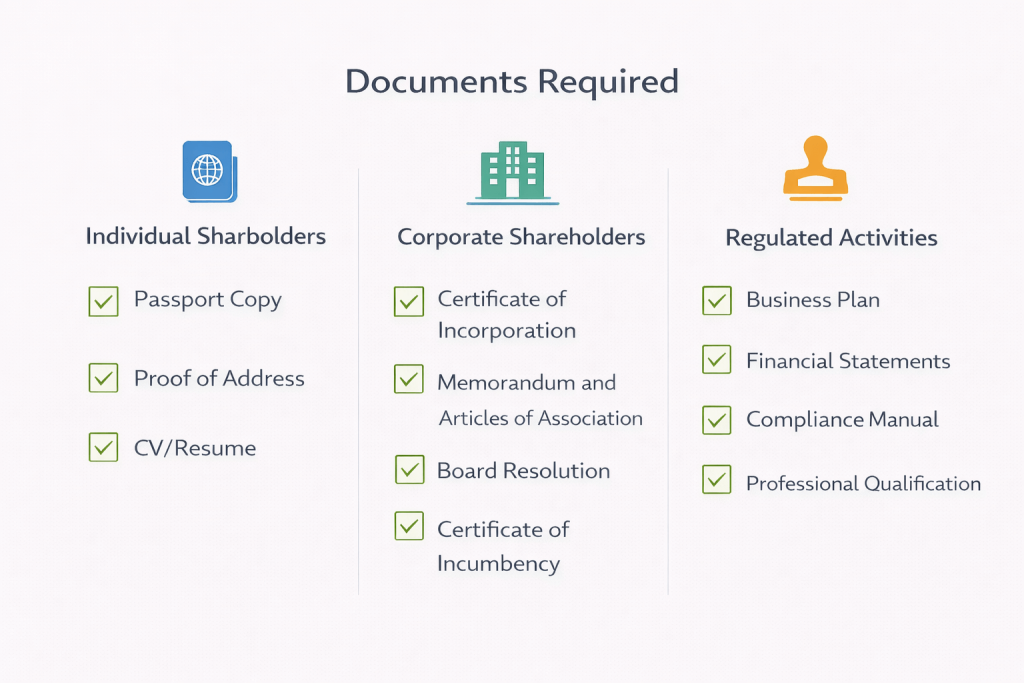
Exact documents required vary by authority and activity, but most registrations use the following foundation pack.
For individual shareholders (most common)
- Passport copy (and visa copy if applicable)
- Passport-size photo (as requested)
- Proof of address (recent)
- Basic background/profile details (often requested for compliance)
- No Objection Certificate (NOC) if applicable (case dependent)
For corporate shareholders (when a company owns shares)
- Certificate of incorporation (and often good standing equivalent)
- Memorandum/Articles of the parent company
- Board resolution approving the UAE company setup
- Ownership chain details (to identify controlling individuals)
- Notarisation/attestation requirements may apply based on country and authority
For regulated activities (examples)
You may need additional approvals, such as:
- Sector regulator approvals
- Professional qualification evidence
- Business plan or compliance policies
- Office specs / fit-out requirements (for certain sectors)
Fast approval principle: the best file is the one that makes the reviewer’s job easy — clear, complete, and consistent.
Timelines: How Long Does Business Registration in UAE Take?
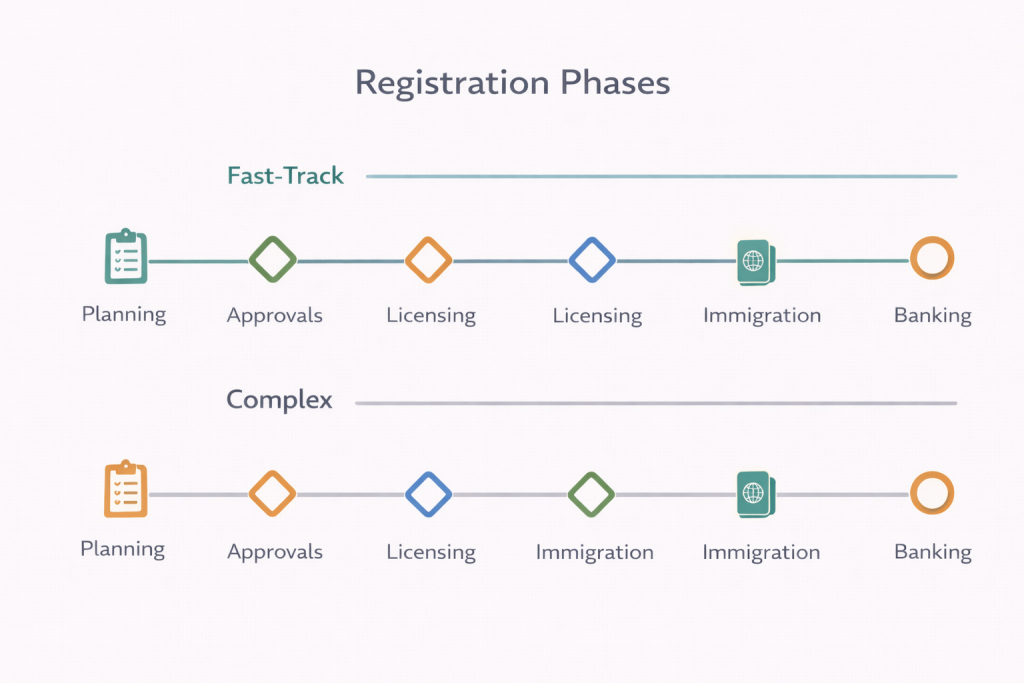
Your timeline depends on three factors:
- Jurisdiction (mainland vs free zone vs offshore)
- Activity (standard vs regulated)
- Document readiness (complete pack vs “we’ll send it later”)
Typical timeline ranges (realistic planning)
- Fast-track, standard activity, clean documents: can move in days to a few weeks
- Regulated activity, complex ownership, overseas corporate shareholder: can take longer due to approvals and document legalisation
What speeds things up immediately
- Pre-checking your activity against licence categories
- Having all shareholders ready to sign promptly
- Keeping names and spellings consistent everywhere (including middle names)
- Preparing a bank-ready profile early (so you’re not rebuilding later)
Costs: What You Actually Pay For (and What Founders Forget)
Rather than quoting a single number (because pricing varies by authority, activity, and visa needs), here’s the cost structure that helps you budget accurately.
Core cost categories
- Name reservation and initial approval fees
- Licence issuance and registration fees
- Office / workspace costs (lease, flexi-desk, warehouse where needed)
- Immigration and visa costs (if you need residency visas)
- Document legalisation (notary, attestation, translation where required)
- Ongoing compliance and renewals (annual renewals, amendments, accounting support)
Hidden cost drivers (the ones that surprise people)
- Extra approvals for regulated activities
- Changing activities mid-process (rework fees + delays)
- Unplanned office upgrades due to activity requirements
- Rushed legalisation because documents weren’t prepared early
Practical budgeting tip: decide your visa headcount first. Visas often change the package, workspace needs, and total cost more than founders expect.
Free Zone vs Mainland: A Decision Framework You Can Use Today
Choose mainland if you plan to:
- Trade broadly inside the UAE market
- Work with a wide set of local clients and contracts
- Keep your options open for future activities and expansion
Choose a free zone if you plan to:
- Run services, consulting, e-commerce, or international trade models
- Start lean with packaged solutions (licence + workspace + visas)
- Benefit from sector ecosystems and defined activity bundles
Choose offshore if you plan to:
- Hold assets, shares, or investments
- Build a holding structure for international contracting outside the UAE local market
- Separate ownership and risk from operating activities (where suitable)
A simple check that works:
If your business success depends on walking into UAE clients’ offices and selling locally, mainland is usually the cleanest route.
If your business success depends on serving clients regionally or globally with a UAE base, free zone is often ideal.
Common Reasons Business Registration in UAE Gets Delayed (and How to Avoid Them)
1) Activity mismatch
Your chosen activity must align with what you actually do. Reviewers (and later banks) can spot “approximate” activities quickly.
2) Inconsistent names and documents
One extra space, different spellings, or missing middle names can trigger resubmissions.
3) Regulated approvals discovered late
If your activity needs external approval and you only learn after submission, your timeline changes instantly.
4) Office requirements not planned
Some activities require specific premises or facility specs. Plan your workspace route early.
5) Banking postponed until “after”
If you build a structure that is difficult to explain to banks, you’ll spend more time later fixing what could have been designed correctly from day one.
After You Register: The “Year 1” Compliance Checklist
Business registration in UAE is the start — staying compliant is how you protect your licence, banking relationships, and long-term stability.
Your first-year essentials
- Licence renewal planning (don’t leave it late)
- Accounting records and clean invoicing structure
- Corporate tax registration (where applicable) and return planning
- VAT readiness if you cross thresholds or are required to register
- UBO transparency and corporate governance basics
- Visa compliance and HR processes (if you have staff)
Keep it simple: treat compliance like operations, not a once-a-year headache. The UAE rewards well-run files.
A Quick Example: Two Founders, Two Different “Right” Registrations
Example A: Service consultancy with regional clients
- Needs: 1–2 visas, professional services activity, lean setup, banking support
- Common fit: free zone package with appropriate activity and a bank-ready profile
Example B: Trading business selling inside the UAE
- Needs: UAE market access, local contracts, broader trading flexibility
- Common fit: mainland structure with the right commercial activity and premises plan
Your best route is the one that matches how you earn money — not the one that sounds cheapest on a brochure.
Register Your UAE Business with Less Stress (and a Cleaner Outcome)

When you want business registration in UAE to move quickly, the biggest advantage is having a structured plan, a complete document pack, and a team that knows how authorities and banks evaluate real applications.
First Elite Global’s UAE business setup service supports your registration end-to-end, including:
- Jurisdiction selection (mainland vs free zone vs offshore)
- Licence process guidance and application handling
- Document preparation, submissions, and follow-ups
- Visa and Emirates ID pathways (when needed)
- Corporate bank account preparation and introductions
- PRO support for ongoing changes and renewals
Trusted by founders who prefer clarity over guesswork:
“Setting up my business in the UAE was seamless. The team handled everything efficiently and made the process stress-free.”
If you want a clear plan with timelines and a written checklist tailored to your activity, start with a free consultation and move forward with confidence.
Frequently Asked Questions
1) How do I start business registration in UAE as a foreigner?
Business registration in UAE typically starts by choosing your jurisdiction (mainland or free zone), selecting the correct activity, reserving a trade name, securing initial approval, submitting your document pack, and then receiving your trade licence. Visa steps and banking usually follow after licensing.
2) What documents are required for business registration in UAE?
Common documents required include passport copies, proof of address, photos (as requested), and shareholder details. Corporate shareholders typically need incorporation documents and board resolutions. Regulated activities may require additional approvals and supporting evidence.
3) How long does business registration in UAE take?
Timelines vary based on jurisdiction, activity, and how complete your documents are. Standard activities with a clean pack can move quickly, while regulated activities or complex ownership can take longer due to approvals and legalisation steps.
4) Is a UAE office required for company registration?
Some registrations require a lease or workspace agreement, while others allow flexi-desk or serviced office options depending on the authority and activity. The workspace requirement should be planned early because it can affect both cost and approvals.
5) Can a free zone company do business in the UAE mainland?
In many cases, free zone companies can work with mainland clients through compliant routes, but the ability to trade directly inside the mainland depends on permissions, activity, and structure. If mainland trading is core to your model, a mainland setup may be the cleaner option.
6) Do I need corporate tax registration or VAT registration after registration?
Corporate tax registration and VAT registration depend on your status and thresholds. Even if registration is not immediately required, it’s smart to design your accounting and invoicing from day one so compliance is smooth as you grow.