
Setting up in the IFZA free zone is one of the fastest ways to get a Dubai-based company with a clear structure, flexible activity options, and a straightforward route to visas. But the best outcomes come from planning the full picture upfront: your activities, visa needs, bank-readiness, and the “hidden” items that shape your true cost.
This guide breaks down IFZA company setup in plain English: the real advantages, what you’ll pay for (and why totals vary), how the process works step-by-step, and how to choose the right IFZA packages without overbuying or getting stuck later.
Quick snapshot (read this first)
IFZA tends to fit best if you:
- Want a Dubai free zone company that can be set up remotely
- Need a simple path to residence visas for owners and staff
- Prefer flexible licensing options (especially for services, consulting, and many trading models)
- Want predictable setup steps with fewer moving parts
IFZA is usually not the best fit if you:
- Must invoice UAE mainland clients directly from day one without a compliant structure for onshore sales
- Need a large physical warehouse footprint immediately
- Require a niche regulated activity that needs multiple external approvals (healthcare, finance, education, certain professional services)
If you’re unsure, the safest approach is to map your activity + clients + visa needs first, then match the zone and package to that reality.
What “IFZA free zone” actually means for your business
A free zone company is incorporated and licensed within a regulated free zone framework. Practically, that impacts three things:
- Where you can operate
- Many free zone companies focus on international business, online business, and B2B services.
- If you want to sell goods or services directly into the UAE mainland, you usually need the right compliant route (for example, an approved distribution model or a mainland structure depending on what you do).
- What you’re licensing
- Your trade licence must align with your exact activities (not just a broad label like “consulting”).
- Choosing activities correctly is one of the biggest levers on approvals, cost, and banking outcomes.
- How visas tie in
- Your visa eligibility is linked to your company, establishment card, and package/space allocation.
- A “cheap licence” can become expensive if it forces upgrades later for visas or office requirements.
The biggest advantages of IFZA (and why founders choose it)
1) Flexible activity options under one licence
A major reason IFZA is popular is flexibility: you can often combine multiple activities under a single licence structure (subject to what those activities are). This matters if you’re building a modern business model (e-commerce + marketing + software services, for example) and don’t want fragmented licensing.
2) Remote-friendly setup and efficient approvals
Many founders set up from outside the UAE. When your documentation is clean and your activities are aligned, the process can move quickly and predictably.
3) Cost efficiency (when you buy the right package)
IFZA is often positioned as a value-driven free zone. The key is avoiding the trap of comparing licence headlines only. The smartest budgeting compares:
- licence + registration items
- establishment card
- visas (entry permit, medical, Emirates ID, stamping)
- workspace allocation (flexi-desk vs office)
- ongoing renewals and compliance
4) Clear pathway to residence visas
If you need UAE residence for yourself, partners, or staff, free zone setup can be a practical route—provided you plan quotas and timings correctly.
5) Practical for service businesses and lean teams
Consultancies, agencies, online services, trading models with international supply chains, and SMEs often choose IFZA when they want a professional Dubai base without unnecessary complexity.
IFZA licence types (and how to pick the right one)
The term IFZA licence (often spelled “license” on official documents) isn’t a single thing—it’s a category that must match what you do.
Commercial-style licences (trading models)
Best if you:
- Import/export
- Trade goods internationally
- Distribute products (depending on your exact structure and route-to-market)
Common fit: general trading models, product-based businesses, wholesale, certain e-commerce structures.
Professional-style licences (services and expertise)
Best if you:
- Provide consulting or specialist services
- Operate as an agency, freelancer, or service firm
- Deliver non-regulated professional work (depending on the activity)
Common fit: marketing, management consulting, IT services, design, project management, and many other service categories.
The best way to choose
Don’t start with the licence label—start with:
- Who pays you (UAE mainland clients, international clients, marketplaces)
- What you deliver (services, goods, digital products)
- How you deliver (online, physical delivery, onshore work, international shipping)
- Whether your activity is regulated (and needs external approvals)
If your activity is even slightly unclear, choosing the wrong category can slow approvals and create bank account issues later.
IFZA packages explained (what you’re really buying)
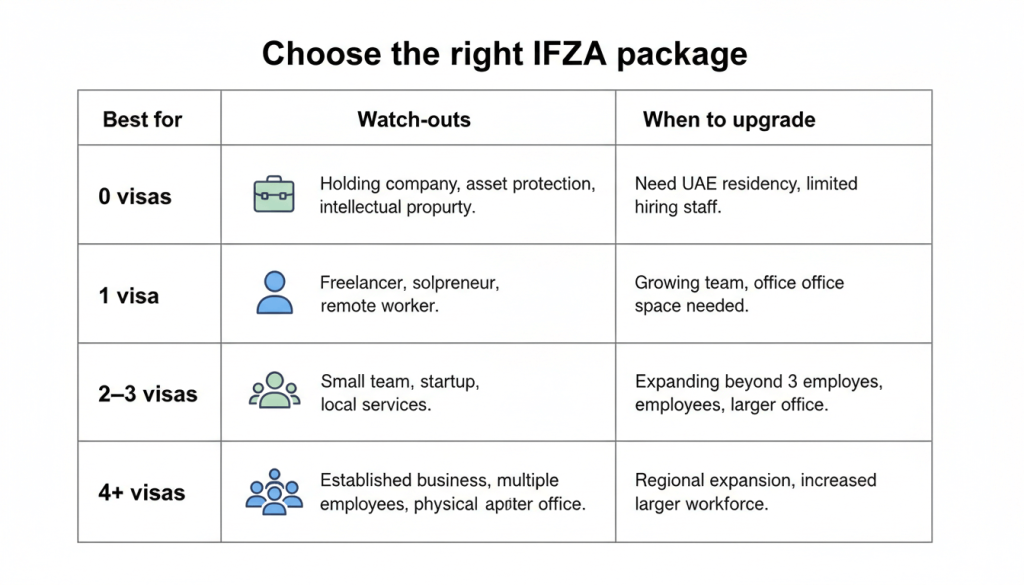
Most IFZA packages bundle the core company formation items and differ mainly by:
- Visa quota (0, 1, 2, 3+ visas)
- Workspace allocation (flexi-desk, shared space, or office options)
- Number of activities and how they’re grouped
- Any promotions (which may exclude key items like establishment card, medical, Emirates ID, and insurance)
A practical way to choose a package (simple rule)
- 0 visas: best if you only need a legal entity for contracts, invoicing, and operations (and you do not need UAE residence)
- 1 visa: best for a solo founder who wants UAE residence
- 2–3 visas: best for a founder + partner or a lean team
- More visas: best when you already have a hiring plan or need family sponsorship pathways
Buying too small can force mid-year upgrades. Buying too big wastes money. The “right” package matches your next 12 months, not your dreams.
IFZA free zone costs: what to budget (and why totals vary)
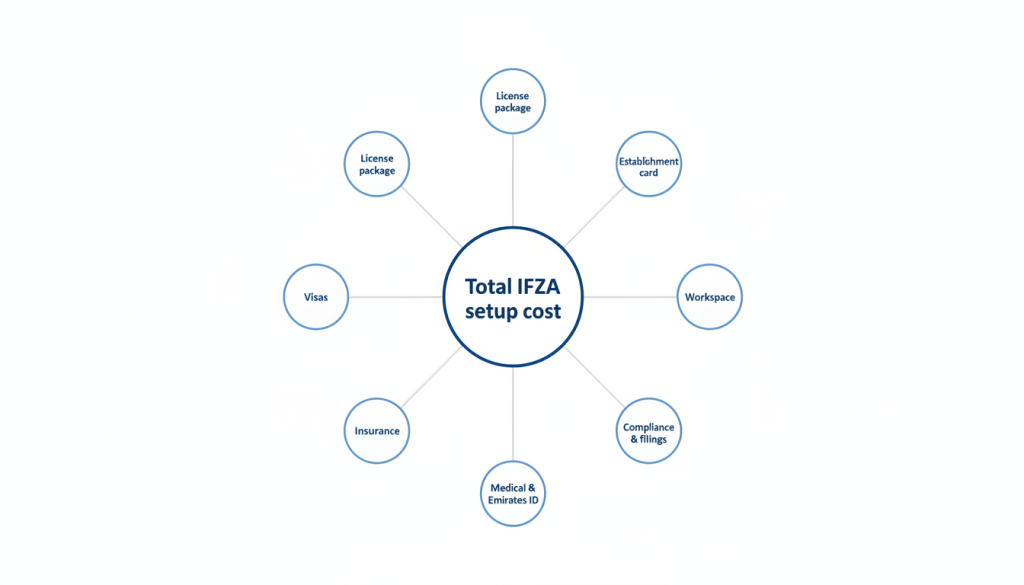
You’ll see wide ranges online because the total depends on your visa count, workspace, activity type, and add-ons. Instead of chasing a single number, budget by cost drivers.
The main cost buckets
1) Licence and registration items
- Your base setup (varies by package and activities)
- Initial approvals and issuance
2) Establishment card
- Required if you will sponsor visas
3) Visas (per person)
Often includes stages like:
- entry permit
- status change (if applicable)
- medical fitness test
- Emirates ID
- visa stamping
4) Workspace / flexi-desk
- Some packages include a basic allocation; upgrades cost more
5) Compliance and operations
- bookkeeping and accounting
- corporate tax registration where applicable
- VAT registration if thresholds apply
- UBO and any required filings
- bank account support and documentation preparation
Real-world budgeting examples (indicative)
Example A: Entity only (0 visas)
Best for founders who live abroad and don’t need UAE residence.
- Base licence package
- Optional: bank account support, compliance setup
Example B: Solo founder (1 visa)
A realistic total often includes:
- licence package
- establishment card
- visa process + Emirates ID + medical
- insurance
- bank-readiness documentation
Example C: Small team (3 visas)
A realistic total often includes:
- higher-tier package or upgrades
- establishment card
- three visa processes
- workspace upgrade if needed
- stronger compliance and payroll planning
“Hidden costs” checklist (the part most guides miss)
Before you commit, confirm:
- What is included vs excluded in the package (especially establishment card and visa-related items)
- Whether your activity requires external approvals
- Whether your bank choice has stricter requirements for your activity/country profile
- Renewal expectations (licence, establishment card, visas, Emirates ID)
- Whether you need attestation or certified translation of documents for banking/compliance
If you want a precise budget, the most efficient approach is a package quote built around your activity list + visa plan + banking goal—not a generic price list.
Step-by-step: IFZA company setup process
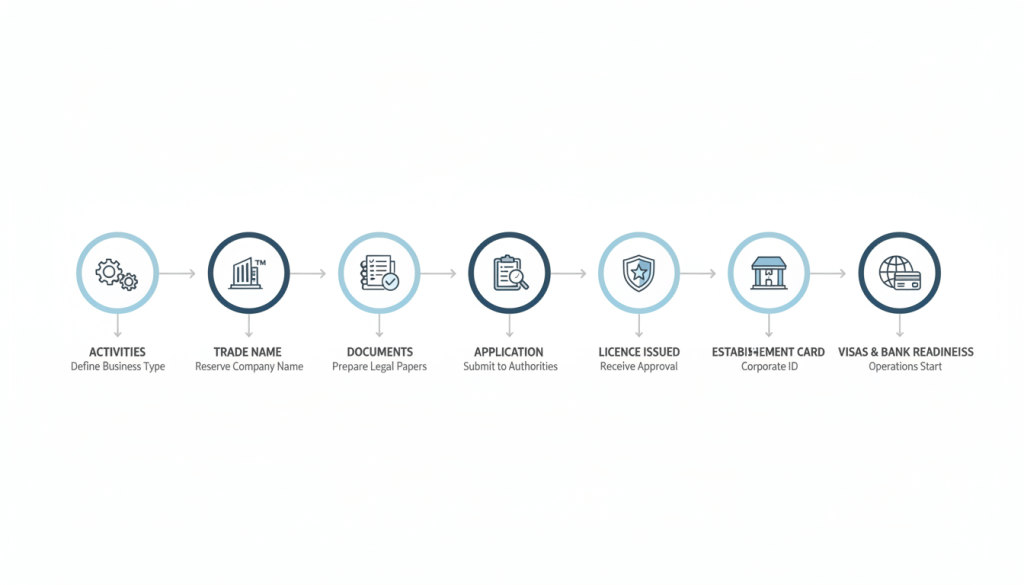
Here’s how IFZA company setup typically runs when done cleanly.
Step 1: Define your activity list (the approval foundation)
Start with a shortlist of activities that match how you’ll earn revenue. Avoid broad, vague labels. Be specific and realistic.
Pro tip: If you’re choosing between two similar activities, pick the one that best matches your invoices, website, and contracts. Consistency matters for banking.
Step 2: Choose the right legal structure
Most founders will choose a simple structure that suits ownership and liability needs. If you’re adding partners or planning future investors, structure it properly now.
Step 3: Trade name selection
Choose 2–3 preferred names and ensure they fit naming rules. A small name issue can cause avoidable delay.
Step 4: Prepare documents (get them “bank-ready”)

Commonly requested items include:
- passport copy (owners/shareholders)
- photo
- proof of address (where required)
- basic business description (what you do, who you serve)
- for certain activities: CV, portfolio, or additional supporting documents
- if you’re already UAE resident: NOC or status documents (as applicable)
Step 5: Submit application and issue the licence
Once approved, the licence is issued and your company is formed.
Step 6: Establishment card (if you need visas)
This enables visa sponsorship through the company.
Step 7: Visa process (owners, staff, dependents)
Visa processing follows the standard pathway and can be staged to avoid operational downtime. The best approach is sequencing: licence first, then establishment card, then visas.
Step 8: Corporate bank account preparation and opening

Banking is where many DIY setups fail—not because banks are “random,” but because documentation and risk alignment are often weak.
What improves approvals:
- clear business model explanation
- clean ownership and source-of-funds narrative
- compliant contracts/invoices templates
- website and email domain consistency
- realistic projected turnover
Step 9: Post-setup compliance and operations
Depending on your situation, this may include:
- corporate tax registration obligations
- VAT registration if thresholds apply
- UBO filings where required
- basic accounting and record-keeping
- employment set-up if you hire (and related payroll planning)
Timeline: how long IFZA setup usually takes
A realistic end-to-end timeline depends on how quickly you supply correct documents and whether your activity needs extra approvals. As a planning range, many free zone formations fall within 1 to 4 weeks once documentation is ready—especially when you avoid rework and mismatched activities.
If you’re on a deadline (travel, contracts, hiring), the best move is to plan backwards from your target date and stage the process: formation first, then visas, then banking.
IFZA vs other Dubai free zones: a practical comparison
You don’t need the “best free zone.” You need the best fit.
IFZA often wins on:
- value for lean teams
- flexible activity mixes
- efficient setup pathways
- straightforward package logic for visas
Other zones may be stronger if you prioritise:
- premium brand positioning in a specific sector
- specialised infrastructure (commodities, media, logistics)
- proximity to specific industry clusters
- larger office/warehouse needs from day one
If your strategy is to start lean and scale, IFZA is commonly chosen as a practical first base—then upgraded later if your business model demands it.
Common mistakes (and how to avoid them)
Mistake 1: Choosing activities for “approval” instead of reality
Your activity must match what you’ll actually do. Otherwise, banking and compliance get harder.
Mistake 2: Underbuying visa quota
If you know you’ll need 2–3 visas within a year, plan for it now. Midstream upgrades can cost more and disrupt timelines.
Mistake 3: Ignoring bank-readiness until after the licence
Treat banking as part of the formation plan, not an afterthought. Your structure, activity, and documentation should support your banking goal.
Mistake 4: Not clarifying what’s excluded from promotions
Many “headline offers” exclude the items that make the company operational (establishment card, Emirates ID, medical, insurance).
Mistake 5: No compliance foundation
Basic bookkeeping, clear invoicing, and correct filings protect you long-term—and make banking and renewals easier.
How First Elite Global helps you set up in IFZA without delays
Most formation problems aren’t complicated—they’re avoidable. Our approach is to keep your setup clean, compliant, and bank-friendly from day one.
What we handle end-to-end:
- activity and licence mapping
- package selection aligned to visas and operations
- trade name and documentation checks
- formation and issuance
- visas and immigration coordination
- bank account preparation support
- ongoing guidance as your needs scale
“First Elite Global made our Dubai free zone setup surprisingly straightforward. Everything from licence to visas and bank account was handled with professionalism and clear updates.”
If you want a fast, predictable setup with clear fees and fewer surprises, book a free consultation and we’ll map your best route in one call.
Frequently asked questions
1) What is the IFZA free zone best for?
The IFZA free zone is commonly used for service businesses, consultancies, SMEs, e-commerce models, and trading structures that prioritise speed, flexibility, and a practical visa pathway—especially for lean teams.
2) How much does IFZA company setup cost?
IFZA company setup cost varies by package and visa count. Your total typically includes the licence package, establishment card (if sponsoring visas), visa processing items per person, workspace allocation, and operational compliance costs.
3) What are IFZA packages and how do I choose?
IFZA packages usually differ by visa quota and workspace allocation. Choose based on your next 12-month plan: whether you need UAE residence, how many people you’ll sponsor, and whether you need flexi-desk or office options.
4) How long does it take to get an IFZA licence?
An IFZA licence timeline depends on documents and activity approvals. When documentation is correct, formation can be quick; the full journey (including visas and banking prep) often takes a few weeks.
5) Can I open a corporate bank account with an IFZA free zone company?
Yes, but approvals depend on your activity, documentation quality, and risk profile. Bank-ready preparation—clear business model, clean ownership story, proper contracts, and consistent online presence—significantly improves outcomes.
6) Do I need a visa to own an IFZA company?
No. You can own an IFZA company without taking a UAE residence visa. Visas are optional and chosen based on whether you want UAE residency and local operational needs.