If you’re searching IFZA UAE, you’re likely trying to answer three practical questions:
- How much will an IFZA company actually cost me?
- What’s the real setup process and timeline?
- Is IFZA the right free zone for my activity, visas, and banking goals?
This guide gives you a clear, decision-ready view of IFZA UAE: what it is, what you can do under an IFZA licence, what you’ll pay (and what people forget to budget for), plus the step-by-step process that keeps approvals smooth.
What “IFZA UAE” actually refers to

IFZA UAE refers to the International Free Zone Authority (IFZA), a Dubai-based free zone community where entrepreneurs can register a company, obtain a trade licence, and (if needed) sponsor UAE residence visas.
In simple terms:
- IFZA is the free zone authority
- Your IFZA licence is the trade licence your company operates under
- Your visa quota is how many residence visas your company can sponsor (0, 1, 2, 3, 4+)
- Your office solution (often flexi-desk) is the registered address requirement used for licensing
Why IFZA is a top choice in the UAE
IFZA has become a go-to option for founders who want a Dubai free zone structure without the heavier overheads seen in premium zones.
The most common reasons founders choose IFZA
- Cost-effective entry point compared with many Dubai alternatives
- Clear package structure (0-visa to multi-visa options)
- Fast incorporation when documents are clean
- Flexible office options (often including flexi-desk solutions)
- Good fit for international-first business models (services, trading, digital, consulting, holding)
Who IFZA is best for (and who should think twice)
IFZA is usually a strong match if you are:
A solo founder or consultant
Ideal for professional activities where you want a clean Dubai entity, a residency visa (or not), and a compliant structure banks understand.
An e-commerce or trading founder
Works well when your operations are international, online, or you trade through proper channels and don’t need a large physical footprint.
A holding / asset structure builder
When your priority is ownership structure, shareholding, and a legitimate UAE entity.
A small team launching lean
If you need 2–4 visas and want a predictable cost path, IFZA packages are often easier to plan around.
You should pause and re-check IFZA if you are:
Selling directly into the UAE mainland market daily
Free zone companies can be fantastic, but day-to-day mainland trading may require additional structuring (distribution, approvals, or a mainland licence depending on your activity and model).
Running a regulated activity
Anything tied to financial services, certain medical activities, education, or heavily regulated sectors often needs extra approvals. Your activity choice matters more than the free zone brand.
Relying on complex banking from day one
If you need immediate trade finance, high-risk payment processing, or multi-currency facilities on launch, you may need a stronger compliance file and a more bank-oriented setup strategy.
IFZA licence types and activities: what you can register
While the exact activity list is extensive, most founders fall into a few practical buckets:
1) Professional licence (services)
Typical for:
- consulting
- marketing and digital services
- IT and software services
- management services
- training and advisory models
2) Commercial licence (trading)
Typical for:
- import/export
- general trading (where suitable)
- e-commerce trading models
- product distribution (when structured correctly)
3) Holding / structured ownership models
Typical for:
- holding shares in subsidiaries
- ownership of assets (where permitted)
- group structuring and expansion
Tip that saves money later: choose the licence type and activities based on how you’ll invoice, how banks will read your profile, and whether you’ll need visas now or later.
IFZA UAE costs: what you’ll pay (and what people forget)
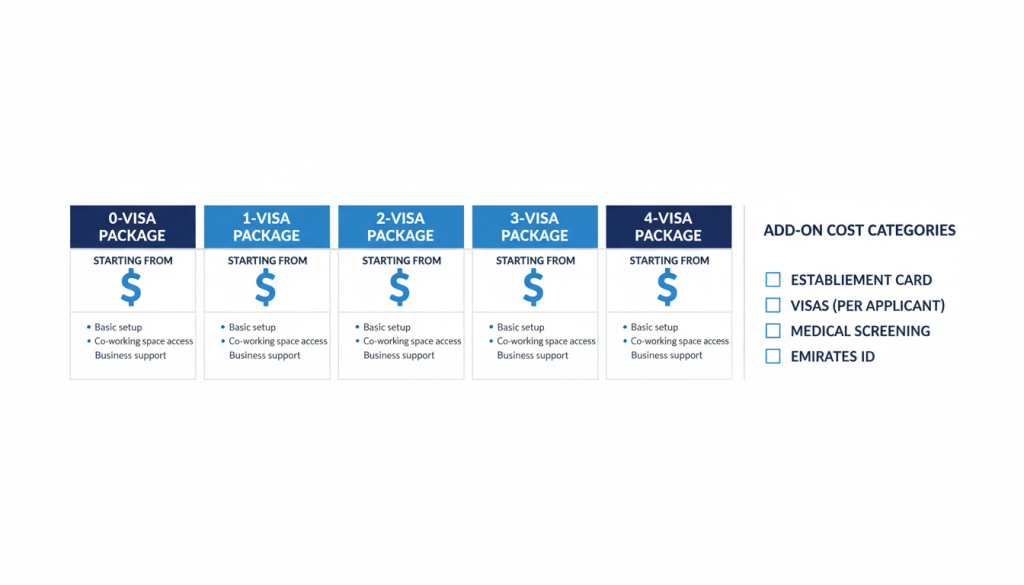
IFZA is often marketed with a “starting from” licence figure. That can be accurate, but your real budget should include:
- licence package (based on visa quota)
- establishment / immigration file items
- visa processing costs (if you want residency)
- medical + Emirates ID steps
- office solution (flexi-desk vs private office)
- banking preparation (documentation and compliance file)
Typical IFZA licence package ranges (market pricing)
Below is a realistic, planning-friendly snapshot founders commonly see for entry packages.
| IFZA package (visa quota) | Typical starting range (AED) | Best for |
| 0 visa | ~12,900+ | holding, non-resident owners, remote-first founders |
| 1 visa | ~14,900+ | solo founder who wants UAE residency |
| 2 visas | ~16,900–18,500 | founder + staff / partner |
| 3 visas | ~18,900+ | small team setup |
| 4 visas | ~20,900+ | growing team needing more quota |
Important: packages vary based on inclusions, promotions, office solution, activity type, and whether add-ons are bundled.
The cost categories most people don’t budget for
1) Establishment card / immigration file
If you want visas, you’ll typically need the relevant immigration setup elements (often treated as a separate line item when comparing providers).
2) Visa processing per person
A UAE residence visa is not one fee. It’s a sequence of steps:
- entry permit
- status change (inside-country processing if applicable)
- medical fitness test
- Emirates ID application
- visa stamping / finalisation
3) Medical + Emirates ID and timing
These are procedural steps that can affect both timeline and cost planning, especially if travel scheduling is involved.
4) Office solution upgrades
Flexi-desk is often enough for many founders, but if your bank or business model requires a stronger operational footprint, you may later upgrade to a private office.
5) Ongoing compliance and filings
Even a lean company needs clean basics:
- bookkeeping structure
- invoicing discipline
- corporate tax and VAT awareness (where applicable)
- licence renewal planning
A practical “all-in” budgeting approach
If you want a simple way to estimate:
- Licence package (based on visas you need now)
- Visa total per person (plan a buffer rather than guessing a single fee)
- Office requirement (flexi-desk vs office)
- Bank-ready compliance file (clean contracts, website/portfolio, invoice plan)
If you want a precise number, the fastest method is to build a line-by-line proposal around:
- your activity
- your visa count
- whether you are inside or outside the UAE
- whether you need banking support now or later
Can you start IFZA with 0 visas and upgrade later?
Yes. Many founders start with 0 visa to keep initial cost low, then upgrade their package when they’re ready to relocate, hire, or formalise residency for banking and operations.
This approach is popular when:
- you want to test demand first
- you’re not ready to move immediately
- you’re building a holding structure first
- you want to stagger cost over time
IFZA setup process: step-by-step (done properly)
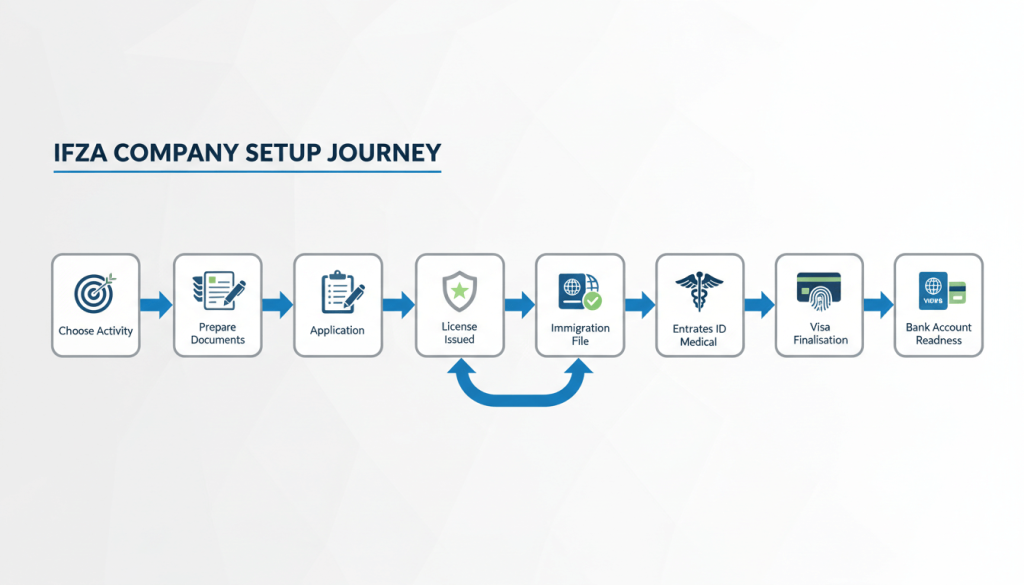
A smooth IFZA UAE setup is mostly about file quality and correct sequencing.
Step 1: Confirm your activity and licence type
Your activity selection affects:
- approvals
- how banks classify your business
- whether you’ll need extra documentation
- whether your licence is professional or commercial
Step 2: Choose shareholder structure
Decide:
- single shareholder vs multi-shareholder
- manager appointment
- any corporate shareholder requirements (if applicable)
Step 3: Prepare documents (clean file = fast approval)
Most founders need:
- passport copy
- photo (as per requirements)
- contact details
- basic business description
- if already resident: current visa / Emirates ID (where relevant)
Step 4: Name reservation and application submission
A good application includes:
- clear activity logic
- consistent spelling across documents
- no mismatched signatures
- a coherent business description aligned with your website/portfolio
Step 5: Licence issuance and company documents
Once approved, you receive your company documents and trade licence.
Step 6 (if needed): Immigration file + visas
If you’re taking residency, the visa path is typically:
- entry permit
- status change (if applying inside the UAE)
- medical test
- Emirates ID
- visa finalisation
Step 7: Corporate bank account preparation

Banks don’t just review your licence. They review:
- business model clarity
- proof of experience
- expected transaction profile
- client/supplier documentation
- website and credibility footprint
A bank-ready file reduces delays dramatically.
IFZA timeline: how long it usually takes
Timelines depend on:
- document readiness
- activity complexity
- whether visas are included
- your travel status (inside/outside UAE)
A practical expectation:
- Licence only (no visa): often the fastest route
- Licence + visa: typically longer due to medical, Emirates ID, and immigration sequencing
If your goal is to launch quickly, prioritise:
- clean documents
- a realistic activity choice
- a straightforward shareholder structure
IFZA pros and cons: the honest view
The strongest advantages of IFZA
1) Lower barrier to launch
IFZA is often chosen because it keeps startup overhead controlled while still giving you a Dubai free zone entity.
2) Visa scalability
Start lean and expand. This matters if you’re hiring or bringing family later.
3) Good fit for modern business models
Consulting, digital services, e-commerce, international trading models: IFZA is frequently used for these.
4) Straightforward package planning
Compared to zones with heavier mandatory office requirements, IFZA can be easier to budget.
The trade-offs to understand upfront
1) Mainland operations need the right structure
If you’re doing daily UAE mainland work, you may need additional steps depending on your activity.
2) Banking depends on your compliance file
Your licence helps, but your documentation and transaction logic matter more.
3) “Cheap setup” can become expensive with hidden add-ons
If a quote is not itemised, founders often discover extra fees later (immigration file items, medical/ID steps, office upgrades).
IFZA vs other UAE free zones (quick comparison)
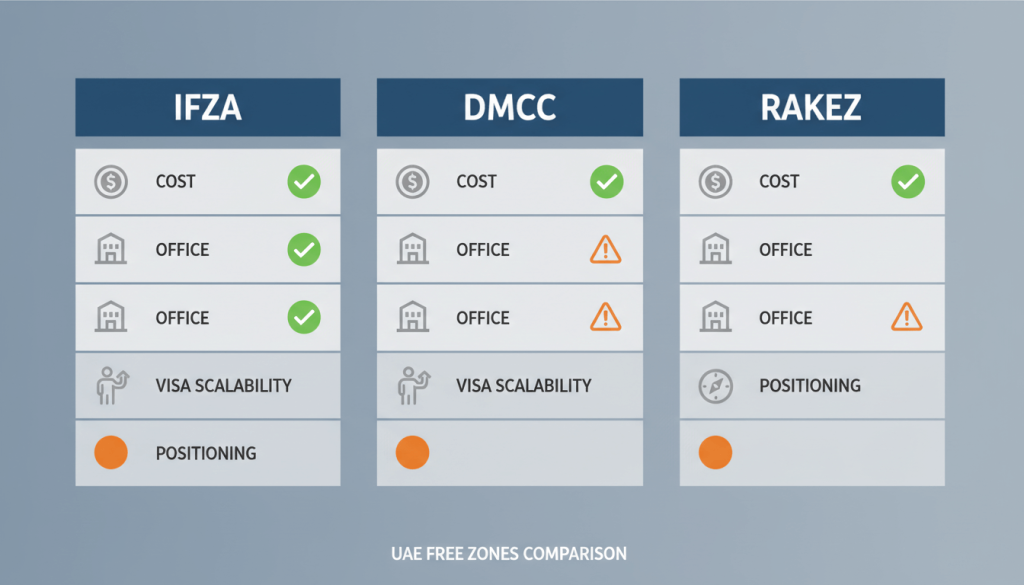
Choosing a free zone is less about hype and more about fit: cost, office requirement, visa planning, and how your industry is perceived by banks and counterparties.
| Free zone | Best when you prioritise | Typical trade-off |
| IFZA | cost control + scalable visas + fast setup | not always the “prestige pick” for every industry |
| DMCC | premium positioning + global recognition | higher costs, stricter office expectations |
| RAKEZ | cost efficiency and broad flexibility | may not suit founders who want a Dubai address for perception |
| Dubai Silicon Oasis area options | tech-friendly ecosystem | cost varies by structure and office needs |
Your best choice depends on:
- whether you need Dubai address perception
- visa count now vs later
- your sector approvals
- banking strategy
Common mistakes that slow down IFZA approvals
1) Picking the wrong activity
This triggers avoidable questions from authorities and banks.
2) Inconsistent documents
Different spellings, mismatched signatures, and unclear roles create delays.
3) Not planning visas in sequence
Trying to compress the visa path without travel planning often causes avoidable rework.
4) Applying for a bank account with a weak profile
If your website, contracts, or business model logic aren’t ready, you lose weeks.
A simple IFZA readiness checklist
Before you apply, confirm you have:
- ✅ clear business activity description (what you sell, who you sell to, where you invoice)
- ✅ clean passport copy and required photo format
- ✅ shareholder decision (solo vs partner structure)
- ✅ visa plan (0 visa now or residency immediately)
- ✅ basic credibility footprint (website, LinkedIn, portfolio, contracts)
- ✅ budget that includes visas and compliance, not just the licence headline
A practical way to get the lowest-risk IFZA setup
Most founders don’t fail because IFZA is complicated. They fail because the setup is treated like a form-fill, not a compliance file.
At First Elite Global, we run IFZA setups like a structured launch:
- activity and licence aligned to banking reality
- line-by-line costs (so there are no surprises later)
- timeline planning around travel and visa sequencing
- a bank-ready file built alongside the licence
If you want a clear IFZA plan built around your exact activity and visa count, book a free consultation and we’ll map your fastest compliant route from application to licence, visa, and banking.
“First Elite Global made our Dubai free zone setup surprisingly straightforward. Everything from licence to visas and bank account was handled with professionalism and clear updates.”
FAQs
1) What is IFZA UAE?
IFZA UAE refers to the International Free Zone Authority in Dubai, where you can register a company, obtain a trade licence, and sponsor residence visas (if your package includes visa quota).
2) How much does an IFZA licence cost in the UAE?
IFZA packages are often marketed from around AED 12,900+ for a 0-visa option, with higher packages for 1, 2, 3, and 4+ visas depending on inclusions and office solutions.
3) Can I set up an IFZA company with zero visas?
Yes. Many founders start with a 0-visa package to keep initial costs low and upgrade later when they want UAE residency or need staff visas.
4) How long does IFZA company setup take?
Licence-only setups can be fast when documents are clean. Setups with visas take longer because medical testing, Emirates ID, and immigration steps must be completed in sequence.
5) Is IFZA good for e-commerce and consulting?
IFZA is commonly used for consulting and international-facing e-commerce models, especially when founders want a Dubai free zone structure with flexible visa planning and controlled overheads.
6) Can an IFZA company trade in the UAE mainland?
A free zone company can work with mainland clients, but the correct structure depends on your activity and how you deliver goods/services. It’s important to plan this properly before licensing.