
If you search “minimum investment to start business in Dubai”, you’ll see headline numbers that look almost too good to be true. The reality is: the minimum depends on (1) where you register, (2) whether you need a residence visa, and (3) what “ready to operate” means for your activity.
A lean founder can often launch with a low five-figure AED budget, but many people underestimate the “second layer” of costs: visas, workspace compliance, banking readiness, approvals, and the first few months of operating runway.
If you want a figure you can actually plan with, use this simple rule:
Realistic minimum investment = setup costs + visa costs + workspace compliance + 3–6 months operating runway + buffer
This guide breaks it down clearly, with practical budget bands and examples—so you can choose a structure that keeps costs low without creating problems later.
What “minimum investment” really means in Dubai
Most founders mean one of these (they’re not the same):
- Minimum to get a trade licence issued (paperwork-only minimum)
- Minimum to open a company + get a residence visa (common for expat founders)
- Minimum to start trading smoothly (licence + visa + bank + basic compliance)
- Minimum to survive the first 6 months (the real number)
If you only budget for item #1, you’ll likely stall at banking, visas, or compliance—and end up paying more to fix it.
Quick answer: realistic budget bands (AED)

Below are planning ranges that typically match what founders experience when they aim for a clean, compliant setup:
| Scenario (most common) | What’s included | Realistic minimum range |
| Licence only (no residence visa) | Trade licence + basic registration | AED 12,000–25,000 |
| Lean founder with 1 visa | Licence + 1 visa pathway + compliant workspace option | AED 20,000–45,000 |
| Small team (2–3 visas) | Licence + multiple visas + stronger workspace requirement | AED 40,000–90,000 |
| Trading / import-export (heavier compliance) | Licence + visas + warehouse/office + customs/logistics readiness | AED 70,000+ |
The biggest budget driver is usually visas + workspace, not the licence itself.
The cost components you must plan for
1) Trade licence and registration fees
Your base setup normally includes:
- Name reservation and initial approvals
- Licence issuance (activity-dependent)
- Establishment file / immigration file (if visas are involved)
- Basic legal paperwork (varies by authority and structure)
What changes the price most:
- Licence type (professional vs commercial vs industrial)
- Number of permitted activities
- Regulated activities requiring external approvals
2) Free zone packages vs mainland setup: what changes financially

Both routes can work, but they’re priced differently because the operating rules differ.
Free zone (typical cost logic)
Free zone packages often bundle:
- Licence + registration
- A workspace option (sometimes flexi-desk style)
- A visa quota option (sometimes included, sometimes extra)
Free zone can be cost-efficient for:
- Consulting, digital services, e-commerce, holding structures
- Founders serving clients internationally or operating remotely
Mainland (typical cost logic)
Mainland is often chosen for:
- Serving customers anywhere in the UAE without operational constraints
- On-site services, local contracts, wider market access
Mainland cost is often influenced by:
- Office/Ejari expectations for certain activities
- Approvals tied to the business activity
- The practical reality of needing a more “bank-friendly” operating footprint
Practical takeaway: If your business model is UAE-local and operational (on-site work, retail, staff), mainland may be the smoother long-term choice even if the headline setup looks higher.
3) Residence visas: the “hidden” minimum most founders forget
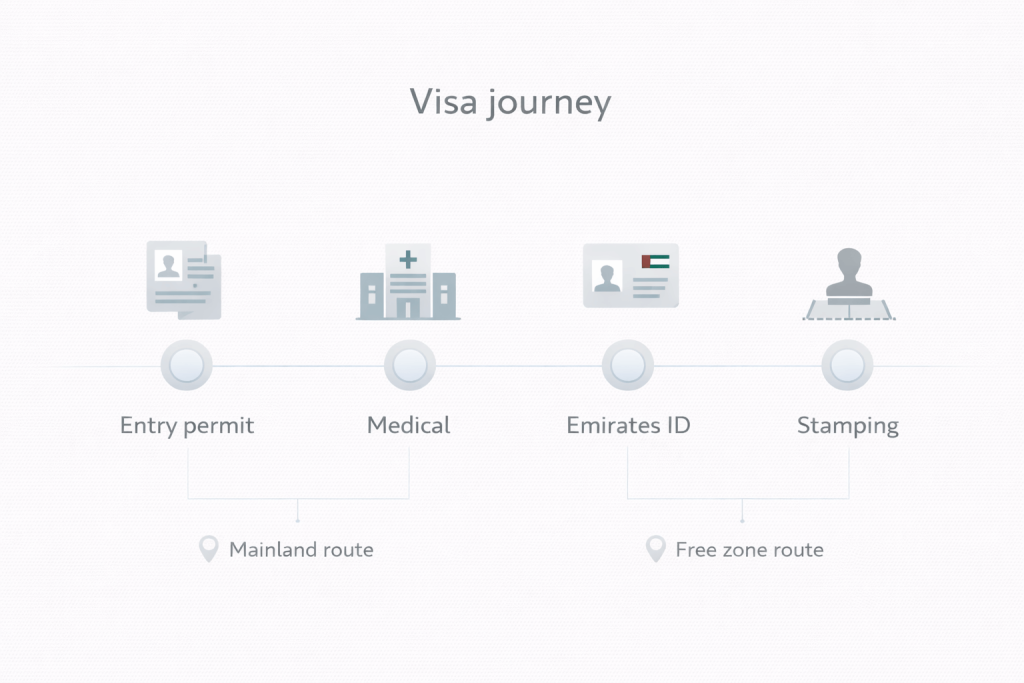
If you need a UAE residence visa through your company, budget for:
- Entry permit / status change (where applicable)
- Medical fitness test
- Emirates ID
- Visa stamping
- Supporting PRO processing steps and government file setup
Important: visa costs are not just “one fee”. They’re a sequence of steps, and they multiply with each person (partners, employees, dependents).
Budget reality check:
- A “cheap licence” becomes expensive fast if it includes zero visa quota, or if adding a visa later triggers extra processing steps.
4) Workspace and office requirements (and why they impact cost)

Dubai is strict about legitimate business addresses. Depending on your activity and jurisdiction, you may use:
- Flexi-desk / shared workspace (lowest-cost compliant option in many cases)
- Serviced office / co-working (mid-range)
- Dedicated leased office with tenancy registration where required (higher-cost)
Why this matters:
- Some activities require a leased office footprint
- Some banks are more comfortable when a business has a clear operating address and documentation trail
- Mainland setups often interact with tenancy registration expectations more directly
Plan for workspace as a compliance requirement, not a lifestyle choice.
5) Banking readiness and “launch friction”
Many founders underestimate the cost of getting bank-ready—not always in fees, but in:
- Document preparation (invoices, contracts, website, company profile)
- Proof of address and operating model clarity
- Time (which becomes a cost if you can’t bill clients yet)
If your goal is “start trading smoothly”, your minimum investment must include a basic bank-readiness pack:
- A simple, credible website
- Service agreements / invoices templates
- Clear description of activities and target markets
- Clean ownership and compliance profile
6) Ongoing compliance and operating runway (the real minimum)
Even a lean setup has recurring costs:
- Licence renewal
- Visa renewals (as applicable)
- Accounting/bookkeeping
- VAT registration and filing (if thresholds apply)
- Corporate tax registration and filing obligations
- Optional: medical insurance, PRO support, office renewals
A realistic plan includes 3–6 months runway:
- Marketing and lead generation
- Tools/subscriptions
- Transport, telecoms
- Basic professional services
Founders who win in Dubai don’t just budget to “open”—they budget to operate.
A simple “minimum investment” calculator you can use today

Use this quick formula:
- Setup (licence + registration + government files)
- Visas (number of people × visa pathway cost)
- Workspace (lowest compliant option for your activity)
- Operating runway (3–6 months)
- Buffer (10–20%) for approvals, amendments, and timing delays
If you want the lowest safe number: minimise visas, choose a compliant light workspace option, and keep the activity scope tight.
Three realistic examples (case-style budgets)
Example A: Solo consultant (lean start, wants 1 residence visa)
Goal: invoice clients quickly, keep overhead low.
Typical plan:
- Professional activity licence
- One visa pathway
- Flexi-desk style workspace option (where allowed)
- 3 months runway for marketing + tools
Planning range: AED 25,000–45,000
Where founders overspend:
- Adding unnecessary activities to the licence
- Choosing a premium address before revenue exists
- Paying for “extras” that don’t improve compliance or bank readiness
Example B: E-commerce seller (needs credibility + logistics)
Goal: sell online, import small quantities, grow.
Typical plan:
- Commercial licence aligned to product category
- One visa (or more if staffing)
- Workspace requirement aligned with operations
- Basic compliance readiness for suppliers and payments
Planning range: AED 40,000–90,000 (depends heavily on visas and logistics footprint)
Where founders get caught:
- Underestimating product/brand approvals (category-dependent)
- Assuming a “cheap licence” automatically equals a scalable operating setup
Example C: On-site services business (local UAE market focus)
Goal: service clients across Dubai/UAE, hire staff, win contracts.
Typical plan:
- Mainland structure often suits operational flexibility
- Office/tenancy expectations may apply
- Multiple visas and staff onboarding pathway
Planning range: AED 50,000–120,000+
Where founders save money safely:
- Start with the minimum viable visa count
- Use a practical workspace solution initially, upgrade later
- Build a clean compliance trail early so growth doesn’t force costly restructuring
How to reduce your startup costs without creating problems
Keep your licence scope tight
- Choose only the activities you genuinely need now
- Add activities later once revenue justifies it
Don’t buy visas you don’t need yet
- Every visa adds cost and admin complexity
- Start lean, scale visas with revenue
Choose workspace for compliance first
- Start with the lowest compliant option
- Upgrade when the business has predictable cash flow
Build “bank-ready” basics early
- A credible website + clear service description
- Simple contracts and invoice templates
- Clean ownership and transparent operating model
Common “hidden costs” checklist (so nothing surprises you)
Depending on activity and jurisdiction, you may need:
- External approvals from regulators (activity-specific)
- Attestation/legalisation for documents (if required)
- Amendments: name change, activity updates, shareholder changes
- Tenancy registration steps (where applicable)
- VAT registration and filings once thresholds apply
- Corporate tax registration and filing obligations
- Medical insurance (often required in practice for residents/employees)
A practical launch plan (fast, clean, low-risk)
- Pick the activity based on how you will actually earn money
- Choose the jurisdiction based on where you need to operate (UAE-wide vs zone-focused)
- Decide visa count now vs later
- Select the lightest compliant workspace option
- Prepare bank-ready documents before you apply
- Open, licence, visa, then start trading—without gaps
If you want the most accurate minimum investment figure for your case, the quickest route is to map your activity, visa needs, and operating footprint into a single cost plan with an advisor—so you don’t pay twice fixing avoidable mistakes.
Frequently asked questions
What is the minimum investment to start business in Dubai in 2026?
For licence-only setups, some founders plan from the low five-figures (AED). If you need a residence visa and a compliant workspace pathway, a more realistic planning range is often AED 20,000–45,000+, depending on activity and visa count.
Can I start a business in Dubai with zero investment?
You can structure a very lean launch, but there are unavoidable government fees for licensing and (if needed) residence visa processing. The lowest-cost path is usually a narrow activity scope, minimal visas, and the lightest compliant workspace option.
Is a free zone always cheaper than mainland?
Not always. Free zone can look cheaper at the headline package level, but mainland can be more efficient if you need full UAE market access, local contracts, or operational flexibility. The “cheapest” route is the one that matches how you’ll operate.
Do I need an office to start a business in Dubai?
It depends on the jurisdiction and activity. Some setups allow flexi-desk style compliance, while others require leased office documentation. Treat workspace as a compliance item, not just a preference.
How much does a Dubai business visa add to the total budget?
Visa cost is usually a multi-step process (permits, medical, ID, stamping). Multiply it by the number of people (partners/employees) and include processing and government file steps. This is often the biggest driver of the true minimum investment.
What’s the biggest mistake founders make with Dubai startup costs?
Budgeting only for the licence. The real minimum investment must include visas (if needed), workspace compliance, banking readiness, and 3–6 months runway.
Helpful Links
- Invest in Dubai (official): Business setup & free zone set-up costs
https://www.investindubai.gov.ae/en/business-setup
https://www.investindubai.gov.ae/en/business-setup/free-zone-companies/free-zone-set-up-costs
- UAE Government Portal (official): Starting a business in a free zone + foreign ownership info
- Dubai Department of Economy & Tourism: Licensing and permits
https://www.dubaidet.gov.ae/en/licences-and-permits
- Federal Tax Authority (official): Corporate tax registration + VAT registration thresholds
https://tax.gov.ae/en/services/corporate.tax.registration.aspx
https://tax.gov.ae/en/taxes/Vat/vat.topics/registration.for.vat.aspx
- Ministry of Finance (official): Corporate tax overview
https://mof.gov.ae/en/public-finance/tax/corporate-tax
https://mof.gov.ae/en/public-finance/tax/vat
- UAE Government Portal (official): Residence visa medical fitness requirement