
Dubai isn’t just attracting more new businesses — it’s attracting different kinds of businesses. The fastest-moving founders are choosing models that can launch lean, scale across borders, and stay compliant without drowning in admin.
If you’re exploring new companies in Dubai, this guide will help you:
- Spot the sectors gaining momentum (and why)
- Choose the right setup route for your business model
- Register your company with a clear, practical step-by-step plan
- Avoid the mistakes that cause delays, rejections, or costly rework
If you’d like a tailored plan (jurisdiction, licence type, visa pathway, and a realistic timeline), First Elite Global can map it out and manage the process end-to-end so you can focus on building revenue, not chasing paperwork.
What’s driving the rise of new companies in Dubai
Most “new business in Dubai” success stories follow a few repeatable patterns:
- Global-first thinking: Dubai works well as a hub for serving GCC, Africa, Europe, and Asia.
- Digital licensing pathways: Many models can start without heavy infrastructure.
- Specialist ecosystems: Free zones and districts attract clusters (tech, media, trade, finance, logistics).
- Speed matters: Founders are prioritising structures that can be approved, licensed, and activated quickly.
The result: the newest wave of new company setup in Dubai is less about “opening an office” and more about “building an operating base”.
What’s trending right now: the sectors behind new companies in Dubai
Below are the business categories we’re seeing most often among new companies — with notes on what makes each one work in Dubai, plus the typical setup considerations.
1) AI, automation, and applied software services
Why it’s trending: Companies want efficiency — from customer support to finance, procurement, logistics, HR, and compliance.
What’s working now:
- AI implementation and workflow automation for SMEs
- Industry-specific software (real estate, clinics, legal, retail)
- Data analytics and reporting services
Setup notes: Often straightforward as a services or technology activity, but be precise with activity selection and scope.
2) E-commerce brands built for cross-border fulfilment
Why it’s trending: Dubai is a natural base for importing, distributing, and shipping quickly across regions.
What’s working now:
- Niche D2C brands (beauty, wellness, accessories, speciality foods)
- Amazon/Middle East marketplace models
- Warehousing + fulfilment partnerships
Setup notes: Your licence needs to match your operating reality (stock holding, importing, online sales, fulfilment).
3) Consultancy, advisory, and specialist “done-for-you” services
Why it’s trending: Low overhead, fast to launch, scalable through retainers.
What’s working now:
- Management and growth consultancy
- Compliance and operational support for SMEs
- B2B lead generation and sales enablement
Setup notes: Choose the right activity description and be clear on regulated vs non-regulated advisory.
4) Marketing, content, and media production studios
Why it’s trending: Dubai is a brand-heavy market with constant demand for content.
What’s working now:
- Performance marketing retainers for SMEs
- Video-first content studios for founders and clinics
- Social media management with production capability
Setup notes: Ensure your licence covers the services you actually deliver (creative, production, media services).
5) Fintech, payments, and financial services support (where permitted)
Why it’s trending: Growth in finance, private wealth, and cross-border commerce.
What’s working now:
- Finance operations outsourcing (non-regulated)
- Compliance support, reporting, analytics, back-office
- Payment-related tech services (depending on activity and approvals)
Setup notes: Many finance activities are regulated; get advice early before choosing a structure.
6) Health, wellbeing, and lifestyle concepts
Why it’s trending: Demand stays strong across residents and visitors.
What’s working now:
- Wellness clinics, physiotherapy, and specialist practices
- Fitness concepts and premium training studios
- Beauty services with strong brand positioning
Setup notes: These can require additional approvals. Plan your timeline around that reality.
7) Education, training, and professional development
Why it’s trending: High demand for upskilling and corporate training.
What’s working now:
- Corporate training providers
- Language, exam prep, and tutoring businesses
- Niche professional programmes
Setup notes: Certain education activities may require additional approvals; get clarity upfront.
8) Real estate support services (without becoming an agency)
Why it’s trending: The sector is active, but not everyone needs a brokerage licence.
What’s working now:
- Property management support services
- Photography, videography, staging, and marketing for listings
- Investor services (non-regulated consulting)
Setup notes: Avoid misalignment between your marketed offer and your licensed activities.
9) Trade, import/export, and specialised distribution
Why it’s trending: Dubai remains a major trading hub.
What’s working now:
- Niche commodity trading
- Import/export of specific categories
- Regional distribution partnerships
Setup notes: Be specific on product categories and whether you require warehousing, customs handling, or third-party logistics.
10) Sustainability-focused services and products
Why it’s trending: Procurement and regulation are nudging businesses towards greener operations.
What’s working now:
- Energy efficiency and sustainability consulting
- Eco-friendly product distribution
- Waste reduction and operational optimisation services
Setup notes: Often fits cleanly into consultancy/trading categories, but ensure your scope is correctly licensed.
Choose the right setup route for your new business in Dubai

Most delays happen because founders pick a structure before they’ve defined how the business will actually operate. Use the decision guide below to choose the route that matches reality.
Mainland vs free zone vs offshore: a practical view
Mainland setup is often best if you want to:
- Sell directly to the UAE market without limitations
- Work with local clients onshore more freely
- Lease office space in the city and hire locally at scale
Best for: service businesses, trading businesses targeting UAE customers, firms that need maximum flexibility.
Free zone setup is often best if you want to:
- Launch quickly with a packaged setup (often with flexible workspace options)
- Keep operations lean while serving clients internationally
- Sit inside a specialised ecosystem (tech, media, trade, logistics, etc.)
Best for: international services, digital businesses, trading models with defined operating patterns.
Offshore setup is often best if you want to:
- Hold assets, manage international ownership, or structure a holding entity
- Operate outside the UAE market with a corporate vehicle
Best for: holding and structuring (not day-to-day UAE trading).
Quick “fit check” before you register
Ask yourself:
- Where are your customers? UAE only, international only, or mixed?
- Will you invoice UAE clients? Regularly, occasionally, or never?
- Do you need visas? For founder only, small team, or growth hiring?
- Do you need physical space? Desk, serviced office, warehouse, clinic, shop?
- Is your activity regulated? Health, education, finance, or certain trading categories can require additional approvals.
If you want to skip the guesswork, book a free consultation with First Elite Global and you’ll get a clear recommendation based on your activity, customer base, and visa goals — with a plan you can actually execute.
How to register a company in Dubai: step-by-step
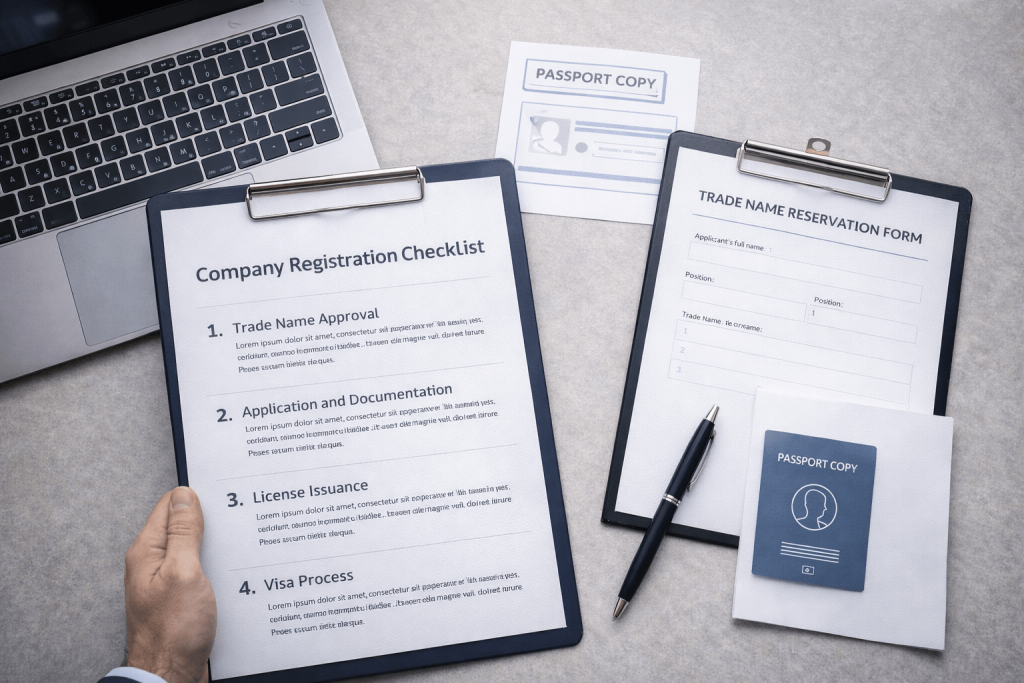
Dubai company registration is simple when you follow the correct order. It becomes painful when founders jump ahead, choose the wrong activity, or submit incomplete documents.
Step 1: Define your business activity (properly)
Your activity isn’t a marketing tagline — it’s the formal description that determines:
- Whether additional approvals are needed
- Which licences you can apply for
- What you’re allowed to invoice for
Tip: If you’re doing multiple services (e.g., consulting + marketing + software), your activity selection must reflect that scope — without becoming a messy “catch-all”.
Step 2: Choose your jurisdiction (mainland or free zone)
Pick based on how you’ll operate, not based on what you heard on social media.
A simple rule:
If your growth depends on UAE local contracts, lean mainland.
If your model is international and digital-first, a free zone can be highly efficient.
Step 3: Decide your legal structure and shareholding
You’ll choose a structure that fits:
- Number of shareholders
- Liability preferences
- Governance and ownership plans
- Whether you plan to add partners or investors later
Step 4: Reserve a trade name
Trade name rules matter more than people expect. A name can be rejected due to wording, restricted terms, or similarity.
Tip: Prepare 2–3 alternatives so the process doesn’t stall.
Step 5: Prepare and submit initial approval
This is the “green light” stage that allows you to move forward with the remaining steps.
You’ll typically submit:
- Passport copies
- Basic business details (activity, ownership, contact details)
- Any required supporting information for certain activities
Step 6: Secure your premises solution (even if you’re starting lean)
Depending on your setup route, you may use:
- A flexi-desk or shared workspace
- A serviced office
- A dedicated office lease
- A warehouse/industrial space (for trading/logistics models)
Reality check: Your premises solution can influence visa allocation and operational permissions.
Step 7: Finalise your incorporation documents
This typically includes:
- Incorporation forms
- Shareholder/manager documentation
- Any required agreements (depending on structure)
If documents need translation, attestation, or legalisation, plan this early to avoid delays.
Step 8: Licence issuance
Once your documents and premises requirements are met, the authority issues your trade licence.
At this point, your company exists — but you’re not finished.
Step 9: Visas, immigration file, and Emirates ID pathway (if required)
If you need residency visas for founders or staff, you’ll typically open the immigration file and follow the visa process appropriate for your setup and role.
Tip: Build your visa plan around how fast you need to be operational, especially if travel or biometrics steps are involved.
Step 10: Corporate bank account preparation and onboarding
Banking is smoother when your company profile is clear and consistent.
Prepare:
- A clean business description (what you do, who you serve, where funds come from)
- Contracts or proof of business activity (where possible)
- A realistic transaction profile
If you want to reduce friction, First Elite Global can help you structure your company profile and documentation so your banking process aligns with how the business truly operates.
What it really costs to set up new companies in Dubai (and why pricing varies)
Most founders look for a single number. In reality, cost depends on the combination of:
- Licence type and activity scope
- Jurisdiction (mainland vs specific free zone)
- Office/desk requirements
- Number of visas needed (now and later)
- Whether additional approvals apply
- Document translation, attestation, and legalisation needs
- Banking support requirements
- Ongoing compliance setup (accounting, tax registrations, contracts)
If you want an accurate figure, the fastest path is a personalised quote based on your business model and visa plan — not a generic online estimate.
Common mistakes that delay new company setup in Dubai

Avoid these and you’ll save weeks.
Mistake 1: Choosing a licence based on the cheapest package
A cheap licence that doesn’t match your real activity can create bigger costs later — including forced amendments, rejected invoices, or compliance issues.
Mistake 2: Mixing regulated and non-regulated services without a plan
If even one part of your offer needs special approvals, the whole timeline can change. Define scope early.
Mistake 3: Vague company profiles for banking
Banks don’t like ambiguity. A clear profile and clean documentation makes onboarding far smoother.
Mistake 4: Under-planning the visa pathway
Founders often license the company and then realise their visa plan doesn’t align with their premises solution or hiring goals.
Mistake 5: Waiting until the last minute for document handling
If your documents need translation, attestation, or legalisation, build that into your schedule from day one.
Real-world examples: how new businesses launch successfully
Here are three realistic “launch patterns” we see often — and how they typically succeed.
Example 1: UK consultancy expanding into the GCC
Goal: A compliant Dubai base to win regional clients.
What works:
- A clean service activity scope
- A structure that supports founder visa needs
- A bank-ready company profile aligned with invoices and contracts
Outcome: Faster client onboarding because the business looks established and structured.
Example 2: E-commerce brand testing demand before scaling
Goal: Launch lean, prove product-market fit, then expand.
What works:
- A licence that fits online selling and supply chain realities
- A premises solution that doesn’t overcommit early
- A plan for scaling visas and warehousing later
Outcome: The brand scales without needing a painful “rebuild” of the setup.
Example 3: Media studio serving both UAE and international clients
Goal: Invoice globally, build a local portfolio, hire creatives.
What works:
- Activity selection that covers services delivered
- Clear contracts and invoice descriptions
- A scalable hiring and visa plan
Outcome: Faster growth because operations match the licensed scope.
If you want a plan built around your exact scenario, First Elite Global can propose the structure, licensing route, and timeline — then execute it for you.
Registration checklist: what to prepare before you start
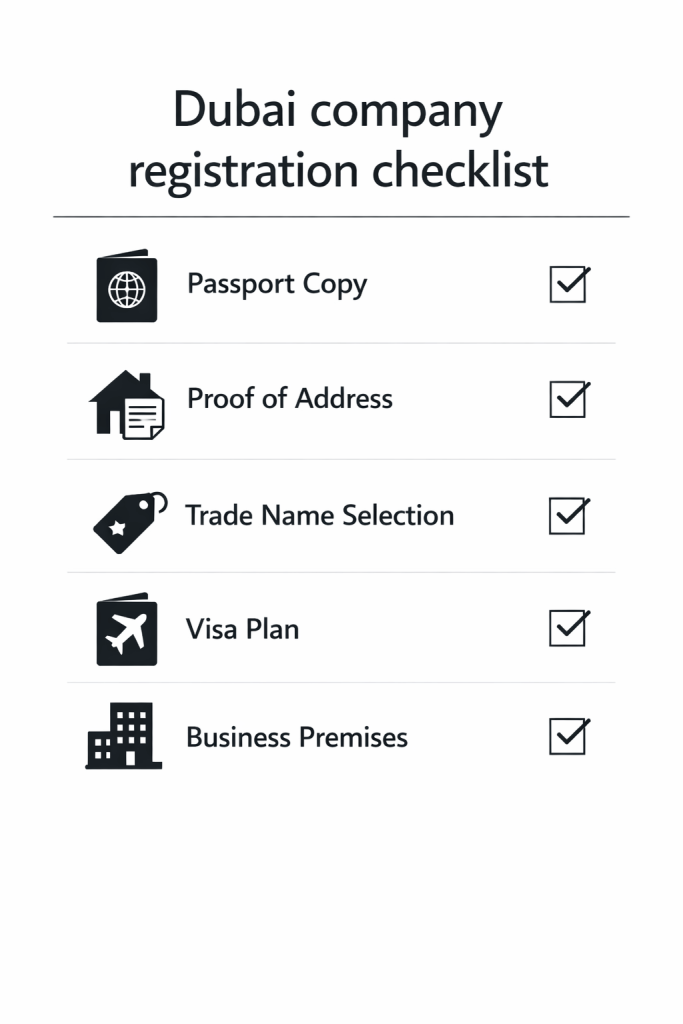
Having these ready makes the process dramatically smoother:
- Passport copy for each shareholder
- Proof of address (as required)
- Basic business description (services/products, customer regions)
- Preferred trade names (2–3 options)
- Shareholding plan (who owns what)
- Visa plan (who needs residency now vs later)
- Premises preference (desk, serviced office, office, warehouse)
- Any existing company documents (if setting up a branch or expansion)
FAQs
1) Can foreigners open a new company in Dubai?
Yes. Many business activities allow full foreign ownership. The key is choosing the right jurisdiction and activity so your structure matches current rules and your operating model.
2) How long does new company setup in Dubai take?
Timelines vary based on activity, approvals, document readiness, and whether visas and banking are required. If your documents are ready and the activity is straightforward, licensing can move quickly — but regulated activities or missing paperwork can extend the process.
3) What’s the difference between mainland and free zone company setup in Dubai?
Mainland companies are often chosen for maximum access to the UAE market and flexibility. Free zones are popular for international operations, packaged setup options, and specialised ecosystems. The best choice depends on where your customers are and how you’ll operate.
4) Do I need an office to register a company in Dubai?
You typically need a premises arrangement, but that doesn’t always mean a traditional office lease. Many setups start with a desk or serviced office solution and scale up as the business grows.
5) Which businesses are the best opportunities for a new business in Dubai right now?
The strongest business opportunities in Dubai are often those that can launch lean and scale: professional services, e-commerce, marketing and media, software and automation, trade and distribution, and specialised lifestyle concepts — as long as the licence matches the real business model.
6) What documents do I need for company setup in Dubai?
Requirements depend on your structure and activity, but commonly include passport copies, basic business details, and supporting documents for certain activities. If documents need translation, attestation, or legalisation, it’s best to plan that early.
Helpful Links
- Invest in Dubai — Business setup (mainland companies)
- Dubai DET — Licenses & permits
- Dubai DET — Business licensing overview
- UAE official portal — Verify business licenses / enquiries
- Invest in Dubai — Search licence information
- UAE official portal — National Economic Register
- UAE Ministry of Economy — Establishing companies (overview steps)
- Federal Tax Authority — VAT information
- Dubai digital govertnment — Starting a business