
Register a business in UAE the right way and you get speed, credibility, banking readiness, and a licence that matches how you’ll actually trade. Do it the “quick” way and many founders end up with the wrong activity, avoidable rejections, visa bottlenecks, or a bank account that drags on for weeks.
This guide gives you the full registration steps, the documents required, and the licence process explained in plain English—plus the decision logic that most “setup cost” articles skip.
What “register a business in UAE” really means
In practice, business registration in the UAE is a sequence of approvals and filings that results in:
- A legal entity (or establishment/branch) with a defined ownership structure
- A trade licence that lists your approved activities
- Immigration and labour files (if you’ll sponsor visas)
- Tax registrations (where required)
- A compliant operating footprint (office/desk/lease where required)
- A bank-ready company profile (so you can actually trade)
You can register in three common “routes”:
- Mainland (licensed by the emirate’s economy/DED authority)
- Free zone (licensed by a specific free zone authority)
- Offshore (usually for holding/structuring; limited UAE operating scope)
The 60-second decision: Mainland vs Free Zone vs Offshore
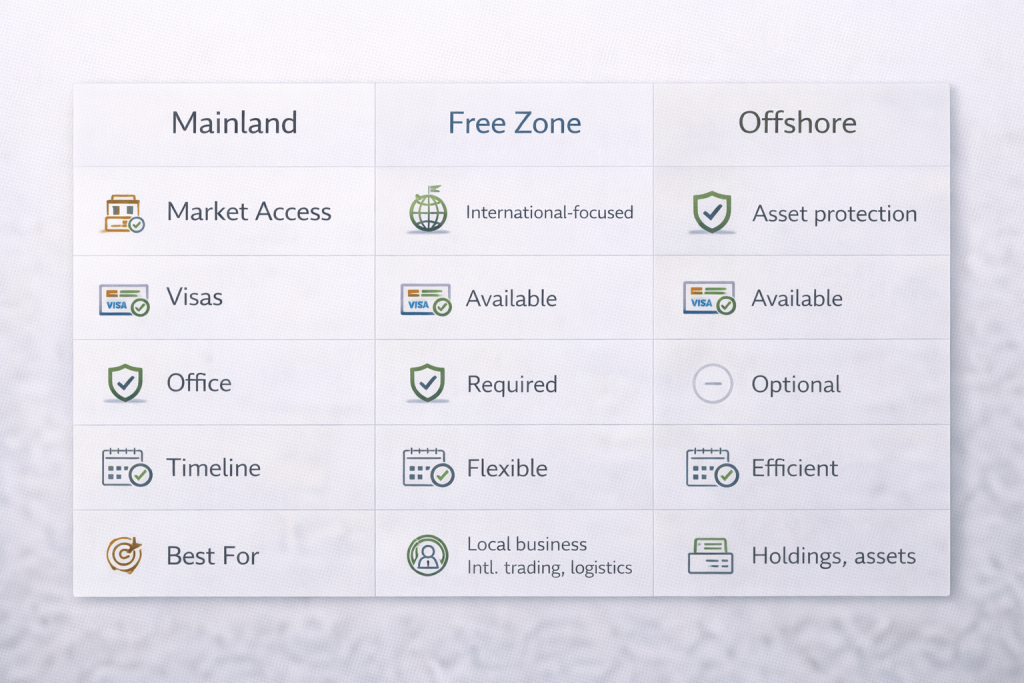
If you only remember one thing, make it this: choose your route based on where you’ll sell, your visa plan, and what banks will expect from your model.
Quick comparison
Mainland (onshore)
- Best when you want to trade across the UAE, work with a wide range of local clients, open physical premises, or bid for larger contracts.
- Often requires office/lease depending on activity and emirate rules.
- Strong fit for teams hiring locally.
Free Zone
- Best when you want fast formation, 100% ownership structures, sector clusters, and packaged facilities.
- Great for services, consulting, e-commerce, international trade, and many modern business models.
- Market access depends on how you’ll sell locally vs internationally and the structure you choose.
Offshore
- Best for holding assets, shares, IP, or international contracting/structuring.
- Typically not the best route if your goal is visas, a UAE operating office, or local trading.
If you’re unsure, that’s normal—your activity and sales model determine the “correct” licence more than your budget does.
Step-by-step: How to register a business in UAE
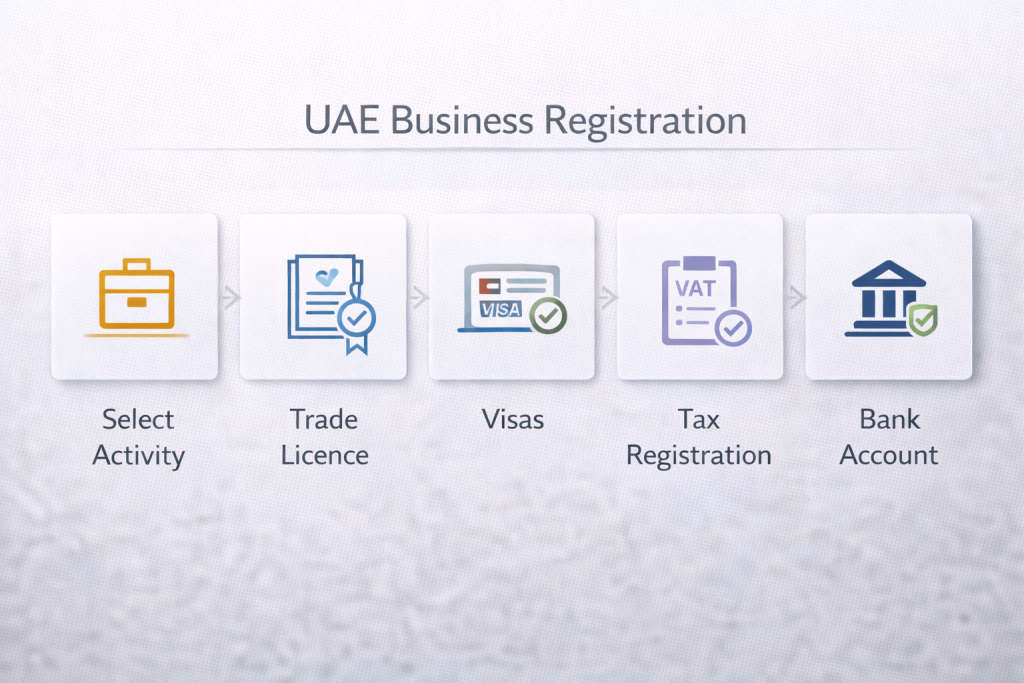
Below is the end-to-end registration steps flow used by most founders and SMEs (exact sequence can vary slightly by emirate and authority).
1) Define your business activity (this drives everything)
Your activity determines:
- the licence type
- whether you need external approvals (regulated sectors)
- what your bank will ask for
- how your invoices and contracts should be drafted
Common licence categories you’ll see in the UAE
- Commercial (trading, general trading, retail, import/export)
- Professional (consulting, services, marketing, IT services)
- Industrial (manufacturing, production)
- Tourism and sector-specific categories (varies by emirate)
Regulated activities (examples) may require additional approvals:
- Healthcare, education, finance, insurance, legal services
- Food & beverage operations
- Security-related activities and select professional services
Practical tip: Don’t pick an activity because it’s “popular” or “cheap.” Pick the one that matches your real invoices and client contracts.
2) Choose the legal structure (ownership + liability)
Your structure controls liability, governance, and what documents you’ll need.
Common options include:
- LLC / limited liability company (widely used for operating businesses)
- Sole establishment / sole proprietor (often for individuals, certain professional models)
- Branch (if you’re extending an existing company)
- Free zone entities such as FZE/FZCO/FZ-LLC (names vary by authority)
Rule of thumb: If you want a scalable operating company with partners, staff, and real contracts, you’ll typically land in an LLC-style structure.
3) Decide where you’ll register (emirate + authority)
Your “where” is two decisions:
- Which emirate (Dubai, Abu Dhabi, Sharjah, etc.)
- Which authority (mainland economy authority vs a specific free zone)
Your choice should reflect:
- where clients are based
- whether you need a physical location
- visa expectations
- cost and timeline realities
- whether your industry benefits from a specific free zone cluster
4) Reserve a compliant trade name
Trade names are not branding only—they’re a compliance checkpoint.
Expect rules such as:
- name must align with activity
- no restricted terms or misleading claims
- must follow the legal form naming conventions where required
- name availability checks and reservation certificate issuance
Tip: Prepare 3–5 name options to avoid delays.
5) Apply for initial approval (your “green light” to proceed)
Initial approval is the authority confirming there’s no objection to you forming the business under the selected activity/structure.
This is where mismatches get caught:
- activity doesn’t match your description
- missing NOC (if applicable)
- regulated approvals not addressed
- shareholder details incomplete
6) Prepare core formation documents (MOA and supporting file)
This is the “paperwork backbone” of your registration.
Typical items include:
- Memorandum of Association (MOA) / equivalent constitutional documents
- Shareholder and manager details
- Passport copies and relevant IDs
- Proof of address and contact details
- If a corporate shareholder is involved: company documents + ownership chain
Tip: Keep your shareholder structure simple unless you have a clear reason to complicate it. Complexity often shows up later in banking.
7) Secure premises if required (office, flexi-desk, lease)
Depending on your route and activity, you may need:
- a lease/tenancy contract
- a flexi-desk package
- evidence of operating address
This step is often tied to:
- visa quota
- licence issuance requirements
- inspection requirements (certain activities)
8) Licence issuance (your business is officially registered)
Once approved, the authority issues your trade licence and the company becomes legally operational (within the scope of that licence).
At this point, you can usually:
- sign contracts under the licensed entity
- begin banking onboarding
- start visa processing (if you will sponsor)
9) Immigration + labour setup (if you need visas)
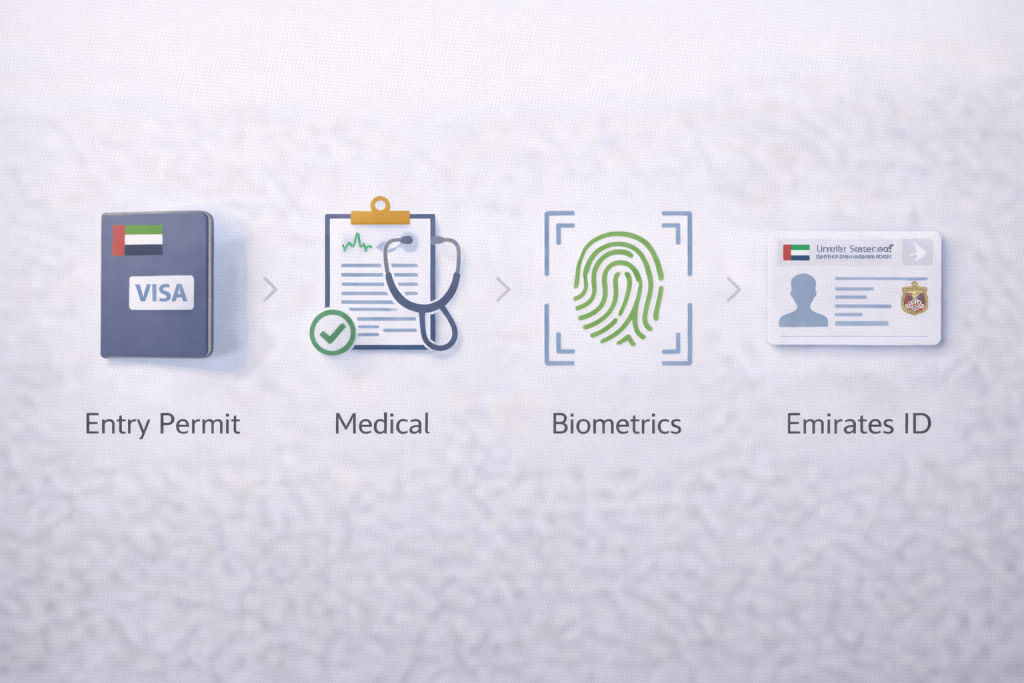
If you plan to sponsor yourself, partners, employees, or family, you’ll typically need:
- immigration file setup
- labour file / establishment registration (where applicable)
- establishment card / equivalent
Then comes:
- entry permit (if outside the UAE)
- medical and biometrics
- Emirates ID processing
- visa stamping/issuance steps (process differs by case)
10) Tax registrations (when required)
Two registrations matter most for new companies:
Corporate Tax
- Most businesses need to assess corporate tax obligations and registration requirements early, even if your payable tax could be low in the first year.
VAT
- VAT registration depends on taxable supplies and thresholds. Some businesses register later; some register earlier by necessity.
Tip: Don’t treat tax as an “afterthought.” Banks often ask about tax registration status or your plan.
11) Open your corporate bank account (often the real finish line)

A licence is not the end. Your company becomes truly operational when it can receive and send funds.
Banks typically evaluate:
- your activity and transaction profile
- shareholder background and residence status
- expected counterparties (countries, industries)
- contract/invoice readiness
- proof of address and substance indicators
- source of funds and supporting documents
Fast-track principle: A clean, consistent story across your licence, website/online presence, contracts, and expected cash flow reduces back-and-forth.
Documents required to register a business in UAE
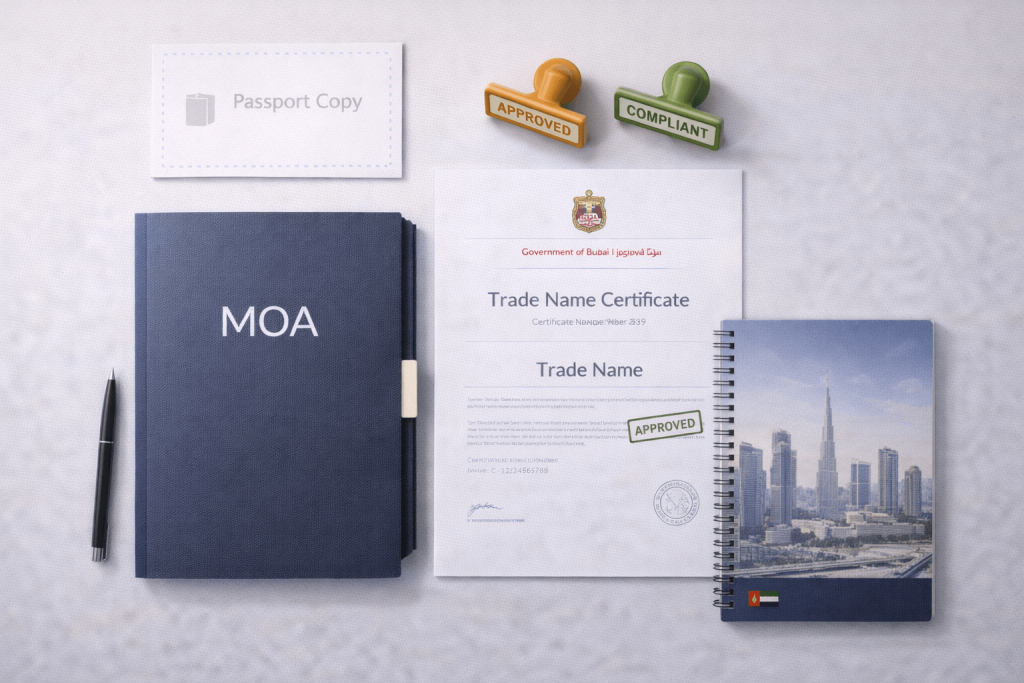
Exact requirements vary, but most registrations draw from the same document set.
Core documents (most common)
- Passport copies for shareholders/managers
- Visa copy / entry status (if applicable)
- Emirates ID (if applicable)
- Proof of address (often required for shareholders)
- Trade name reservation certificate
- Initial approval certificate
- MOA / formation documents
- Tenancy contract / address evidence (where required)
- NOC (if applicable; depends on personal status and authority rules)
If a corporate shareholder is involved
- Certificate of incorporation
- Memorandum/Articles (or equivalent)
- Board resolution approving the UAE entity
- Shareholding structure/UBO information
- Good standing certificate (sometimes requested)
- Notarisation/legalisation requirements (case dependent)
The UAE licence process: what slows founders down
Most delays happen for predictable reasons:
- Activity mismatch
Your real business model doesn’t match the selected activity codes. - Regulated approvals not identified early
Some activities require approvals before final issuance. - Name rejections
Not having alternate names ready costs time. - Premises/visa dependency
Visa plans tied to office size or address requirements. - Banking readiness ignored
You register a company that’s difficult to onboard with banks.
Costs and timelines: what to budget for (without guesswork)
UAE registration costs vary widely because they’re driven by choices, not one “fee.”
The cost drivers that matter most
- Mainland vs free zone vs offshore route
- Licence type and number of activities
- Number of visas required
- Office vs flexi-desk vs larger premises
- External approvals (regulated sectors)
- Legal drafting/notarisation requirements
- Banking complexity (especially international profiles)
Typical timeline reality
- Straightforward setups can complete in days to a few weeks (depending on authority and approvals).
- Add visas, regulated approvals, and banking, and you should plan for a longer end-to-end runway.
Tip: Speed comes from preparing a complete file, choosing the right activity the first time, and aligning your setup with your banking plan.
Key tax thresholds and compliance checkpoints founders should know
Even early-stage businesses should understand the main compliance lines:
- Corporate Tax: the UAE corporate tax framework applies broadly, with thresholds and reliefs that depend on your size and status.
- VAT: VAT registration depends on your taxable turnover and whether you meet mandatory thresholds, with voluntary registration possible in some cases.
- Employment compliance: once you sponsor staff, labour and immigration compliance becomes a continuous responsibility.
- Licence renewals: renewals and amendments are routine; missing deadlines can become expensive.
Three real-world examples (so you can choose correctly)
Example 1: Consultant serving UAE clients
Best fit often: a professional/service licence with a structure that supports invoices, contracts, and visa needs.
Common mistake: choosing an unrelated activity to “save cost,” then struggling with contracts and banking.
Example 2: E-commerce brand selling to GCC customers
Best fit often: a structure that supports online sales, payments, shipping arrangements, and a clean banking narrative.
Common mistake: ignoring payment gateway and bank requirements until after the licence is issued.
Example 3: Trading/import-export model
Best fit often: a commercial/trading licence with the right activity scope and documentation for suppliers.
Common mistake: picking a narrow activity that blocks what you actually intend to import/export later.
A practical checklist before you apply (reduces rejections)
Have these ready before starting the registration steps:
- Clear one-sentence description of what you sell and to whom
- List of 1–3 primary activities (with a realistic plan for expansion)
- Shareholder structure (simple unless necessary)
- 3–5 trade name options
- Basic expected transaction profile (countries, average invoice size, payment method)
- Visa plan (who needs visas now vs later)
- Address plan (flexi-desk vs office vs shop)
- Banking plan (which banks fit your profile and why)
If you want a done-for-you registration plan tailored to your model, book a free consultation with First Elite Global and we’ll map the fastest compliant route from licence to bank account.
Frequently Asked Questions
1) How long does it take to register a business in UAE?
It depends on your route (mainland or free zone), whether your activity is regulated, and how quickly documents are ready. Straightforward cases can complete in days to a few weeks, while visas and banking can extend the overall timeline.
2) What documents are required to register a business in UAE?
Most applications require passport copies, shareholder details, trade name reservation, initial approval, MOA/formation documents, and address evidence (where required). Additional documents may apply for corporate shareholders or regulated activities.
3) Do I need an office to register a company in the UAE?
Some routes and activities require a physical office or lease, while others allow flexi-desk or shared workspace packages. Your visa plan can also influence the premises requirement.
4) Can a foreigner register a business in UAE with 100% ownership?
Many structures allow 100% foreign ownership, particularly in free zones and for many mainland activities. The correct answer depends on your activity and licensing route.
5) Do I need to register for VAT when I start?
VAT registration depends on your taxable turnover and whether you meet mandatory thresholds. Some businesses register later; some register earlier (including voluntary registration in certain cases).
6) What’s the biggest mistake when registering a company in the UAE?
Choosing the wrong activity or route for how you will actually trade—this often causes delays in approvals, issues with contracts, and difficulty opening a corporate bank account.