
If you’re ready to register business in Dubai, you’re already ahead of most founders: Dubai rewards speed, but only when you choose the right setup route, file the right documents, and plan banking and visas from day one. This guide walks you through the full business registration steps, the licence process, and the exact documents you’ll need, plus the decisions that impact cost, timeline, and whether you can legally trade where your customers are.
If you want this built as a done-for-you plan (jurisdiction + licence + visas + bank-ready file), book a free consultation with First Elite Global and we’ll map your fastest compliant route before you pay any government fees.
The 60-second checklist (read this before you apply)
Before you submit anything, lock these in:
- Your revenue model: UAE local customers, exports only, or holding structure?
- Your activity list: what you will do (and what you won’t do) on the licence
- Your market access need: do you need to invoice clients across the UAE directly?
- Your visa plan: how many visas now vs later (avoid overpaying)
- Your banking profile: who your customers are, where money comes from, and proof you can show it
- Your office requirement: flexi-desk, serviced office, or physical lease
- Your compliance basics: accounting setup + corporate tax registration readiness
Miss any of these and your “quick setup” becomes a slow one.
Choose the right route to register your company in Dubai
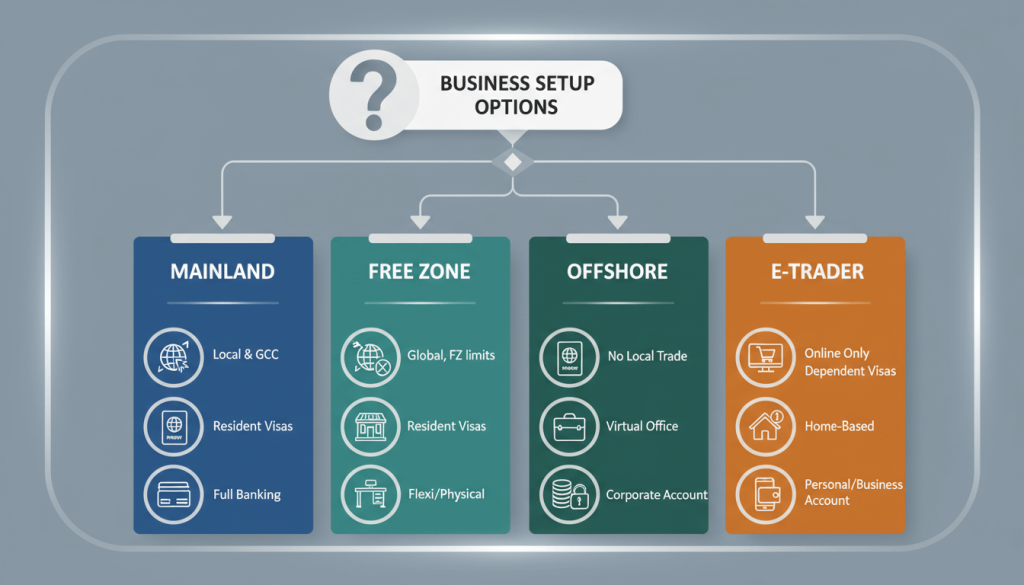
Most “company registration in Dubai” advice fails because it treats mainland, free zone, and offshore like interchangeable options. They are not. Choose your route using these three lenses:
- Where you need to trade (UAE local market vs outside UAE)
- How you need to bank (KYC, payments, counterparties)
- How you need to hire (visas, office quota, growth plans)
Mainland vs Free Zone vs Offshore (simple comparison)
| Option | Best for | Where you can trade | Office | Visas | Common advantage | Common trade-off |
| Mainland (Dubai) | UAE local clients, retail, restaurants, service businesses | Across UAE market (direct) | Often required (varies by activity) | Flexible | Maximum market access | More activity approvals for regulated sectors |
| Free Zone (Dubai/UAE) | Startups, online, import/export, international services, niche sectors | Mostly within the free zone + exports (local trading rules apply) | Flexi-desk or office packages | Package-based | Fast setup packages, sector clustering | Local UAE market access may need extra structuring |
| Offshore | Holding companies, asset ownership, international contracting (non-UAE local trading) | Not for UAE local trading | Typically no local office | Usually no visas | Clean holding structure | Limited operational use inside UAE |
| E-trader / light-touch online route | Solo online sellers & home-based services | Specific permitted online activities | Often minimal | Limited | Lowest barrier to “go legal” | Not suitable for teams or complex operations |
Practical rule:
- If you need to invoice UAE clients directly at scale, mainland is often the cleanest route.
- If you’re testing a model, exporting, or operating internationally, free zone is often the fastest start.
- If you’re building a holding structure, offshore can be the right tool.
What it really takes to register business in Dubai (the full licence process)
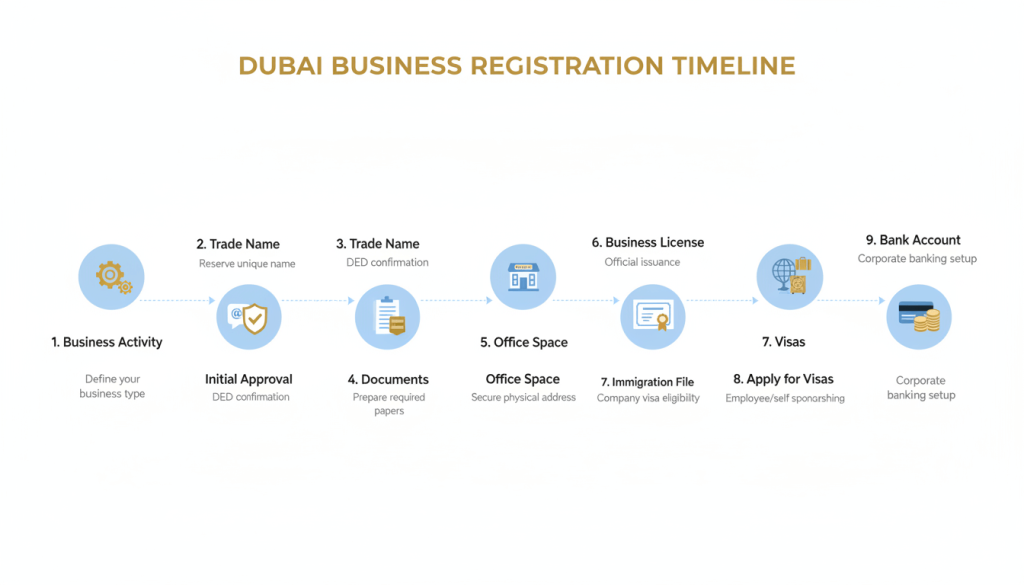
Below is the real-world registration steps + licence process most founders go through. The order matters because each step unlocks the next.
Step 1: Confirm your business activities (and pick the “right-fit” licence type)
Dubai licensing begins with what you will do. Your activity selection affects:
- Which authority issues your licence
- Whether you need external approvals (health, education, finance, transport, etc.)
- Whether you need a physical office, inspections, or specific qualifications
- Whether you can add multiple activities under one licence
Definition: Business activity
A legally coded description of your permitted operations. In Dubai, the activity you choose determines what you’re allowed to invoice for.
Smart move: list your revenue streams (how you’ll get paid), then map activities to match. Many delays come from picking an activity that doesn’t match invoices and contracts.
Step 2: Choose your legal structure
Common structures include (depending on route and activity):
- Single-owner structure
- Multi-partner company
- LLC-style structures (mainland or free zone variants)
- Branch or subsidiary (for an existing foreign company)
Your structure impacts:
- Shareholder paperwork
- Bank KYC complexity
- Future fund-raising, partner entry, and exit options
Step 3: Reserve a trade name that won’t get rejected
Trade names are easy—until they aren’t. Rejections often come from:
- Restricted words (or words implying regulated activities)
- Names too close to existing brands
- Inconsistent naming vs your activity
- Missing legal suffix where required
Fast way to avoid delays: shortlist 3–5 options and keep them aligned to your activity.
Step 4: Initial approval (your green light to proceed)
Initial approval is where authorities confirm:
- Your activity + structure is acceptable
- Your shareholder profile can proceed
- Any special approvals required are identified early
This step is crucial because it prevents paying for leases or drafting documents that won’t be accepted.
Step 5: Draft and sign your company documents
Depending on your setup, you may need:
- Memorandum / Articles (company constitution)
- Shareholder resolutions (especially for corporate shareholders)
- Appointment of manager(s)
- Power of attorney (if you’re setting up remotely)
Tip for overseas founders: plan notarisation and attestation early if any documents must be legalised.
Step 6: Secure your office or business address (as required)
Your office requirement depends on:
- Mainland vs free zone route
- Activity type
- Visa plan (visa quota is often linked to office type/size)
Options typically include:
- Flexi-desk or shared workspace packages (common in free zones)
- Serviced offices
- Physical leased office
Don’t overpay: match office commitment to your first 6–12 months hiring plan.
Step 7: Submit the final application and pay government fees
Once your file is complete (activity, name, approvals, documents, office), you submit and pay required fees. If your activity is regulated, approvals can add time.
Step 8: Licence issuance (your company becomes real)
Your trade licence is the moment you can:
- Sign contracts under the company name
- Proceed with immigration file setup (for visas)
- Move toward a corporate bank account
Reality check: a licence alone is not the finish line. Banking + visas are usually the next bottleneck—unless you plan for them.
Step 9: Immigration file + establishment card (if you need visas)
If you need residence visas (owner, staff, family), you typically open the immigration file, then proceed with visa steps.
Step 10: Open a corporate bank account (do this with a “bank-ready” file)
Banking is where many founders lose weeks. The best way to win is to prepare a KYC-ready pack before you submit your licence.
(You’ll get the exact checklist below.)
Documents required to register a business in Dubai (complete checklist)

Your required documents vary by authority and activity, but these are the most common:
For individual shareholders (most common)
- Passport copy (clear, valid)
- Visa / entry status documents (as applicable)
- Emirates ID (if resident)
- Passport photo (white background)
- Contact details + UAE address (if available)
For corporate shareholders (if a company owns the company)
- Certificate of incorporation
- Memorandum / Articles of the parent company
- Board resolution approving the UAE/Dubai setup
- UBO details and ownership structure chart
- Authorised signatory documents
For the company application
- Activity selection and licence type
- Reserved trade name confirmation
- Signed constitutional documents (MOA/AOA or equivalent)
- Office lease / flexi-desk agreement (when required)
- External approvals (only for regulated activities)
Pro tip: if you’re setting up to win contracts quickly, keep your first licence clean and narrow. You can expand activities later once revenue and banking are stable.
How much does it cost to register business in Dubai?
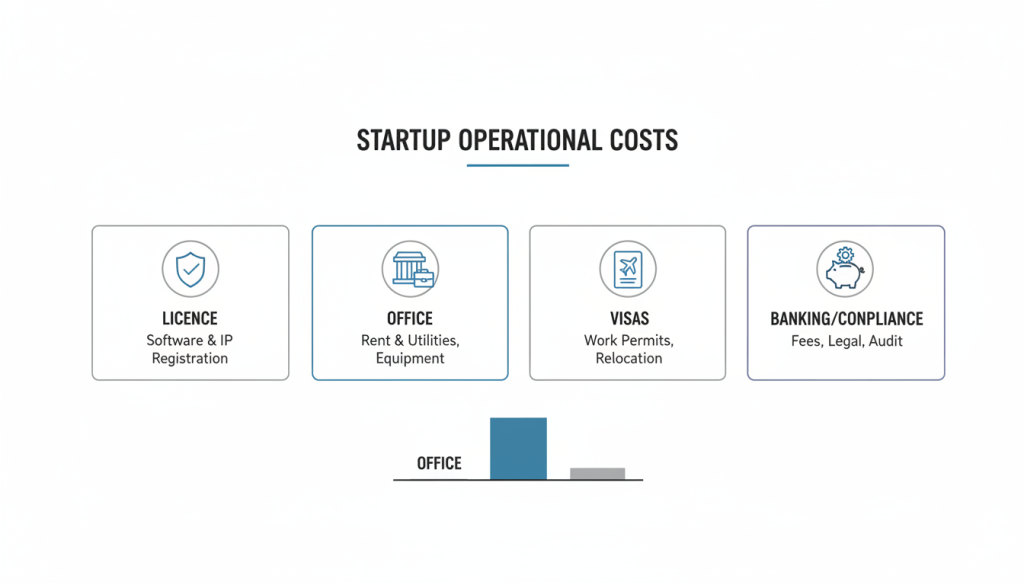
Costs vary because fees depend on:
- Mainland vs free zone vs offshore
- Activity category (and whether approvals apply)
- Number of visas
- Office requirement (flexi-desk vs leased office)
- Whether you need immigration, medical, Emirates ID, and family visas
- Banking support and compliance complexity
Realistic starting ranges (founder-friendly guidance)
- Light-touch online / solo routes: often the lowest entry point
- Free zone packages (simple activities): commonly mid-range, often bundled
- Mainland (straightforward activities): commonly mid-to-higher range depending on office + approvals
- Regulated activities: can rise quickly due to approvals, premises, and compliance
Best way to budget: split into four buckets:
- Licence + registration fees
- Office/address costs
- Visas (now and later)
- Banking + compliance readiness (accounting, contracts, policies)
Two example budgets founders can relate to
Example A: Solo consultant (testing demand)
- One activity
- Minimal visas initially
- Flexi-desk / low-commitment setup
- Bank-ready file prepared early
Goal: legal operation + banking without paying for unused visas.
Example B: Trading business (needs inventory + suppliers)
- Trading activity + approvals as needed
- Office/warehouse considerations
- Multiple visas (owner + staff)
- Strong banking file (supplier contracts, invoices, website, KYC pack)
Goal: avoid bank delays that block supplier payments.
If you want a precise cost map, First Elite Global can issue an itemised quote aligned to your activity, visa plan, and banking profile—so you don’t pay twice.
The “bank-ready” file: how to avoid the #1 delay after registration
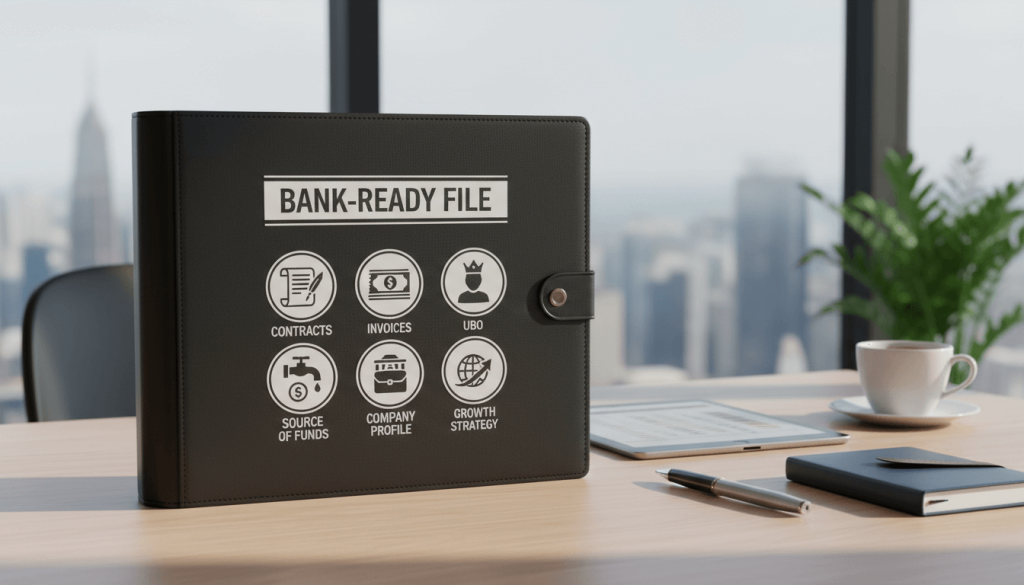
Many founders assume a trade licence automatically leads to banking. In reality, banks prioritise clarity, transparency, and provable commercial logic.
Prepare this pack early:
Your KYC-ready banking pack
- Clear business model summary (1 page)
- Website or company profile (even a simple landing page helps)
- Customer/supplier list (who pays you, who you pay)
- Signed contracts, proposals, or pipeline evidence
- Source of funds explanation (and supporting documents)
- Ownership structure + UBO details
- Expected monthly volumes and typical transaction countries
- Clean bookkeeping plan (software + accountant, even early stage)
Quote worth remembering:
“A bank account isn’t opened because you have a licence. It’s opened because your story makes sense—and you can prove it.”
Dubai has introduced improvements that can speed up verification, but your documentation quality still decides the outcome.
Visas and hiring: plan them before you pay
Your visa plan impacts:
- Office choice (and sometimes office size)
- Government fees
- Timelines (medical, Emirates ID biometrics, stamping steps)
A safer visa strategy for most founders
- Start with only the visas you truly need (owner + essential staff)
- Confirm how visa quota scales with your office plan
- Add visas as revenue stabilises (reduces unnecessary cost)
If you’re moving family members, factor in:
- Dependent visas
- Health insurance expectations
- Emirates ID timelines
Corporate tax and VAT: what to do in the first 30 days after licensing
Dubai business setup doesn’t end at licence issuance. To stay compliant, you need a basic finance system early.
Corporate tax (don’t ignore this)
Even if your tax due is low, compliance still matters. Build this foundation:
- Proper bookkeeping from day one
- Corporate tax registration readiness
- Clean separation of personal and business spending
VAT (only when applicable)
VAT registration depends on your taxable supplies and thresholds. Even if you’re not registering immediately:
- Track revenue monthly
- Keep VAT-ready invoices and records
- Build a filing habit early (it prevents panic later)
Simple principle: compliance is cheaper when it’s built early than when it’s fixed later.
Common mistakes when registering a business in Dubai (and how to avoid them)
Mistake 1: Choosing the cheapest option, not the right option
Cheapest can become expensive if it blocks:
- UAE market access
- Banking approvals
- Visa flexibility
Mistake 2: Picking an activity that doesn’t match invoices
If your invoices don’t match your permitted activity, you create risk for:
- Banking compliance
- Contracting
- Renewals and approvals
Mistake 3: Overbuying visas in year one
Buy what you need now, scale as you hire. Match visas to a 6–12 month plan.
Mistake 4: Treating banking as an “afterthought”
Banking is a compliance process. Prepare your KYC story before you apply.
Mistake 5: Starting without a record-keeping system
Even a small business needs:
- Invoices
- Receipts
- Basic bookkeeping
- Clear transaction descriptions
Which setup route fits you? (real-world scenarios)
Scenario 1: You sell services to UAE clients (B2B or B2C)
If you need direct UAE market access and plan to scale hiring, a mainland route is often the cleanest.
Scenario 2: You’re exporting, consulting internationally, or testing demand
A free zone route can be a fast, founder-friendly entry—especially with bundled office and visa options.
Scenario 3: You want a holding structure (assets, shares, investments)
Offshore can be the right tool when you don’t need UAE local trading.
Scenario 4: You’re a solo online seller or home-based operator
A light-touch online licensing route can help you go legal quickly—then upgrade once revenue and hiring grow.
If you want the fastest compliant route tailored to your activity, budget, and banking profile, First Elite Global will map it for you and handle the full process end-to-end.
Client snapshot (typical outcome when the process is managed properly)
“Everything from the licence to visas and bank account was handled with clear updates and no back-and-forth. We launched faster than expected.”
The pattern is consistent: when your licence route, documents, visa plan, and bank-ready file are aligned, approvals move smoothly.
FAQs
1) How long does it take to register business in Dubai?
It depends on your activity, approvals, and whether your documents are ready. Straightforward files can move quickly, while regulated activities and incomplete documentation add time.
2) What documents are required to register a company in Dubai?
Most founders need passport copies, photos, entry status/visa details (as applicable), trade name reservation, activity selection, company documents (MOA/AOA or equivalent), and an office/address arrangement where required.
3) Is it better to register in Dubai mainland or a free zone?
Choose mainland if you need direct UAE market access and flexible scaling. Choose a free zone if you’re exporting, testing a model, or want a packaged setup aligned to a specific sector. Your banking and visa plan should influence the decision.
4) Can I register business in Dubai if I’m not living in the UAE?
Yes, many founders start remotely, but some steps may require entry status or in-person completion depending on the setup and visa requirements. Plan notarisation and timing early if overseas.
5) Do I need an office to register a business in Dubai?
Some setups allow flexi-desk or shared office packages, while others require a physical lease. Office requirements vary by licence type, activity, and visa plan.
6) Do I need to register for corporate tax or VAT after setup?
Corporate tax compliance is part of running a business in the UAE and requires proper records and registration readiness. VAT registration depends on your taxable supplies and thresholds; track revenue and keep VAT-ready records from day one.