If you want to set up business in Dubai free zone, the fastest path is also the most structured one: choose the right activity and jurisdiction, secure the correct licence package, then build your visa + banking plan around what authorities and banks actually expect. Done well, you launch quickly, stay compliant, and avoid costly restructures later.
This guide is built for founders who want clarity—not vague “steps” that ignore real-world blockers like banking, visa quotas, office requirements, and tax compliance.
Want a personalised setup plan in one call? First Elite Global can map the best free zone route for your activity, visa needs, and budget—then handle the full process end-to-end so you can focus on building revenue.
Why Dubai free zones are popular (and when they’re not)
Dubai free zones are designed for international trade, services, startups, and regional expansion—often with streamlined incorporation and flexible packages.
Common reasons founders choose a free zone:
- 100% foreign ownership in most setups
- Profit and capital repatriation (structure-dependent)
- Fast licensing for many service/trading activities
- Package-based costs (licence + workspace + visa allocation often bundled)
- Industry clusters (media, logistics, finance, tech, commodities, etc.)
But a free zone may not be ideal if you:
- Need to sell directly to UAE mainland consumers immediately (structure matters)
- Require certain regulated activities needing external approvals
- Need a large physical retail footprint across the UAE from day one
Rule of thumb: choose free zone for speed + flexibility + international focus; choose mainland if your business model depends on onshore trading, tenders, or broad UAE market access.
The 7 decisions that control your cost, speed, and banking success
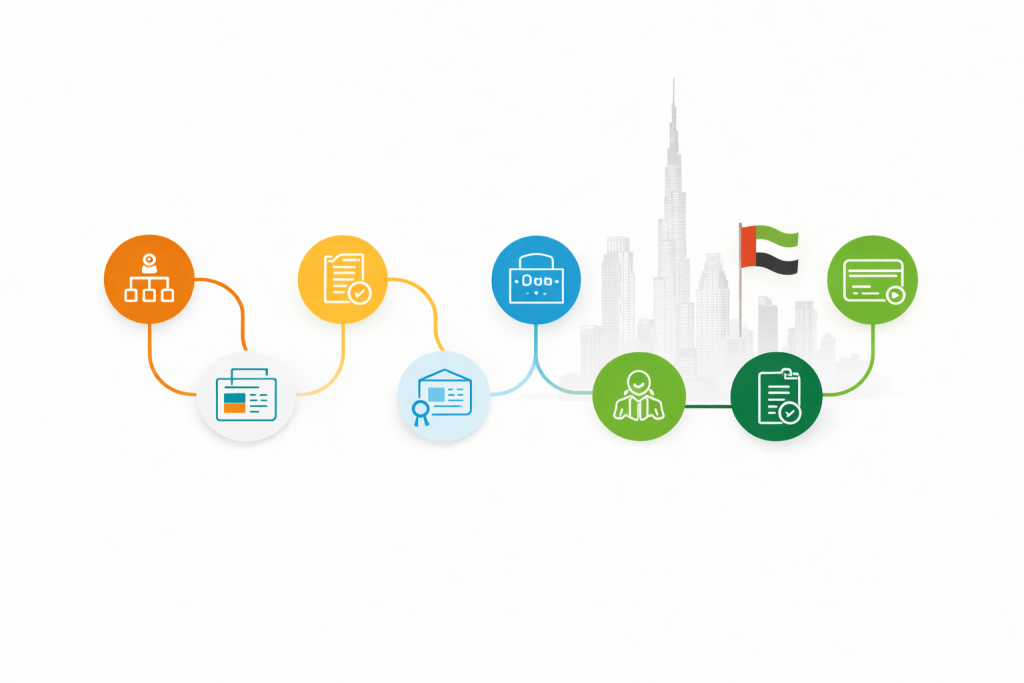
Most “free zone setup guides” skip the decisions that actually determine outcomes. Make these choices early:
1) Your business activity (the real one)
Authorities license you based on official activity lists. Banks also assess your risk based on your activity.
Avoid this mistake: picking a “close enough” activity to save time, then struggling with banking, invoicing, or compliance later.
Better approach: define your activity in one sentence:
- What you sell
- Who you sell to (UAE / international)
- How you deliver it (online / in-person / logistics)
2) Your target market (UAE mainland vs international)
This affects whether you’ll need:
- A distributor/agent model for mainland sales
- A branch or dual-licence approach (where available)
- A future mainland upgrade plan
3) Visa package and headcount plan
Visa allocation isn’t just “how many visas you want.” It’s tied to:
- Workspace type (flexi-desk vs office)
- Free zone rules
- Your growth forecast (0–3 visas now vs 10+ later)
4) Office requirement (and the hidden cost of “cheap” packages)
Low-cost packages can be smart—unless they restrict:
- Visa quota
- Bank perception (some banks prefer substance signals)
- Activity scope
5) Shareholding structure (solo founder vs partners vs group)
This impacts:
- Documentation requirements
- Bank onboarding complexity
- Governance and signature authority
6) Your banking plan (don’t leave this until last)
Banks want a coherent story:
- Clear activity + source of funds
- Contracts/invoices or pipeline evidence
- Professional online presence
- Realistic transaction profile
7) Your compliance baseline (tax, UBO, accounting, renewals)
A clean compliance setup reduces future surprises:
- Corporate tax and VAT considerations
- Beneficial ownership filing (where applicable)
- Accounting records and potential audit requirements (zone-dependent)
- Licence renewals and immigration renewals
Free zone vs mainland vs offshore (quick clarity)
Free zone
Best for: international services, e-commerce, regional trading, startups, holding IP, operational businesses that don’t require immediate mainland retail.
Mainland
Best for: full UAE market access, local contracts, broad operational freedom across the UAE.
Offshore
Best for: holding structures and asset ownership (usually not for visas or onshore operations).
If you’re unsure, the safest path is often: start free zone lean → build revenue + banking track record → expand or add mainland presence when the business model proves itself.
Step-by-step: how to set up a Dubai free zone company (end-to-end)

Step 1: Shortlist the right free zone (based on business model, not hype)
Choose based on:
- Activity fit (approved list matters)
- Visa allocation flexibility
- Workspace requirements
- Budget and renewal profile
- Reputation for your sector (and how banks typically view it)
Example shortlists (illustrative):
- Consulting / professional services: flexible, service-friendly zones
- Trading / import-export: zones aligned to logistics + warehousing needs
- Media / creative: zones built for media activities and permits
- Tech / startups: zones with startup packages and digital processes
Step 2: Pick your legal form
Most founders choose a free zone entity designed for:
- Single shareholder (individual)
- Multiple shareholders (partners)
- Corporate shareholder (company owns the UAE entity)
Step 3: Reserve a trade name
Have 3–5 options ready. Names often fail due to:
- Restricted terms
- Similarity to existing companies
- Misalignment with activity
Step 4: Submit incorporation documents
Typical document set (varies by zone and structure):
- Passport copy (and visa/entry status where relevant)
- Photo (digital)
- Application forms
- Shareholder details / corporate docs (if applicable)
- Business description / plan (sometimes required)
- Proof of address or CV (sometimes requested)
Step 5: Choose your licence package (licence + workspace + visas)
This is where costs and constraints are set.
Common package types:
- Zero-visa / no-visa (good for non-resident owners who don’t need UAE residency yet)
- 1–3 visa packages (common for solo founders and small teams)
- Multi-visa packages (growth-ready, higher workspace requirements)
Step 6: Pay fees and receive your licence
Once approved and paid, you typically receive:
- Licence certificate
- Incorporation documents
- Establishment/immigration file initiation (depending on package)
Step 7: Set up visas (if needed)
A standard visa journey can include:
- Establishment card / immigration file
- Entry permit (if applicable)
- Medical fitness test
- Emirates ID biometrics
- Residency stamping/process completion
Practical tip: plan visas around travel, timelines, and banking. Some banking steps can be easier once residency is active.
Step 8: Open your corporate bank account (bank-ready setup)

This is where many founders lose weeks—because they treat banking as “a form,” not an approval process.
Bank-ready checklist:
- Clean, consistent activity description
- Website or landing page (even a simple one)
- Company profile (1 page is enough)
- Contracts, invoices, or pipeline evidence
- Clear source-of-funds narrative
- Expected monthly transaction ranges (realistic, not inflated)
If you want to move faster, First Elite Global can align your licence structure with the bank profile before you incorporate—so you don’t end up re-licensing later.
Costs: what you’re really paying for (and how to budget smart)

Instead of chasing the “cheapest free zone,” budget around the cost drivers you can control.
| Cost driver | What changes the price | How to control it |
| Licence type | Trading vs services vs specialised | Choose only the activities you truly need |
| Free zone choice | Premium zones vs lean zones | Match zone to business stage, not ego |
| Visas | Quantity + processing | Start lean; scale visas as revenue grows |
| Workspace | Flexi desk vs office vs warehouse | Choose based on visa plan + operations |
| Banking | Compliance and KYC intensity | Prepare documents early; keep story consistent |
A realistic first-year budget usually includes:
- Licence + registration
- Workspace/facility fee
- Visa costs (if applicable)
- Medical + Emirates ID (if applicable)
- Insurance (where required)
- Bank onboarding preparation (documents, profiles)
- Renewal planning (don’t ignore year 2 pricing)
Fastest way to avoid overspending: choose the smallest package that meets your next 6–12 months of operational reality—then upgrade from a position of revenue.
Timelines: how long does free zone setup take?
Timelines vary by activity, approvals, and how complete your documentation is.
Typical timeline pattern:
- Zone selection + activity confirmation: 1–3 days
- Name reservation + application: 1–3 days
- Licence issuance (once approved + paid): a few days in straightforward cases
- Visas (if needed): often 2–4 weeks depending on steps and appointments
- Banking: depends heavily on readiness and risk profile
If speed matters, the biggest lever is document readiness + activity clarity + banking preparation—not rushing the licence step.
Common mistakes (and how to avoid them)

Mistake 1: Picking a free zone before defining the business model
Fix: define activity + market + visa needs first, then choose the zone.
Mistake 2: Overbuying visas “just in case”
Fix: start with what you need now; upgrade once revenue and hiring are real.
Mistake 3: Assuming “free zone = no tax”
Fix: build a compliance baseline from day one (corporate tax, VAT where relevant, bookkeeping).
Mistake 4: Weak banking narrative
Fix: align your licence activity, website, contracts, and transaction expectations.
Mistake 5: Ignoring year-two renewal costs
Fix: ask for renewal estimates early and plan cashflow accordingly.
Mini case-style examples (illustrative)
Example A: Solo consultant relocating to Dubai
- Priority: 1 visa, simple service activity, professional banking profile
- Smart move: lean package + strong documentation + clear service scope
Example B: E-commerce brand importing and selling across channels
- Priority: trading activity alignment, logistics plan, payments + banking readiness
- Smart move: zone aligned to trade/logistics + realistic VAT planning
Example C: Startup building SaaS with international clients
- Priority: service/tech activity fit, founder visa, bank readiness, potential hiring
- Smart move: start lean, structure for scaling headcount without redoing the licence
The “Free Zone Launch Checklist” (copy/paste)
Before you apply
- One-sentence business model definition
- Confirm exact activity list match
- Decide: UAE mainland sales now or later
- Visa plan for 6–12 months
- Workspace requirement check
Documents
- Passport + photo
- Proof of address (if requested)
- Corporate docs (if corporate shareholder)
- Company profile (1 page)
- Website/online presence ready
Bank readiness
- Source of funds summary
- Pipeline/contracts/invoices (even early-stage)
- Transaction profile estimate aligned to reality
Launch with confidence (and avoid costly rework)
Setting up in a Dubai free zone can be straightforward—when your licence, visas, and banking plan are aligned from day one.
If you want it done properly the first time, First Elite Global can:
- recommend the best free zone route for your activity and market
- secure your licence and incorporation documents
- manage visas end-to-end
- prepare you for banking with a bank-ready file and guidance
- keep your setup clean, compliant, and scalable
FAQ Section
1) How do I set up business in Dubai free zone as a foreigner?
You choose a free zone that supports your activity, apply for the right licence package, complete incorporation, then add visas and banking based on your operational plan. Most steps can be handled remotely in many cases, but visas and some banking steps may require in-person actions.
2) What are the steps to start a free zone company in Dubai?
The usual free zone steps are: choose zone → confirm activity → reserve trade name → submit documents → select licence package → pay fees → receive licence → process visas (if needed) → open corporate bank account.
3) How does the Dubai free zone licence process work?
A free zone authority issues the licence after reviewing your activity, name, shareholder structure, and package selection. Once approved and paid, you receive incorporation and licensing documents and can proceed to visas and banking.
4) Can a Dubai free zone company sell to UAE mainland customers?
It depends on the structure and activity. Many free zone companies trade internationally and within their zone. Mainland sales may require a distributor/agent model, specific permissions, or a mainland setup/branch depending on what you’re selling and how.
5) What is included in a Dubai free zone visa package?
Visa packages typically bundle a licence with a workspace/facility arrangement and a set visa allocation. The exact inclusions vary by zone and package tier, and visa processes include medical and Emirates ID steps.
6) How long does it take to set up a Dubai free zone company?
Straightforward licensing can be relatively fast when documents are complete and activities are simple. Visas and banking typically take longer and should be planned early to avoid delays.
Helpful Links
- Dubai Department of Economy & Tourism — licences and permits
- Invest in Dubai — business setup hub
- Invest in Dubai — Dubai Unified Licence guide
- UAE Government portal — Corporate tax overview
- Federal Tax Authority — Free Zone Persons (Corporate Tax guide PDF)
- Federal Tax Authority — Designated Zones VAT Guide (PDF)
- GDRFA Dubai — residency and visa services
- ICP Smart Services — residency/Emirates ID services