
Dubai makes it possible to launch fast—but only if you choose the right setup route, pick the correct activity, and build a “bank-ready” file from day one. This guide walks you through the full registration process, a practical setup checklist, realistic timelines, the costs that actually move the needle, and the compliance tasks that keep your licence safe.
If you want a clean, low-risk setup plan tailored to your activity, book a free consultation with First Elite Global and we’ll map the most efficient route before you pay for anything you don’t need.
First, choose the right setup route (mainland vs free zone vs offshore)
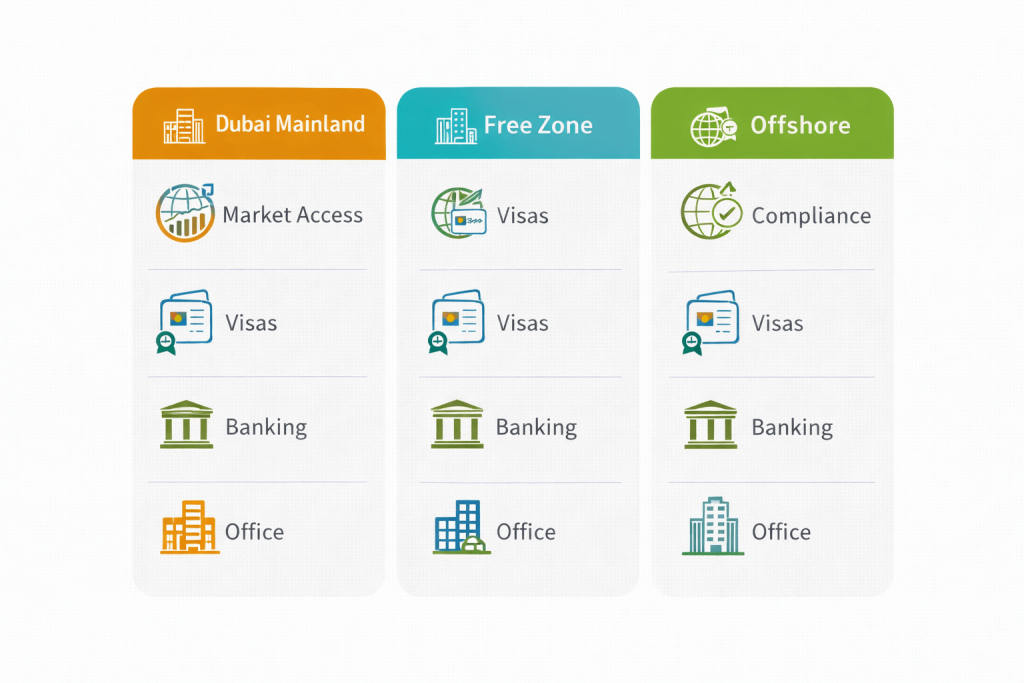
Most confusion comes from treating “Dubai company formation” as one product. It isn’t. Your best option depends on where your customers are, how you’ll get paid, whether you need visas, and what your activity is allowed to do.
Quick comparison
| Route | Best for | Where you can trade | Visas | What to watch |
| Dubai Mainland | Local UAE contracts, broader flexibility, client-site work (services, contracting) | UAE + international | Yes | Office/lease requirements may apply; activity rules matter |
| Dubai Free Zone | International trade, e-commerce, consulting, holding/IP, startup-friendly launches | Mostly international; UAE trading depends on structure/activity | Yes | Bank compliance and substance; rules vary by free zone |
| Dubai Offshore | Holding structures, asset ownership/structuring, international contracting (no local operations) | International only | Usually no | Not designed for onshore trading or operational hiring |
A simple decision rule that avoids expensive mistakes
- Choose mainland if you’ll sell to UAE clients, do on-site work, or need maximum commercial flexibility.
- Choose a free zone if you’re export-led, online-first, or want a structured, scalable launch with zone-specific benefits.
- Choose offshore if you need a holding/structuring entity and don’t need visas.
The Dubai business setup checklist (what you must decide before you apply)
Before you touch forms, lock these in. This is where most delays begin.
1) Your exact business activity (not just your industry)
Activities drive:
- licence type and approvals
- whether you can invoice locally
- visa quotas and office requirements
- banking risk profile
Tip: Many founders choose an activity that “sounds right,” then discover it blocks banking, requires extra approvals, or doesn’t match how they plan to invoice. Getting this right upfront saves weeks.
2) Legal structure
Common structures include:
- LLC (common for mainland)
- FZE / FZCO (common for free zones; single vs multiple shareholders)
- Branch (for existing companies expanding)
3) Ownership, shareholders, and who will be the manager
Have passports, contact details, and decision authority confirmed early—especially if shareholders are in different countries.
4) Your “bank story” (how money will move)
Banks don’t only review documents—they review logic:
- Who pays you? From where? For what?
- Where do you deliver the service/product?
- What are your expected monthly volumes?
- What contracts, invoices, or proof of business can you show?
If you prepare this in advance, bank account opening becomes dramatically easier.
Step-by-step: the Dubai company registration process (from idea to licence)
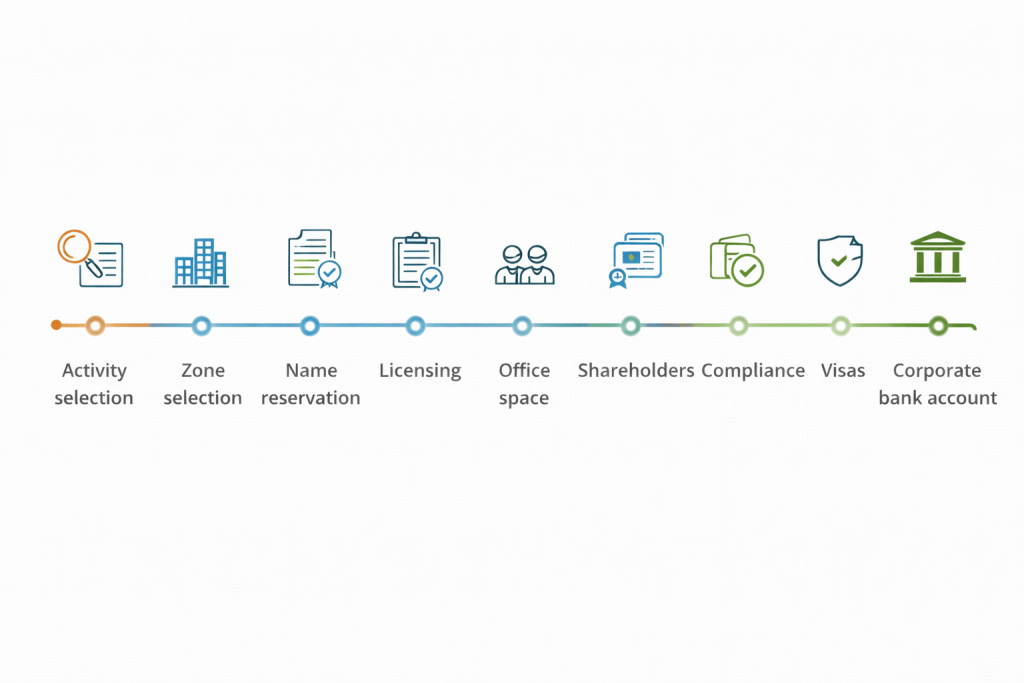
This is the core “registration process” most people search for. The steps are similar across mainland and free zones, but the order and documents can differ.
Step 1: Confirm activity + route (mainland/free zone/offshore)
This is your foundation. A wrong route can mean:
- you can’t legally trade where you planned
- you pay for visas you can’t use properly
- you struggle with banking because the setup doesn’t match your business model
Step 2: Reserve your trade name
Prepare 2–3 options. Avoid:
- restricted words and regulated terms
- names that imply regulated activity (finance, medical, education) unless you’re approved
- names too close to existing brands
Step 3: Initial approval / pre-approval
This is a preliminary green light that your activity and structure are acceptable.
Step 4: Prepare incorporation documents
Typically includes:
- passport copies (and visa/entry status where relevant)
- proof of address (recent)
- shareholder/manager details
- basic business description (what you do, where you operate, who you serve)
For certain structures, you may also need:
- board resolutions
- corporate documents for corporate shareholders
- a short business plan or compliance questionnaire
Step 5: Draft and sign constitutional documents
Depending on route:
- MOA/AOA (often relevant for LLCs)
- free zone formation docs and specimen signatures
- manager appointment documents
Step 6: Secure your business address / workspace
This can be:
- flexi-desk / co-working (common early stage)
- dedicated office
- warehouse or industrial facility (for trading/logistics/manufacturing)
Reality check: Workspace is not only “rent.” It often influences your visa quota and compliance substance.
Step 7: Pay fees + issue the licence
Once approvals and documents are accepted, your trade licence is issued.
Step 8: Establishment card + immigration file (if you need visas)
This opens the path for:
- investor/partner visas
- employee visas
- Emirates ID processing
- medical testing and residency stamping
Step 9: Open the corporate bank account (the step that can make or break momentum)
You’ll usually need:
- licence + company docs
- proof of address and KYC for shareholders
- contracts/invoices or evidence of planned business activity
- a clear compliance narrative
If your profile is complex (multiple shareholders, higher-risk industries, international flows), you need tighter preparation.
Step 10: Post-licence compliance setup (don’t skip this)
Set up:
- accounting and bookkeeping from day one
- invoicing templates aligned to your activity
- VAT readiness (if applicable)
- corporate tax registration planning
- UBO/ESR checks if relevant to your structure/activity
Costs: what it really costs to set up a business in Dubai
There isn’t a single “Dubai company setup price” because cost depends on choices you control. Think in cost drivers, not marketing packages.
The main cost drivers (what changes your total most)
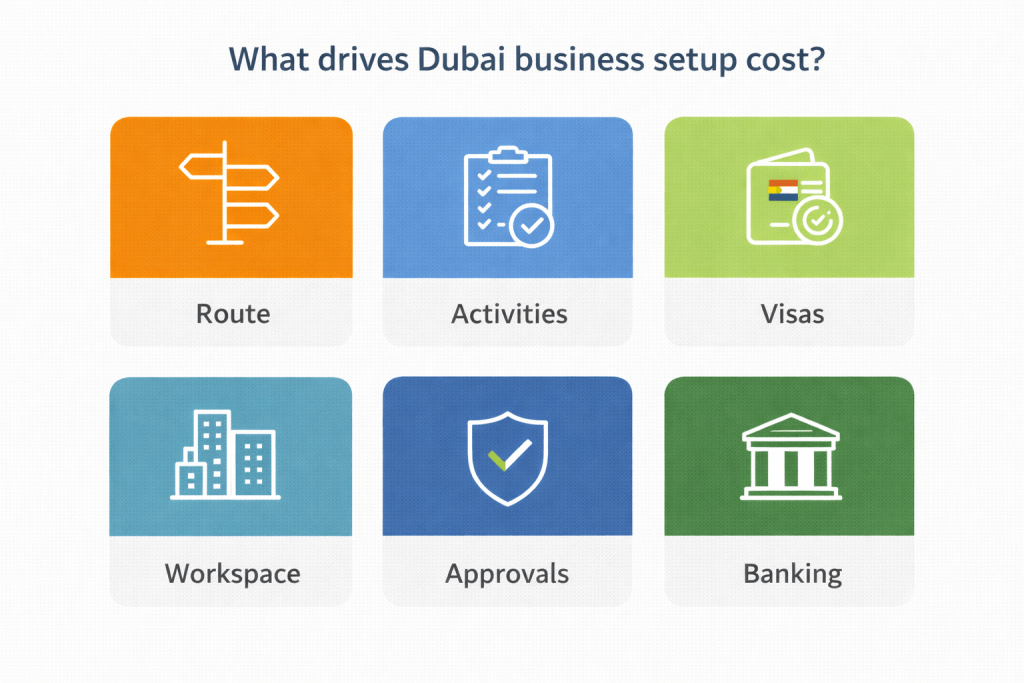
- Route: mainland vs free zone vs offshore
- Activity count: more activities can increase fees/approvals
- Visas: number of visas + whether you sponsor family
- Workspace: flexi-desk vs office vs warehouse
- Approvals: regulated activities add cost/time
- Banking complexity: higher scrutiny requires stronger documentation and sometimes more time
Realistic starting ranges (to help you budget)
For straightforward structures, many entrepreneurs start in the AED 10,000–25,000+ range for licensing-related costs—then add visas, workspace, and any approvals based on their setup needs.
If you want an accurate figure, the fastest way is a short discovery call where we confirm your activity, route, visa needs, and office requirement—then you receive a clean, itemised estimate.
Timelines: how long business setup in Dubai usually takes (and why delays happen)
A realistic timeline is less about “how fast Dubai is” and more about:
- how clean your documents are
- whether your activity is regulated
- how prepared your bank file is
Typical timeframes (practical expectations)
- Free zone setup: often 1–4 weeks once documents are ready and approved
- Mainland setup: can be fast, but varies by activity and office requirements
- Bank account opening: depends heavily on readiness and profile; recent initiatives have reduced timelines when you meet requirements and work with participating banks
The top 5 causes of delays
- activity mismatch (what you chose doesn’t match what you do)
- missing or inconsistent shareholder documents
- unclear source of funds / business model for banking
- workspace and visa quota misunderstandings
- regulated approvals discovered late
Banking: how to make your Dubai company “bank-ready” (and avoid rejections)
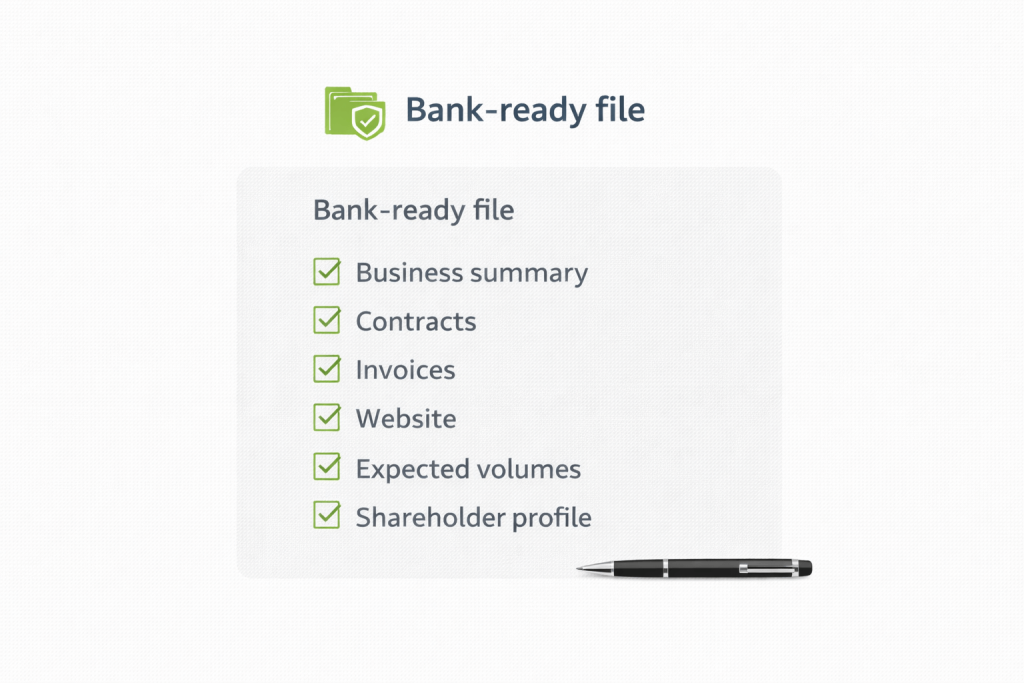
Opening the bank account isn’t a formality anymore—it’s a compliance gate. The strongest founders treat banking readiness as part of company formation, not an afterthought.
What banks want to see
- clarity: what you sell, to whom, and where
- evidence: contracts, proposals, invoices, a website, supplier/customer context
- consistency: activity matches invoices and marketing
- predictability: expected volumes and counterparties make sense
- clean documentation: no gaps, no mismatched details, no vague narratives
A practical “bank-ready file” checklist
- short business summary (one page)
- sample invoice and contract template
- website/portfolio or product catalogue
- proof of existing clients (where available)
- expected monthly turnover range and payment flows
- shareholder CV or background summary (especially for services/consulting)
If you want this done properly, First Elite Global prepares your bank-ready file alongside your licence—so your business can actually operate, not just “exist on paper.”
Visas, hiring, and family sponsorship (how to plan without overspending)
Visas are one of the most common hidden cost multipliers—mainly because founders apply for more than they need early on.
A low-risk visa strategy
- start with the minimum visas required to operate
- expand visas only after banking and revenue are active
- align your workspace choice with your real hiring plan
Common visa categories founders use
- investor/partner visa
- employee visa
- family visa (once your residency is active)
If your priority is long-term residency planning, build the structure around that goal from the start instead of retrofitting later.
Compliance that protects your licence (and keeps you out of trouble)
Dubai is efficient—but also rules-based. The cleanest setups are the ones built with compliance in mind from day one.
Corporate tax (what founders need to understand)
- corporate tax applies based on taxable income thresholds and rules
- free zone entities can have different treatment depending on whether they meet qualifying conditions
- record-keeping and (in some cases) audited financials can matter depending on your structure
VAT
VAT registration depends on thresholds and business activity. Even if you’re not registered yet, your invoicing and bookkeeping should be “VAT-ready.”
UBO and substance considerations
Depending on your activity and structure, you may need:
- UBO filings
- economic substance considerations
- proper record-keeping and renewals
Rule of thumb: If you want banking and future financing to be smooth, keep compliance clean and consistent from the beginning.
Approvals and regulated activities (don’t discover this after you pay)
Some activities require additional approvals from relevant authorities (examples include certain finance-related services, education, healthcare, and specialised regulated sectors). These approvals can affect:
- timeline
- documents required
- office/workspace requirements
- eligible structures
If your activity sits anywhere near “regulated,” confirm approval requirements before you lock your route and pay fees.
Three real-world setup paths (to help you choose confidently)
Example 1: Consultant selling internationally (lean launch)
- Best fit: free zone
- Why: simple operational footprint, scalable, efficient for international invoicing
- Key focus: bank-ready file + clear service contracts
Example 2: Technical services doing on-site work in Dubai
- Best fit: mainland
- Why: client-site operations and local market access
- Key focus: activity accuracy + workforce/visa planning + compliance
Example 3: Holding company for assets/investments
- Best fit: offshore or specific holding-friendly structures
- Why: structuring and ownership objectives without operational needs
- Key focus: banking suitability + legal clarity on what the entity can and can’t do
What clients typically want (and how to get it without stress)
Most founders don’t just want a licence—they want a working business with:
- a bank account that can receive payments
- visas processed without surprises
- compliance handled so renewals are easy
- a structure that won’t block scaling later
“First Elite Global made our Dubai free zone setup surprisingly straightforward. Everything from licence to visas and bank account was handled with professionalism and clear updates.”
If you want a smooth, properly structured launch, book a free consultation and we’ll give you a clear route, checklist, and timeline tailored to your activity.
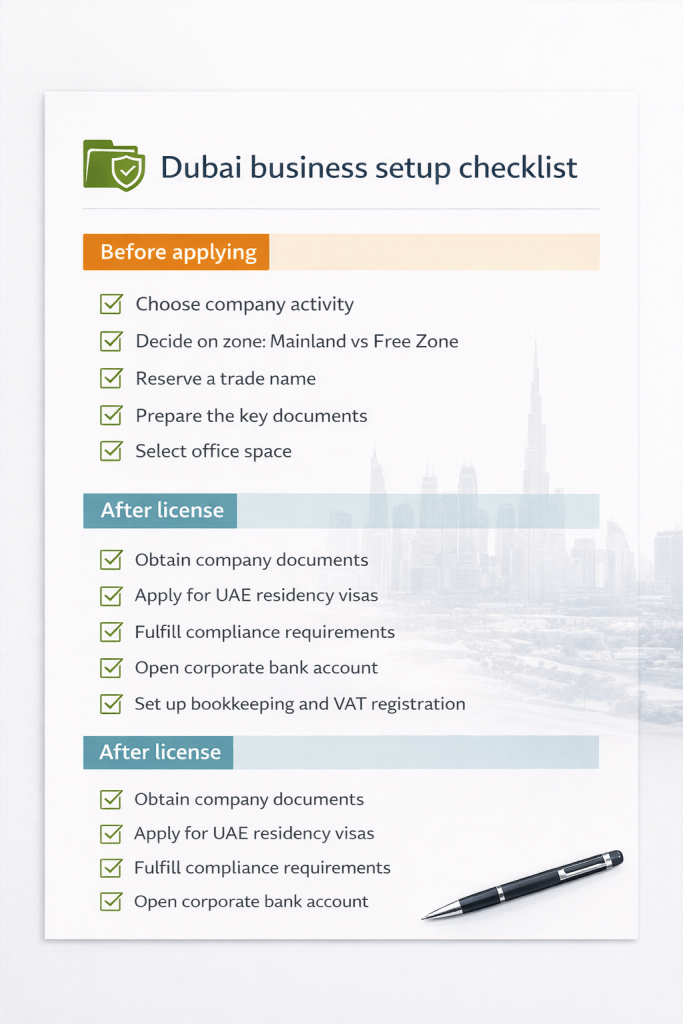
A practical “done-right” launch checklist (copy/paste)
Before applying
- Confirm activity list (exact wording matters)
- Choose route (mainland/free zone/offshore)
- Decide legal structure and shareholders
- Prepare passports + proof of address
- Draft a one-page business summary (for banking)
- Shortlist trade names
- Confirm visa needs (now vs later)
After licence
- Set up accounting + invoicing
- Build bank-ready file and apply to suitable banks
- Open immigration file (if visas needed)
- Process visas + Emirates ID
- Review VAT and corporate tax obligations
- Calendar renewals and compliance filings
FAQs
How much does it cost setting up a business in Dubai?
Costs depend on route (mainland/free zone/offshore), activities, visas, workspace, and approvals. Many straightforward setups start in the AED 10,000–25,000+ range for licensing-related costs, then add visas and workspace as needed.
What are the steps for setting up a business in Dubai?
Common licence steps include: choose activity and route, reserve trade name, get initial approval, prepare documents, secure workspace, pay fees, issue licence, open immigration file (if needed), open bank account, then complete post-licence compliance.
Is a Dubai mainland company better than a free zone company?
It depends on where you trade and how you operate. Mainland is often best for UAE-local contracts and client-site services. Free zones are often ideal for international trade, e-commerce, and structured startup launches.
How long does the Dubai business registration process take?
It varies by activity, documents, and approvals. Many setups can complete in weeks when documents are ready and the application is clean. Banking timelines depend heavily on your profile and preparedness.
Can I get a UAE residency visa when setting up a business in Dubai?
Many mainland and free zone structures support investor/partner visas and employee visas. Offshore structures are generally not used for residency visas in the same way.
What documents do I need for company formation in Dubai?
Typically: passport copies, proof of address, entry/visa status where relevant, shareholder/manager details, and incorporation documents. Corporate shareholders require additional company documents and ownership details.
Helpful Links
- Invest in Dubai — setting up a business (mainland)
- Invest in Dubai — free zone companies
- Dubai Unified Licence update
- One Freezone Passport announcement
- UAE corporate tax overview
- Ministry of Finance — Corporate Tax
- Federal Tax Authority — Free Zone Persons Corporate Tax Guide (PDF)
- Ministry of Economy & Tourism — establishing companies