
If you’re planning to setup new business in Dubai, the fastest path isn’t “find the cheapest licence”. It’s choosing the right jurisdiction (mainland vs free zone vs offshore), matching the correct activity and legal structure, then completing the licence steps in an order that keeps you bank-ready and compliant from day one.
This guide gives you a practical, founder-friendly blueprint: a step-by-step process, a copy/paste registration checklist, realistic costs and timelines, and the common mistakes that delay approvals.
The 60-Second Snapshot: What “Done” Looks Like
A proper startup setup in Dubai usually means you’ve completed these milestones:
- Trade name + initial approval
- Trade licence issued
- Immigration file / establishment card active (so visas can be processed)
- Visas and Emirates ID underway (owners, then team/family if needed)
- Corporate bank account in progress (or opened)
- Post-licence compliance set (UBO, tax registrations where applicable, bookkeeping, renewals calendar)
If any of those pieces are missing, founders often end up “licensed but stuck” (can’t invoice properly, can’t hire, can’t bank, or can’t scale).
Step 1: Choose the Right Route (Mainland vs Free Zone vs Offshore)

This is the decision that determines what you can sell, where you can trade, how you rent space, and what your banking and visa pathway looks like.
Quick comparison
| Route | Best for | Key advantage | Key limitation |
| Mainland (Dubai DET) | Selling to UAE clients, opening a shop/office, wider flexibility | Trade across the UAE without geographic restriction | More requirements can apply depending on activity and premises |
| Free Zone | Fast launch, focused activities, international trade, digital businesses | Streamlined setup, strong packages, 100% foreign ownership | Serving the UAE local market may require additional structuring (e.g., distributor/branch/other route) |
| Offshore | Holdings, asset ownership, international structuring | Clean holding structure when used correctly | Generally not used for operating locally or visa-led setups |
A simple decision rule (most founders get this wrong)
- Choose mainland if you need full UAE market access, local contracts, or a physical customer-facing operation.
- Choose a free zone if you want speed + simplicity, focused activities, and a cost-controlled launch.
- Choose offshore if your priority is holding (shares/property/assets) rather than operating with visas and local trading.
If you’re unsure, don’t guess. Selecting the wrong route is the #1 reason founders have to restructure later.
Step 2: Pick the Right Activity (This Drives Everything)
Dubai licensing is activity-driven. Your activity impacts:
- Which authority approves you
- Whether you need external approvals (regulated sectors)
- Your bank’s risk view of the business
- Visa quotas and office requirements (often indirectly)
- Ongoing compliance expectations
Founder tip: choose for “how you make money”, not how you describe yourself
If your revenue is from advising, you’re usually in professional/consultancy territory.
If you buy/sell goods, you’re in commercial/trading territory.
If you produce/manufacture, you’re in industrial territory.
Misaligned activities lead to:
- licence delays,
- rejected bank onboarding,
- or restrictions when you try to invoice and contract properly.
Step 3: Select a Legal Structure That Won’t Box You In
Your legal form affects liability, ownership, governance, and how you add partners later.
Typical options include:
- LLC-style structures (common for operating businesses)
- Branch (when expanding an existing company into Dubai)
- Free zone entity types (varies by free zone)
The best structure is the one that matches:
- who owns the company,
- how profits are distributed,
- how you’ll hire and expand,
- and what banks expect to see for your activity.
Step 4: Trade Name Reservation (Do This With Rules in Mind)
Trade names get rejected for avoidable reasons. Common issues include:
- names that are too similar to existing businesses,
- restricted terms,
- unclear abbreviations,
- or wording that triggers additional approvals.
Practical approach:
- Shortlist 3–5 name options
- Keep the name aligned with your activity
- Avoid anything that implies government or regulated services unless you are authorised
- Confirm availability and reserve it through the correct authority route
Step 5: Initial Approval (Your Green Light to Proceed)
Initial approval confirms the authority has no objection (in principle) to:
- your chosen activity,
- shareholders,
- and trade name.
It’s not the final licence—but it’s the checkpoint that tells you you’re moving in the right direction.
Step 6: Premises & Address (Only Get What You Actually Need)
This is where startup budgets often get burned.
Depending on your route and activity, you may need:
- a physical office,
- a flexi-desk,
- a warehouse,
- or (in some cases) an eligible virtual solution.
Founder rule: don’t sign a long lease just to “get the licence” unless it’s actually required for your activity and scale plan.
Step 7: Documents, MOA, and Any External Approvals
You’ll typically prepare and submit:
- shareholder/manager documentation,
- constitutional documents (e.g., MOA),
- and any required approvals for regulated activities.
Typical document set (varies by authority)
- Passport copy (each shareholder/manager)
- UAE visa / entry stamp (if applicable)
- Emirates ID (if already a resident)
- Proof of address
- Passport-style photo
- Business description (and sometimes a brief business plan)
- Corporate documents (if a shareholder is a company)
Some activities require extra items (qualifications, NOCs, approvals).
Step 8: Pay Fees and Receive the Trade Licence
Once your file is complete:
- fees are paid,
- final documents are issued,
- and your trade licence becomes your operational starting point.
At this stage you can typically:
- contract under the company name,
- invoice correctly,
- begin visa processing,
- and proceed with business banking.
Step 9: Immigration File / Establishment Card (So You Can Process Visas)
For visa processing, most setups require:
- an immigration file, and/or
- an establishment card pathway (depending on route and authority).
This step is often missed in “cheap setup deals”, and founders realise too late they can’t process visas smoothly.
Step 10: Visas, Medical, Emirates ID (Owners First)
A common best practice:
- Process owner/partner visa first (establish credibility and operations)
- Then add employees/family as needed
Expect the visa journey to include:
- entry permit (if required),
- medical test,
- biometrics,
- Emirates ID,
- visa stamping (process varies by route and status).
Step 11: Corporate Bank Account (Make It “Easy to Approve”)

Banking is where many new companies stall—especially if the file looks unclear.
What banks want to see (your “bank-ready pack”)
- Clear activity and business model (simple explanation)
- Signed contracts or pipeline evidence (where possible)
- Website or company profile (even a clean one-pager helps)
- Expected countries of operation and top counterparties
- Source of funds documentation (shareholders)
- Shareholder structure clarity (especially if corporate shareholders exist)
- Clean compliance posture (UBO, tax registrations where relevant, bookkeeping plan)
Pro tip: If your activity is trading-heavy, cross-border, crypto-adjacent, or high-volume payments—prepare deeper documentation early.
Step 12: Post-Licence Compliance (The Part That Prevents Future Headaches)

To keep your company safe and scalable, set these up immediately after licensing:
- UBO declaration (ultimate beneficial owner)
- Corporate tax awareness (registration requirements and filing calendar)
- VAT assessment (register when you meet the threshold)
- Economic substance considerations (only if you perform relevant activities)
- Bookkeeping and invoicing system
- Renewals calendar (licence, lease, establishment/immigration, visas)
Dubai rewards founders who stay organised. Most penalties come from “we didn’t know we had to do that”.
The Registration Checklist (Copy/Paste)
Use this as your startup setup checklist to stay on track:
Before you apply
- Confirm where your customers are (UAE / international / both)
- Choose route: mainland / free zone / offshore
- Pick activity based on revenue model
- Decide shareholders + ownership split
- Choose legal structure that supports scaling
- Prepare name options (3–5)
Licence steps
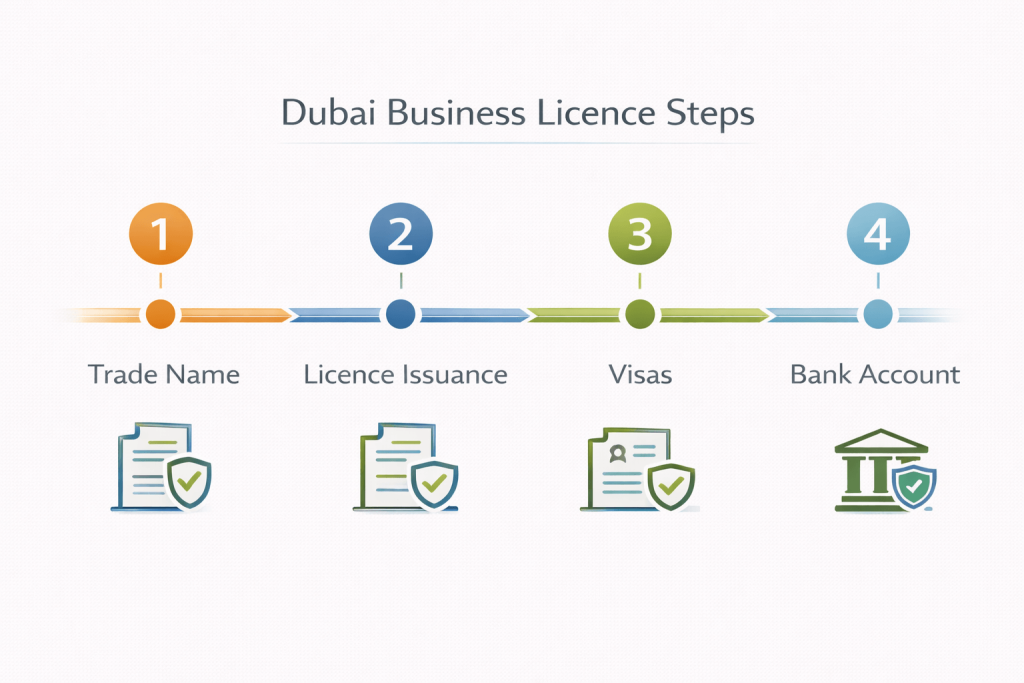
- Reserve trade name
- Obtain initial approval
- Confirm premises requirement (flexi/office/warehouse)
- Draft and sign MOA (if required)
- Secure external approvals (if regulated)
- Submit final file + pay fees
- Receive trade licence
Immediately after licensing
- Open immigration file / establishment card pathway
- Start owner visa + Emirates ID
- Prepare bank-ready pack and start corporate banking
- File UBO declaration
- Set up bookkeeping + invoicing
- Create renewals calendar (licence/visas/lease)
Costs: What You’re Actually Paying For (and What’s Optional)

There’s no one-size-fits-all total. Cost depends on:
- mainland vs free zone vs offshore,
- number of activities,
- number of visas,
- office/lease needs,
- approvals for regulated activities,
- and whether you need help with banking and compliance.
Realistic starting point (most straightforward setups)
Many founders budget in the range of AED 10,000–25,000+ for simpler structures, with some online-style options sometimes lower, and regulated or multi-activity setups higher.
Common cost buckets
- Licence and registration fees
- Name reservation and approvals
- Premises (office/flexi/warehouse)
- Visa costs (each visa is a separate cost)
- Medical, Emirates ID, stamping steps
- Banking support (if required)
- PRO and document processing support
- Ongoing renewals and compliance
Timelines: How Long Does It Take to Setup New Business in Dubai?
Timelines vary by route, activity, approvals, and how prepared your documents are.
A practical planning range:
- Trade licence: often achievable in days for straightforward cases once documents are ready
- Owner visa + Emirates ID: commonly 1–3 weeks depending on status and process route
- Corporate bank account: can take longer depending on activity risk and documentation quality
The fastest setups are not the ones that rush. They’re the ones that submit correctly the first time.
Common Mistakes That Delay Approvals (Avoid These)
- Picking the cheapest package without checking market access restrictions
- Choosing the wrong activity “because it sounds right”
- Underestimating visa and office requirements
- Using a trade name that triggers rejection or extra approvals
- Submitting inconsistent shareholder details across documents
- Ignoring UBO and post-licence compliance until it becomes urgent
- Trying to open banking without a clean business explanation and source-of-funds pack
- Mixing personal and company transactions early (banks hate this)
- Not planning renewals (licence + visas + premises timelines)
- Delaying bookkeeping and invoicing structure until tax/VAT deadlines appear
Mini Scenarios: Which Route Fits Which Founder?
Scenario A: Consultant, coach, or agency
- Usually thrives with a lean structure, controlled overhead, and clear invoicing
- Priorities: simple compliance, owner visa, clean banking narrative
Scenario B: E-commerce brand
- Needs clarity on fulfilment, payments, suppliers, and returns
- Priorities: activity alignment, banking readiness, and a scalable structure
Scenario C: Import/export or trading business
- Banks focus heavily on source of funds, counterparties, and transaction patterns
- Priorities: documentation pack, compliance clarity, and properly structured activities
Scenario D: Local customer-facing business (clinic, restaurant, shop)
- Often benefits from mainland flexibility
- Priorities: premises, approvals, staffing pathway, and proper licensing category
How First Elite Global Helps You Launch Smoothly
Founders usually come to us after one of two experiences:
- they’ve started alone and hit delays (banking, approvals, unclear activity), or
- they want a clean, done-for-you process from the start.
With First Elite Global, you get:
- Route selection based on your real business model (not generic packages)
- End-to-end licence handling (mainland, free zone, offshore)
- Visa and Emirates ID processing support
- Corporate banking guidance with a bank-ready documentation approach
- Ongoing PRO and compliance support as you grow
Trust signals founders care about:
- 22+ years of experience
- 50,000+ companies served
- Strong public review footprint
- Real-world, operational support beyond “just the licence”
If you want a clear plan and a predictable timeline, speak to a setup specialist and get a structured proposal built around your activity, visa needs, and budget.
FAQs
1) How much does it cost to setup new business in Dubai?
Costs depend on route (mainland/free zone/offshore), activity, number of visas, office requirements, and whether you need approvals. Many straightforward setups start around AED 10,000–25,000+, while regulated or multi-activity businesses can be higher.
2) What are the main licence steps for a startup setup in Dubai?
Most startups follow: choose activity and route → reserve trade name → initial approval → premises (if needed) → prepare MOA/documents → approvals (if required) → pay fees → receive trade licence → immigration/establishment file → visas → banking → post-licence compliance.
3) What should be on my Dubai business registration checklist?
At minimum: activity and route decision, trade name, initial approval, premises requirement, final documents (MOA where needed), licence issuance, establishment/immigration file, owner visa, banking pack, UBO, bookkeeping, and renewals calendar.
4) Is a free zone or mainland better for setting up a new business in Dubai?
Free zones often suit founders prioritising speed and packaged setup. Mainland typically suits founders needing full UAE market access, local contracts, or customer-facing operations. The “best” option depends on where you’ll sell and how you’ll operate.
5) How long does it take to set up a new business in Dubai?
A straightforward licence can often be issued in days once documents are ready. Visas and Emirates ID commonly take 1–3 weeks. Corporate bank account timelines vary more and depend heavily on activity risk and documentation quality.
6) Do I need corporate tax or VAT registration when I start?
Not every new company registers immediately, but every company should plan for it. Corporate tax and VAT obligations depend on your structure, activity, and turnover. Set up bookkeeping early so you can register and file correctly when required.
Helpful Links
- Invest in Dubai (official business setup platform)
- Invest in Dubai — free zone company setup overview
- Dubai DET — business licensing overview
- UAE Government Portal — corporate tax overview
- Federal Tax Authority — corporate tax portal
- Federal Tax Authority — corporate tax registration service
- UAE Ministry of Finance — VAT overview
- UAE Ministry of Finance — Economic Substance Regulations (ESR)
- ICP Smart Services (visas/residency)
- MOHRE services (work permits)